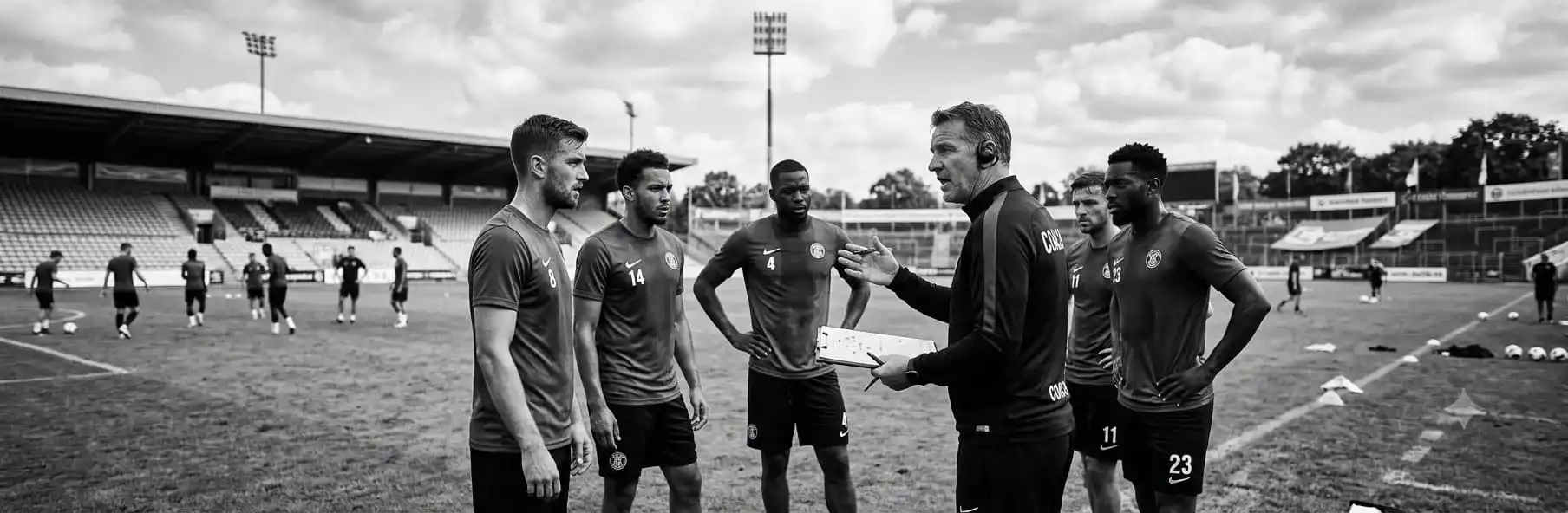
Squad Selection During the Season in Football: Rotation Without Breaking Team Spirit
How to manage squad selection and rotation through the competitive season without wrecking group cohesion. Practical communication and planning strategies.
Written by
João Araújo
Physical Education Teacher (FADEUP – University of Porto) · Futsal Coach – Level II · UEFA B License · Master’s in Physical Education
15 years teaching Physical Education in schools, 20 years coaching futsal at youth development level and 5 years coaching football. Federated and amateur football and futsal player.
It’s Monday afternoon, and posting the squad list is no longer the tensest moment of the week, that’s late Saturday morning, when the manager has to decide who starts out of 22 players of similar quality. In the opening weeks of the season, rotation feels easy. By matchday 15, with fatigue building, injuries piling up and the squad starting to question the selection criteria, squad management becomes the single biggest strain on dressing-room cohesion.
The difference between teams that stay united through a long league campaign and teams that fracture mid-season almost always comes down to how the manager communicates, not just decides, who plays.
Why Squad Selection Turns Into a Problem
The most common mistake is treating rotation as a purely tactical decision, communicated only through a team sheet pinned to the dressing-room wall. Without an explanation, players fill the information gap with their own narratives: “he doesn’t trust me,” “he’s protecting the other lad for personal reasons,” “he’d already decided the starter before I got my chance.” These narratives spread quickly through the group and erode collective trust in the fairness of the process, even when the technical decisions are correct.
Consequences of Ignoring Selection Communication
A squad that doesn’t understand the rotation criteria informally splits into “starters” and “chronic substitutes” long before that split is technically justified. Demotivated players train with less intensity, lower the group’s internal standards, and become a liability instead of an asset exactly when they’re finally needed, right when an injury or an accumulation of yellow cards forces the manager to turn to them.
The Solution: Core Principles
- Communicate criteria before communicating names: at the start of the season, publicly explain the factors that determine selection: physical form, training performance, tactical fit against the opponent
- Individual conversation before the public team sheet: players dropped from the starting eleven or left out of the squad deserve a brief, direct explanation before they see the name (or its absence) posted
- Planned rotation, not reactive rotation: decide weeks in advance which specific matches certain players will get more minutes in, so rotation doesn’t feel arbitrary match by match
Practical Application: Concrete Strategies
Monthly One-to-One Conversations
A short, regular conversation with each player about their current role in the squad prevents silent frustration from building up. It doesn’t need to be long, five minutes of direct clarity beats months of silence.
Visible Minutes Log
Sharing the distribution of minutes per player with the squad (not necessarily in real time, but periodically) reinforces a sense of transparency, even when the distribution is uneven for legitimate technical reasons.
Rotation Criteria Tied to the Fixture List
In two-match weeks, decide in advance that one specific group of players starts the first match and another group starts the second, communicated before the week begins, not decided the night before.
🔧 Useful Tool
Communicating squad selection in an organised, consistent way leaves less room for misreading. SportsLabTools Callups lets you manage and share the matchday squad clearly, keeping a minutes history that backs up individual conversations with objective data.
Special Cases: The Player Who Never Accepts Rotation
Not every player’s resistance to rotation gets solved through communication. Some stay demotivated regardless of how clear the process is. In these cases, the individual conversation needs a different register: instead of justifying the decision, focus on defining concrete, measurable targets that, if met, change the situation, and be honest about a realistic timeframe for that change.
See also: Squad Selection in Pre-Season: Giving Everyone Minutes Without Losing Structure, the rotation principles established before the season even starts.
Checklist: Squad Selection Through the Competitive Season
| Practice | Implemented? |
|---|---|
| Selection criteria communicated publicly at the start of the season | ☐ |
| One-to-one conversations with players left out of the starting eleven | ☐ |
| Minutes log per player shared periodically | ☐ |
| Rotation planned in advance for two-match weeks | ☐ |
| Concrete targets set for demotivated players | ☐ |
| Quarterly review of the rotation criteria with the coaching staff | ☐ |
Conclusion
Managing squad selection through a long season isn’t just about picking the best eleven for each match, it’s about keeping the other 11 to 15 players in the squad motivated, training hard, and ready when they’re called upon. That’s built through deliberate communication, not silence.
Organise and communicate your squad selection with transparency throughout the season. Use SportsLabTools Callups to keep the squad informed and reduce friction in group management.