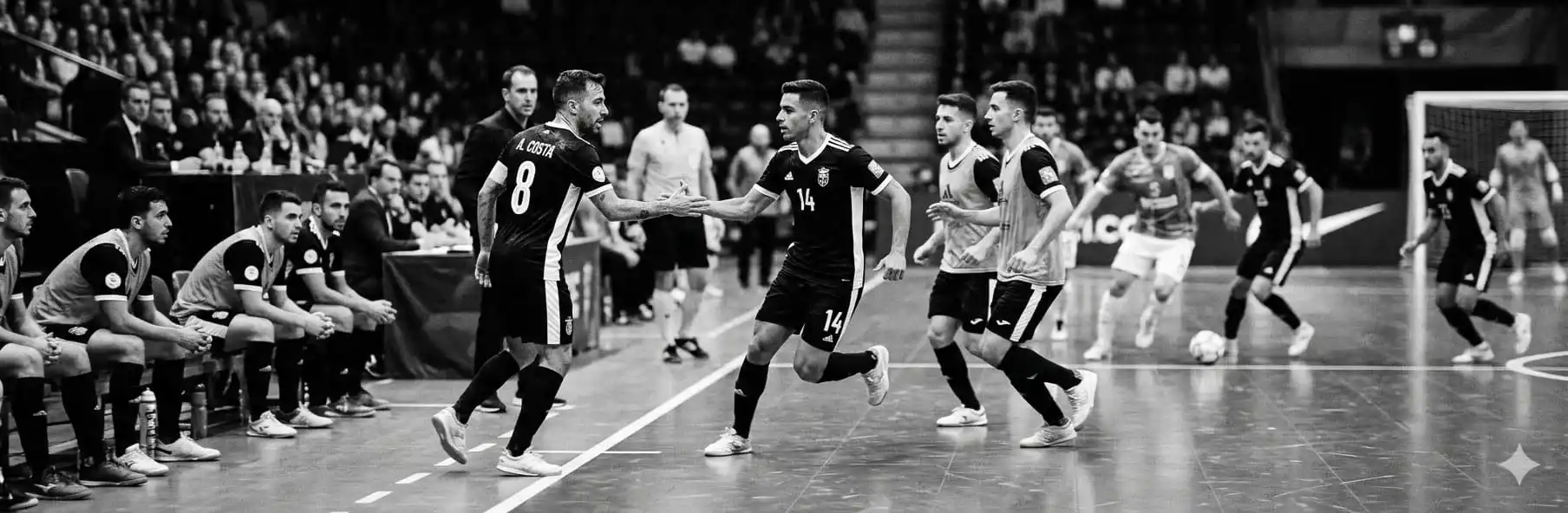
Substitution Management in Futsal: How to Keep Intensity High
Learn how to use substitutions in futsal as an active tactical tool to maintain competitive intensity and exploit your full squad across both periods of play.
Written by
João Araújo
Physical Education Teacher (FADEUP – University of Porto) · Futsal Coach – Level II · UEFA B License · Master’s in Physical Education
15 years teaching Physical Education in schools, 20 years coaching futsal at youth development level and 5 years coaching football. Federated and amateur football and futsal player.
In futsal, substitutions are not simply a response to fatigue, they are an active tactical tool. The sport allows unlimited rolling substitutions, which transforms bench management into one of the most differentiating skills a coach can possess. Teams that use substitutions strategically maintain higher intensity for longer. Teams that use them reactively merely manage decline.
The Rotation Model in Futsal
Unlike field football, where substitutions are infrequent and numbered, in futsal continuous rotation is a structural feature of the game. A squad of 10 to 12 players can and should be deployed regularly across both periods.
The most common rotation model splits the squad into two groups of five (including the goalkeeper), with groups alternating in 1–2 minute blocks depending on game intensity and tactical context.
This model only works when:
- All players know their role and are mentally ready to enter at any moment
- The coach has clear criteria for substituting, not instinct alone
- Bench communication is established and functional during the match
When to Substitute to Maintain Intensity
Intensity in futsal deteriorates quickly. Warning signs include:
- Slowing transitions: the team starts recovering shape more slowly after losing the ball
- Repeated decision errors: players choosing the wrong option in situations they normally resolve well
- Late positioning: players arriving at positions late, especially in defensive structure
- Negative body language: heads down, reduced communication, gestures of frustration
When these signs appear in a player, the substitution is not a punishment, it is a tactical decision that serves the team.
Strategic vs. Reactive Substitution
| Type | When it happens | Purpose |
|---|---|---|
| Strategic | Before fatigue is visible | Sustain high work rate longer |
| Reactive | When player is clearly spent | Recover lost performance |
| Disciplinary | After foul accumulation or behaviour | Manage tactical risk |
| Tactical | Response to a specific game situation | Change profile or system |
The coach who only makes reactive substitutions is always one step behind. The goal is to anticipate, not react.
Managing the Bench Dynamic
Players on the bench are an active part of the team on court. A well-managed bench:
- Stays alert: players ready to enter at any moment
- Communicates with the coach: provides feedback on what they see from outside that the coach cannot see from the bench
- Maintains positive energy: the bench directly influences the team’s emotional climate
Players who react poorly to substitutions or sit with negative body language destroy team cohesion. Working on bench culture is part of the team’s psychological training.
How Long Should Each Player Play?
No universal rule applies, but practical benchmarks:
- In competitive matches, 60–90 second shifts for high-intensity players sustain peak output
- Players with more tactical functions (e.g., a reading fixed player) can play longer shifts
- Goalkeepers rarely rotate, but must have a clear protocol for the 5v4
🔧 Useful Tool
The SportsLabTools Futsal Scoreboard lets you log substitution moments, each player’s time on court and associated match events in real time, giving you the data you need to optimise rotations game by game.
Checklist: Effective Substitution Management
| Practice | In Place? |
|---|---|
| Substitution criteria defined before the match | ☐ |
| Bench players actively warming up | ☐ |
| Bench-to-coach communication established | ☐ |
| Strategic substitutions before visible fatigue | ☐ |
| 5v4 protocol with goalkeeper defined | ☐ |
| Bench culture worked on in training | ☐ |
| Post-match playing time analysis | ☐ |
Conclusion
Substitutions in futsal are a mirror of the coach’s tactical competence. Those who use them strategically control the game’s tempo, sustain intensity and deploy the squad intelligently. Those who use them reactively are merely managing decline.
Start treating substitutions as a tactical decision, not an obligation, and you will see the difference in the second half of your matches.
Track each player’s on-court time and match events. Use the SportsLabTools Futsal Scoreboard to make substitution decisions with real-time information.