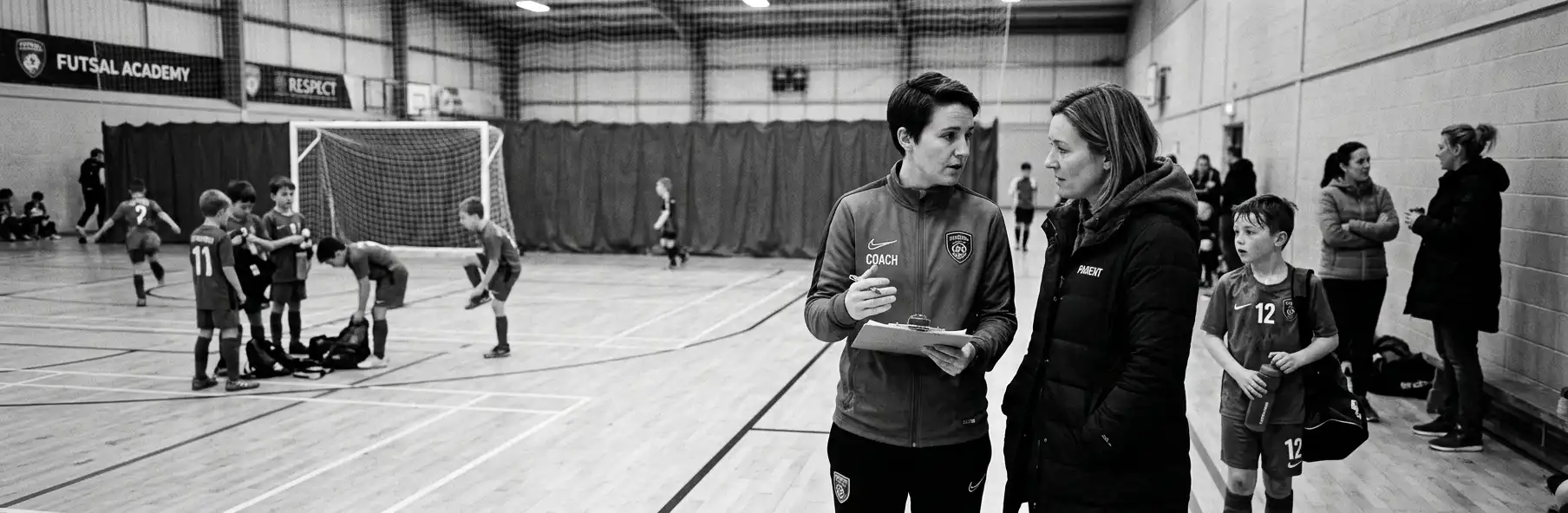
Talking to Parents in Youth Futsal: Aligning Expectations
How youth coaches should communicate with the parents of young futsal players to align expectations and prevent conflict over the course of the season.
Written by
João Araújo
Physical Education Teacher (FADEUP – University of Porto) · Futsal Coach – Level II · UEFA B License · Master’s in Physical Education
15 years teaching Physical Education in schools, 20 years coaching futsal at youth development level and 5 years coaching football. Federated and amateur football and futsal player.
“My son should be playing more” is a line every youth coach has heard dozens of times, often loaded with tension that’s been building for weeks. Without a structured communication channel with parents, that frustration goes unspoken until it explodes at the worst possible moment: leaving a match, in front of other parents, or worse, in front of the child himself.
The problem is rarely the parents’ demands as such; it’s the absence of aligned expectations from the start of the season. Without knowing what to expect, each parent builds their own version of what “should” happen, and that version almost never matches the coach’s actual plan.
Why Conflicts With Parents Happen
Parents see their child every day, but rarely see the team’s full context: who has more technical quality, who misses more sessions, what the season’s rotation plan looks like. Without that information, the natural interpretation for their child’s lack of minutes is always personal: favouritism, unfairness, or the coach’s incompetence.
The Consequences of Ignoring Communication With Parents
When a coach avoids talking to parents out of discomfort or lack of time, discontent grows in private (in the team’s WhatsApp groups, on the sidelines) until it becomes collective pressure the club’s board ends up feeling, by which point it’s already hard to manage.
The Solution: Core Principles for Communicating With Parents
- Present the season’s plan to parents at the start: squad selection criteria, rotation, and development goals, not just results
- Set clear channels and times upfront for parents’ questions, avoiding improvised conversations by the bench or in the stands
- Communicate proactively when a player is going through a phase of fewer minutes, before the parent has to ask
Application: Concrete Communication Strategies
Start-of-Season Meeting
Present the coaching staff’s general decision-making criteria to parents as a group: not case by case, but the principles guiding squad selection and playing time.
A Formal Channel for Individual Questions
Set the rule that questions about a specific child are handled in a scheduled conversation, never in the heat of a match, protecting both the coach and the player himself.
Proactive Communication at Sensitive Moments
If a young player is getting fewer minutes at some point in the season, tell the parent before they notice on their own. Getting ahead of it reduces the feeling that something is being hidden.
🔧 Useful Tool
Sharing objective data about a child’s progress (attendance, technical progression, coach feedback) makes the conversation less emotional and more factual. SportsLabTools Planning helps document and communicate the season’s criteria and goals clearly.
Special Cases: When the Conflict Is Already There
If the relationship with a specific parent is already strained, avoiding the one-to-one conversation only makes things worse. In those cases, an in-person conversation, with concrete facts and no accusations, is always preferable to letting the conflict drag on through messages or indirect comments.
See also: The Psychology of Squad Selection: How to Manage Player Expectations. The same expectation-management principles apply directly to the player.
Checklist: Communicating With Parents in Youth Development
| Practice | In place? |
|---|---|
| Start-of-season meeting with criteria explained | ☐ |
| Formal channel set up for individual questions | ☐ |
| Proactive communication before low-minutes phases | ☐ |
| Objective data shared instead of vague opinions | ☐ |
| Difficult conversations held in person, not by message | ☐ |
| Squad selection and rotation criteria documented | ☐ |
Conclusion
Talking to parents isn’t a distraction from the technical work; it’s part of managing youth development. Aligning expectations from the start of the season, with clear criteria and proactive communication, is what stops accumulated frustration turning into open conflict.
Document and share your team’s criteria transparently. Use SportsLabTools Planning to align expectations with parents from the start of the season.
Optional accelerator · the tool is always free
Start the season with the whole year already planned
Macrocycle, monthly mesocycles and weekly microcycles with the real season dates, sessions categorised by focus and technical-tactical blocks, and exercises with animated diagrams. From U11 to Seniors, 1 to 5 sessions per week.