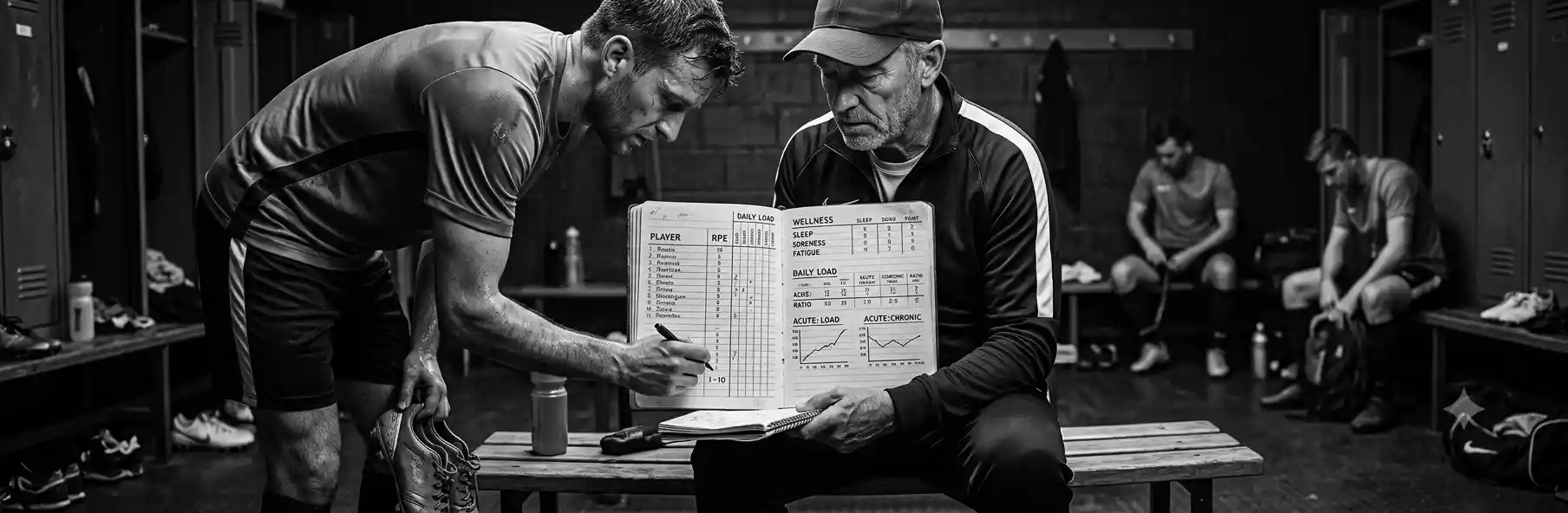
Training Load Monitoring Without GPS in Football: RPE and Affordable Methods for Amateur Clubs
How to monitor training load in football without GPS: session RPE, acute-chronic workload, daily wellness and a practical protocol for amateur clubs.
Written by
João Araújo
Physical Education Teacher (FADEUP – University of Porto) · Futsal Coach – Level II · UEFA B License · Master’s in Physical Education
15 years teaching Physical Education in schools, 20 years coaching futsal at youth development level and 5 years coaching football. Federated and amateur football and futsal player.
A player’s internal load can be estimated with a 10-second question asked 30 minutes after training. The rating of perceived exertion (RPE) scale, validated in hundreds of studies, correlates strongly with objective physiological measures, and it costs nothing. GPS is useful, but the idea that you can’t monitor load without it is the myth that holds amateur clubs back the most.
This article lays out a complete load-monitoring protocol with no expensive technology: what to measure, how to calculate it, and what decisions to make with the numbers.
Why Load Monitoring Is a Different Challenge in Amateur Football
In the professional game, the performance department cross-references GPS, heart rate and daily strength tests. At amateur level, the manager gets 2-3 weekly sessions, players who work eight-hour shifts before training and zero budget. The paradox: it’s precisely in this context that monitoring matters most, because the variability of load outside training (physical jobs, irregular sleep, stress) is far greater.
The science is clear on the principles: abrupt spikes in load increase injury risk, and well-built chronic load protects. The acute:chronic workload ratio (ACWR) (last week’s load divided by the average of the last four weeks) should stay roughly between 0.8 and 1.3. Spikes above 1.5 are an alert zone. These calculations work with RPE exactly as they do with GPS.
The Plan: A 3-Step Monitoring Protocol
| Element | What it measures | When | Cost |
|---|---|---|---|
| sRPE (RPE × minutes) | Session internal load | 30 min after training/match | £0 |
| Daily wellness | Sleep, fatigue, soreness, stress (1-5) | Morning | £0 |
| Weekly ACWR | Acute:chronic ratio | End of each week | £0 |
Step 1: Implement sRPE
Thirty minutes after the session (never immediately, as the last drill contaminates perception), each player answers: “How hard was training, 0 to 10?” (Foster’s CR-10 scale). Multiply by session time in minutes: a 90-minute session at RPE 6 = 540 arbitrary units (AU). That number is the session’s internal load.
Collection rules: individual (no group answers, which contaminate each other), consistent (always the same time after training) and judgement-free (a player who senses that a high RPE “earns punishment” starts lying).
Step 2: Add Daily Wellness
Before training, four questions scored 1-5: sleep quality, general fatigue, muscle soreness, stress. A total below an individual threshold (e.g. a 20% drop from the player’s own average) = a conversation before training and a possible load adjustment. Wellness contextualises RPE: normal load + continuously falling wellness = an early sign of overreaching.
Step 3: Calculate and Interpret the ACWR
At the end of each week, sum the AU of all sessions and matches. Divide by the average of the last 4 weeks. Practical interpretation:
- 0.8–1.3: functional zone; healthy progression
- 1.3–1.5: caution; avoid stacking more load next week
- >1.5: elevated risk; cut volume next week, keep intensity
- <0.8: underload; the player is detraining (watch post-injury or post-holiday)
The Most Common Mistakes in GPS-Free Monitoring
- Collecting without deciding: data that doesn’t change Thursday’s session is bureaucracy. Define decision rules before you start.
- RPE out loud in the dressing room: players adjust their answer to whatever the captain said. Collect individually.
- Ignoring life context: an RPE 8 from a player who slept 5 hours on shift work is not the same as from a rested student.
- Starting with everything at once: run sRPE alone for 3-4 weeks before adding wellness, as adherence dies with long forms.
- Treating ACWR as physical law: it’s a compass, not an oracle. Always combine it with the coaching eye and a conversation with the player.
🔧 Useful Tool
Paper and spreadsheets work, but they get lost and nobody fills them in by week two. The SportsLabTools Athlete Journal centralises each player’s RPE and wellness and shows you individual trends with no admin work.
Communicating the Data to the Squad
Monitoring dies when players see it as surveillance. Explain the “why” in week one: the data exists to protect them from injury, not to catch them out. Share concrete examples (“we lowered your load this week because your wellness dipped; it’s so you arrive fresh on Saturday”) and compliance turns into habit.
Also read: In-Season Injury Prevention: Load Management in Double-Game Weeks. Learn how to apply this data in the most congested weeks of the fixture list.
Checklist: Your Squad’s Load Monitoring
- RPE scale (CR-10) explained to the whole squad
- sRPE collected 30 minutes after every session
- Individual collection, never in groups
- Daily wellness with 4 questions (after 3-4 weeks of sRPE)
- ACWR calculated weekly per player
- Decision rules defined for each ratio zone
- Regular feedback to the squad on how the data is used
Conclusion
You don’t need GPS to train with data; you need consistency. A well-executed sRPE protocol across a full season is worth more than a month of misread GPS files. Start simple, decide with clear rules, and remember: the goal isn’t the number, it’s the player available on matchday. That’s not luck; it’s deliberate load management.
Start logging your squad’s load this week. Use the SportsLabTools Athlete Journal to centralise RPE and wellness and make decisions with real data.