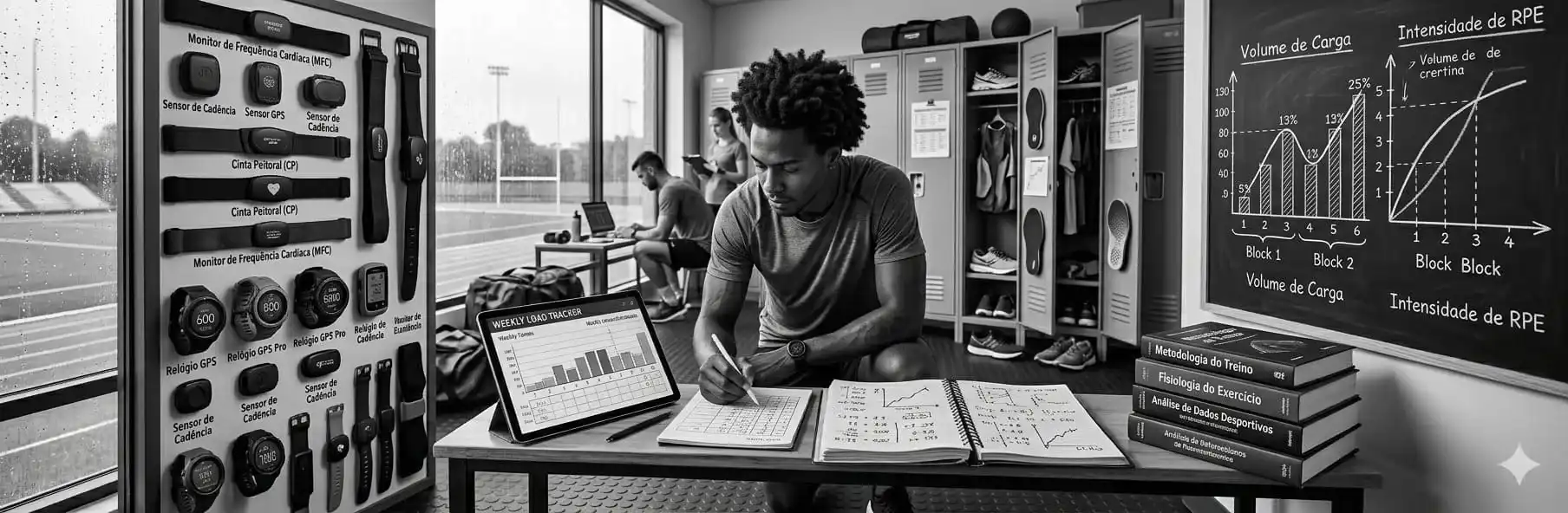
The Difference Between Volume and Intensity: What Your Data Says
Volume and intensity are distinct concepts, and confusing them is one of the most common mistakes in training planning. Find out what your data reveals about the right balance.
Written by
João Araújo
Physical Education Teacher (FADEUP – University of Porto) · Futsal Coach – Level II · UEFA B License · Master’s in Physical Education
15 years teaching Physical Education in schools, 20 years coaching futsal at youth development level and 5 years coaching football. Federated and amateur football and futsal player.
Two athletes. Both train five days a week. Both consider themselves “highly dedicated”. Yet one improves while the other stagnates. When you look at their data, the reason becomes clear: one is doing too much volume at low intensity; the other is pushing too hard without enough volume to drive adaptation.
Understanding the difference between volume and intensity and knowing how to read that distinction in the data is one of the most valuable skills an athlete can develop.
What Is Volume?
Volume is the total amount of work performed. It varies by sport:
- Running/Swimming/Cycling: total kilometres or hours per week
- Strength training: sets × reps × weight (tonnage)
- Team sports: total minutes on the field, distance covered per session
- Racket sports/Combat sports: number of points played, rounds completed
A runner who logs 60 km in a week has high volume. A football player who covers 45 km in a microcycle has high volume. A strength athlete performing 20 sets per muscle group has high volume.
What Is Intensity?
Intensity is the degree of effort per unit of work. Common metrics include:
- Running: pace per km, percentage of maximum heart rate, RPE
- Cycling: power in watts, training zones
- Strength training: percentage of 1RM, execution speed
- Team sports: percentage of time at high intensity, number of sprints, explosive actions per minute
A runner who completes 30 km at 90% of maximum heart rate has low volume but high intensity. A player who spends 80% of a match at moderate intensity with few sprints has high distance volume but relatively low intensity.
What Happens When You Confuse the Two
Case 1: High volume, low intensity (individual sport)
An amateur swimmer trains 10 hours per week, but 90% of the time in Zone 2 (easy aerobic). Her data shows consistent kilometres but average heart rate always below 70% of maximum. Result: a solid aerobic base, but no neuromuscular or speed adaptations. Her competition times have plateaued for two years.
The data diagnosis: high volume without sufficient intensity stimulus. Solution: introduce 20–30% of training in Zones 4–5.
Case 2: High intensity, insufficient volume (team sport)
A futsal player trains at maximum intensity in every session. His sprints and explosive actions per session are high. But he only trains 3 times per week, 45 minutes per session. The data shows excellent intensity peaks but insufficient total volume to build the endurance adaptations that sustain him in the final minutes of matches.
The data diagnosis: high intensity with low volume. Result: strong start to matches, drop in performance in the last 10 minutes.
Case 3: The right balance (strength training)
A strength athlete logs 4 sessions of 60 minutes per week, with 12–16 sets per muscle group (adequate volume) and 70–80% of 1RM on main sets (adequate intensity). His data shows consistent progress in strength and body composition.
How to Read the Balance in Your Data
For any sport, the key questions are:
- What is the intensity distribution in my training? (time spent in each zone or effort level)
- Is my weekly volume growing steadily or has it plateaued?
- Is there a correlation between intensity peaks and my best performances?
A general principle supported by scientific literature: for most endurance sports, 80% of training should be at low intensity and 20% at high intensity (the polarised model). For strength sports, the right balance between volume and intensity shifts with the periodisation cycle.
What the Data Makes Visible
Data does not lie about what you are actually doing, only about what you think you are doing. An honest record of volume and intensity is often surprising: most athletes either do too much volume at insufficient intensity or push too hard without accumulating enough work.
Analysing this balance is the first step towards genuinely effective training planning.
Tracking match intensity starts with recording the events that define it. The SportsLabTools Futsal Scoreboard creates a record of every match, the raw material that over time reveals whether your team is training at the right volume and intensity.
Training a lot and training well are different things. The data shows you which is which.