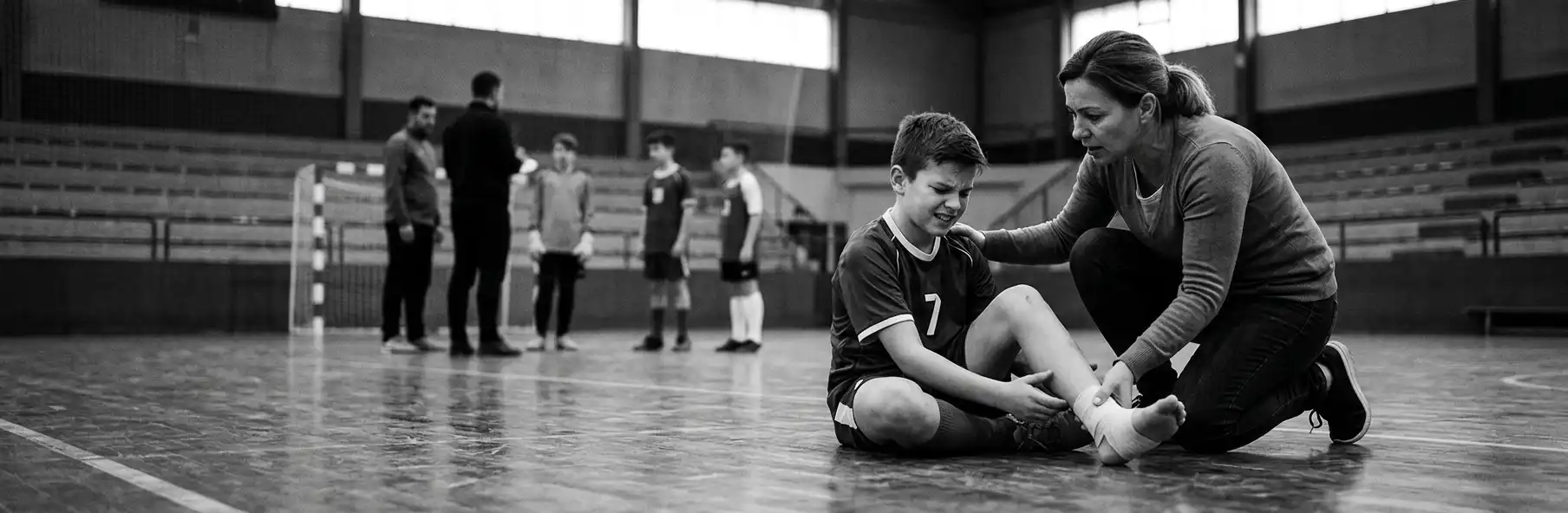
Ankle Sprains in Futsal: Warning Signs Parents Should Know
The ankle is the most common injury in futsal, precisely because of the hard court and constant changes of direction. A guide for parents on warning signs and when to act.
Written by
João Araújo
Physical Education Teacher (FADEUP – University of Porto) · Futsal Coach – Level II · UEFA B License · Master’s in Physical Education
15 years teaching Physical Education in schools, 20 years coaching futsal at youth development level and 5 years coaching football. Federated and amateur football and futsal player.
The ankle is, by a wide margin, the most common injury in futsal, far more so than in sports played on grass. The reason is simple: hard court, sharp stops and changes of direction every few seconds, on a surface that doesn’t absorb impact the way grass does. For parents, the challenge isn’t avoiding every sprain: it’s telling the difference between an awkward step that’s nothing serious and an injury that needs immediate medical attention.
Why the Ankle Takes Such a Beating in Futsal
Futsal demands constant braking and acceleration in a tight space, often on synthetic or wooden courts with little cushioning. On top of that, many young players are still growing, with ligaments and proprioception, the body’s ability to “feel” where a joint is, still developing, which makes sprains more likely than in physically mature adult athletes.
The Consequences of Ignoring the Signs
A mild sprain treated as if it were nothing tends to become a recurring problem. An ankle that doesn’t heal properly loses stability, and each new sprain is usually worse than the last because the ligaments are already weakened. It’s one of the more common reasons young players drop out of sport early, not because of the severity of the first injury but from the build-up of poorly managed sprains over several years.
The Signs Parents Should Recognise
Three signs that call for a doctor’s visit, not just ice and rest at home:
- Swelling that appears quickly and is visible, not just mild tenderness to the touch.
- Inability to bear normal weight on the foot, even after a few minutes of rest.
- Pain that doesn’t ease noticeably within 24 to 48 hours, even with ice and elevation.
A mild sprain typically shows visible improvement within a day or two. If it doesn’t, there’s a good chance ligament involvement needs a professional assessment, and continuing to train through that window almost always makes the injury worse.
What to Do in the First Few Hours
In the first 48 hours after any sprain, even a mild-looking one, the basic protocol is: rest, ice (15-20 minutes, several times a day), light compression and elevating the foot above heart level. Avoid heat, massage and alcohol in the first 48 hours: all of them speed up inflammation instead of controlling it.
Many parents only realise how serious a sprain really is once it’s too late, because they don’t have a record of how many times their child has complained about the same ankle over the season. That’s why I started recommending logging any physical complaint, however minor it seems, in an athlete journal, not to create anxiety but to spot patterns. The SportsLabTools Athlete Journal tool helps with exactly this: if the same ankle shows up three times in six weeks, that’s no longer “an awkward step”: it’s a pattern that deserves a physio assessment.
Special Case: When Your Child Wants to Come Back Too Soon
It’s common for young players themselves to push to return before they’re fully recovered, worried about losing their place in the squad. This is where parents matter most: the decision to return to play after a sprain should always be confirmed by a health professional, never just by the absence of pain at rest, because the joint can feel fine standing still and give way exactly on the first sharp movement on court.
See also: Injury Prevention in Futsal: Proprioception and Strengthening Exercises, concrete exercises to reduce sprain risk before it happens.
Checklist: How to Respond to an Ankle Sprain in Futsal
| Practice | Done? |
|---|---|
| Applied ice within the first 2 hours | ☐ |
| Checked for visible swelling | ☐ |
| Confirmed they can bear normal weight on the foot | ☐ |
| Logged the complaint, even if mild | ☐ |
| Didn’t let them train again before 48h if pain persisted | ☐ |
| Booked a medical assessment if symptoms hadn’t improved in 48h | ☐ |
Conclusion
Most ankle sprains in futsal aren’t serious, but the difference between an injury that clears in three days and one that drags on for months almost always comes down to how it’s managed in those first hours. Recognising the warning signs isn’t alarmism; it’s the difference between your child getting back on court safely or carrying instability that follows them for years.
Log every physical complaint your child mentions, however small it seems. Use the SportsLabTools Athlete Journal tool to spot patterns before they become bigger injuries.