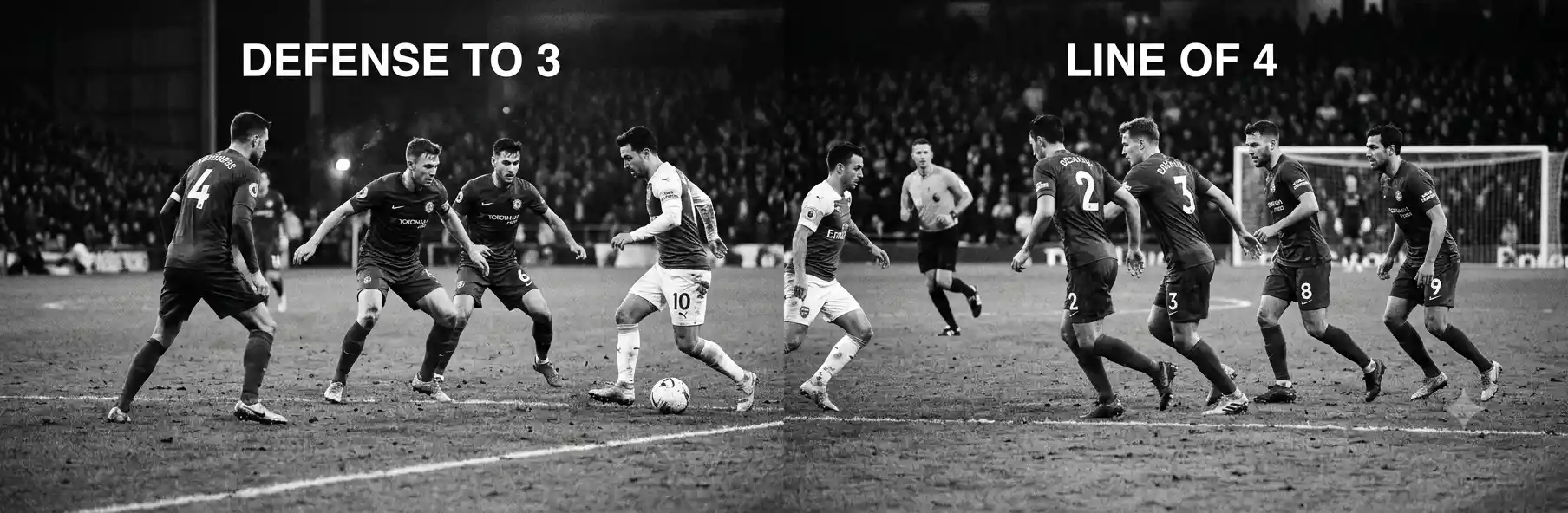
Back Three or Back Four in Football: Which Defensive Structure Suits Your Team
Back three vs back four in football: strengths, limitations and practical criteria for choosing the right defensive structure for your squad and league.
Written by
João Araújo
Physical Education Teacher (FADEUP – University of Porto) · Futsal Coach – Level II · UEFA B License · Master’s in Physical Education
15 years teaching Physical Education in schools, 20 years coaching futsal at youth development level and 5 years coaching football. Federated and amateur football and futsal player.
There is no universally superior defensive structure. only the one that best fits your players, your game model and the league you compete in. The “back three vs back four” debate fills television studios, but for the coach on the touchline the real question is different: which structure maximises what my squad has and hides what it lacks?
This article compares both structures using practical criteria: defensive behaviours, positional demands and the contexts where each one performs best.
The Back Four: The Classic Reference
Strengths
- Rational use of space. four players cover the width of the pitch with 10-12 metres between them; the shuffling and cover mechanisms have been documented for decades
- Ease of teaching, doubling up, cover and rotations in a back four are standard academy content; any player joining your squad already knows them
- Pressing compatibility. the back four steps up as a unit with clear references (line of the ball, offside line)
- Economy of numbers behind. frees an extra player for midfield or attack
Limitations
- Dependence on the full-backs. full-backs who both attack and defend well are the scarcest resource in amateur football
- Vulnerable between centre-back and full-back. the channel between them is the favourite space of inverted wingers
- 2v2 in transition. with both full-backs high, the two centre-backs defend the counter alone
When to use it: a squad with complete full-backs, wingers willing to track back, and a game model built on a mid-block or coordinated pressing.
The Back Three (5-3-2 / 3-5-2 / 3-4-3): Central Security and Free Wing-Backs
Strengths
- Permanent superiority in the central channel. three centre-backs against two strikers guarantee +1 in the most dangerous zone; one centre-back can step out to press without breaking the line
- Wing-backs with an attacking licence. they push on knowing a stable back three remains behind
- Safer defensive transitions. the natural 3+1 rest defence protects against the counter
- Easier build-up. three centre-backs naturally create superiority against two-man pressing lines
Limitations
- Brutal physical demands on the wing-backs. the wing-back covers the entire flank; without elite aerobic capacity out wide, the system becomes a permanent 5-3-2 and the team sinks
- Exposed flanks in a high block. when the wing-back pushes up and the ball goes past him, the wide centre-back must defend far from his zone
- One fewer player between the lines. the extra man at the back comes from somewhere: usually attacking midfield
- Conversion takes time. centre-backs raised in a back four need weeks to master the references of a back five
When to use it: a squad with three quality centre-backs but fragile full-backs, two fixed strikers, or a need for extra security against counter-attacking sides.
How to Choose: Three Decision Criteria
- What do you have out wide? Complete full-backs → back four. Quick but defensively undisciplined wide men, or weak full-backs → back three with wing-backs.
- How many quality centre-backs do you have? Two → back four. Three or more (or slow centre-backs needing mutual cover) → back three.
- How does your league attack? Leagues dominated by direct play and second balls reward the spare centre-back. Possession-and-width leagues punish tired wing-backs. a back four with tracking wingers may be more stable.
🔧 Useful Tool
Before switching structures, test the behaviours on paper. The SportsLabTools Tactical Board lets you draw the shuffling patterns of a back three and a back four against your league’s typical attacks and show the squad the differences.
Comparison Table: Back Three vs Back Four
| Criterion | Back three | Back four |
|---|---|---|
| Central-channel security | High (permanent +1) | Medium (frequent 2v2) |
| Physical demand on wide defenders | Very high | High |
| Ease of teaching | Medium-low | High |
| Short build-up | Easier (3 in first line) | Needs mechanisms (dropping pivot) |
| Behaviour in a high press | Complex (centre-back jumps) | Clear references |
| Typical vulnerability | Flanks after wing-back pushes up | Centre-back/full-back channel |
| Players available between the lines | One fewer | One more |
Also read: How to Install a New Tactical System in Pre-Season Without Wasting Time. the training process for changing structure without sacrificing results.
Conclusion
The problem is never the structure. it’s the fit to context. A back four with fragile full-backs bleeds down the flanks; a back three with exhausted wing-backs sinks into a permanent low block. Assess your squad honestly, choose the structure that hides your weaknesses, and give it enough training time for the automatisms to appear. The best defence in the league is rarely the most modern. it’s the best drilled.
Compare both structures with your own players. Use the SportsLabTools Tactical Board to draw defensive scenarios and decide with clear criteria before the next microcycle.
Optional accelerator · the tool is always free
A library of exercises instead of drawing every one
Packs of 40 exercises per theme, with an animated tactical diagram, four levels of progression, teaching points and success criteria. Import them and they stay in your library, ready to edit and present to the team.