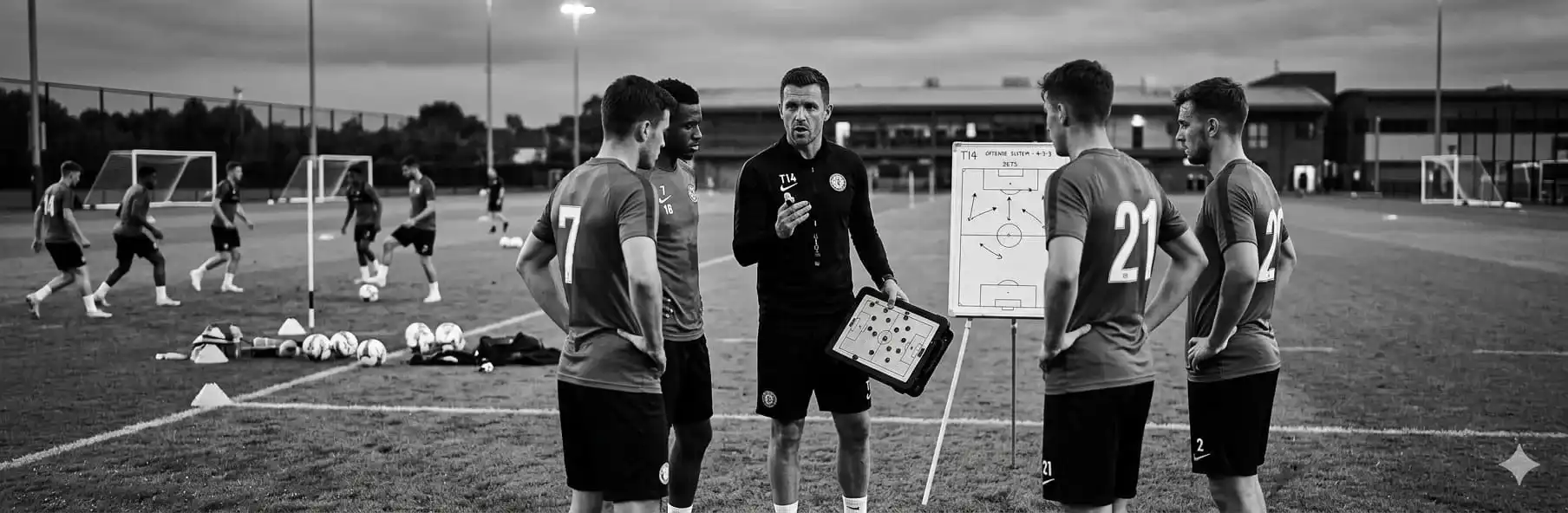
How to Install a New Tactical System in Football Pre-Season Without Wasting Time
Practical guide for installing a football tactical system during pre-season. Introduction sequence, reference drills and mistakes that cost weeks of training time.
Written by
João Araújo
Physical Education Teacher (FADEUP – University of Porto) · Futsal Coach – Level II · UEFA B License · Master’s in Physical Education
15 years teaching Physical Education in schools, 20 years coaching futsal at youth development level and 5 years coaching football. Federated and amateur football and futsal player.
Changing or installing a new tactical system during pre-season is one of the biggest challenges any manager faces. It is not simply a matter of communicating a formation. It is ensuring that 11 players (and the substitutes) develop automatic responses to complex match situations in a matter of weeks. Time is limited and sequencing errors cost weeks of wasted work.
The difference between squads that quickly assimilate a new system and those that arrive at the first fixture still wondering where they should be almost always comes down to the quality of the introduction sequence. not the quality of the players.
The Problem
Most managers make the mistake of presenting the tactical system in the abstract. on a whiteboard, in a team talk, with video clips of another team. The problem is that players need to experience it in a playing context to internalise it. The mental map formed in the dressing room is always different from the one that emerges on the pitch under opposition pressure.
The second mistake is trying to install everything simultaneously: defensive organisation, offensive organisation, transitions and set pieces in the first two weeks. The result is widespread confusion and a squad that “knows” the system but cannot execute it.
Core Principle: Install in Blocks, from Simple to Complex
The installation sequence must follow a logic of increasing complexity:
- Positioning in defensive organisation. where each player is when we do not have the ball
- Positioning in offensive organisation. where each player is when we have the ball
- Defensive transition. what we do in the first seconds after losing the ball
- Offensive transition. what we do in the first seconds after winning the ball
- Offensive and defensive set pieces. fixed routines with defined responsibilities
This is the blueprint. Never introduce point 3 before point 1 is at least minimally consolidated.
Practical Application: Week by Week
Weeks 1–2: Positioning (Defensive Organisation)
Start with the defensive reference. It is easier to communicate and easier to assess. The team is either correctly positioned or it is not. Exercises without opposition (shadow), then with passive opposition, then with increasing pressure.
Reference drills:
- Defensive shadow: all 11 defensive players move in response to the position of an imaginary ball moved by the manager
- Block organisation: 6v6 or 8v8 with the defending team fixing positions after a transition
- Pressing triggers and counter-press: define clear triggers (pass to the opposition centre-back = striker presses; turnover in midfield = immediate counter-press before the opposition reorganises, plus who holds depth to protect against the counter)
Week 3: Offensive Organisation
With the defensive reference installed, introduce the offensive principles: ball circulation, midfielder positioning, forward breaking movements.
Reference drills:
- Structured possession: maintain the ball in 8v5 with the obligation to respect system positions
- Build-up progression: build-out from the goalkeeper with passive opposition
- Sector triangulations: work by unit (defence, midfield, attack) in reduced spaces
Week 4: Transitions
Only once both static blocks are consolidated does it make sense to work on what happens between them. Transitions are the moments of greatest disorder; where the automatisms from previous weeks are put to the test.
Reference drills:
- Transition game: two blocks in halves of the pitch; the game starts from a turnover by one side
- 5 seconds: immediate press in the first 5 seconds after losing possession
Weeks 5–6: Friendlies + Adjustment
Friendlies in this phase are not for winning. They are for testing the system under real pressure. Post-match video analysis must focus on collective behaviours, not individual mistakes: “is the defence pressing at the right moment?” rather than “John misplaced that pass.”
🔧 Useful Tool
Visualising and communicating your tactical system is faster with digital support. The SportsLabTools Tactical Board allows you to draw positioning, set piece routines and tactical movements to share with staff and players before the session.
Common Mistakes When Installing a New Tactical System
- Skipping blocks: installing transitions before static organisation is consolidated
- Too much information at once. cognitively overloaded players make more mistakes and learn more slowly
- Whiteboard only, no pitch work. The system must be experienced in drills, not just explained
- No clear triggers defined. “defend” is not an instruction; “press when the opposition centre-back receives with their back to goal” is
Checklist: Tactical System Installation in Pre-Season
- Block sequence defined: defensive → offensive → transitions → set pieces
- At least 2 defensive shadow sessions before introducing opposition
- Pressing triggers defined and communicated before week 3
- Offensive organisation worked in structured drills (not free rondos)
- Friendly in week 4 or 5 to test automatisms under real pressure
- Post-friendly video analysis focused on collective behaviours
- Offensive and defensive set pieces installed before matchday 1
Conclusion
Installing a new tactical system is not an event. It is a process. The speed at which the squad assimilates it depends on the clarity of the installation sequence, the quality of the drills and the manager’s ability to give collective feedback throughout.
Well-structured tactical pre-season weeks are worth more than months of adjustment during the competitive season.
See also: Set Pieces in Football Pre-Season: How to Train Corners and Free Kicks before Matchday 1
Communicate your tactical system with clarity and speed. Use the SportsLabTools Tactical Board to prepare each session with movements, positioning and routines ready to show the squad.
Optional accelerator · the tool is always free
A library of exercises instead of drawing every one
Packs of 40 exercises per theme, with an animated tactical diagram, four levels of progression, teaching points and success criteria. Import them and they stay in your library, ready to edit and present to the team.