Cramp at the End of Football Matches: Why It Happens and How to Prevent It
Cramp in the last fifteen minutes of a football match is rarely just a lack of water. What actually triggers it and the week's plan to reduce it.
Written by
João Araújo
Physical Education Teacher (FADEUP – University of Porto) · Futsal Coach – Level II · UEFA B License · Master’s in Physical Education
15 years teaching Physical Education in schools, 20 years coaching futsal at youth development level and 5 years coaching football. Federated and amateur football and futsal player.
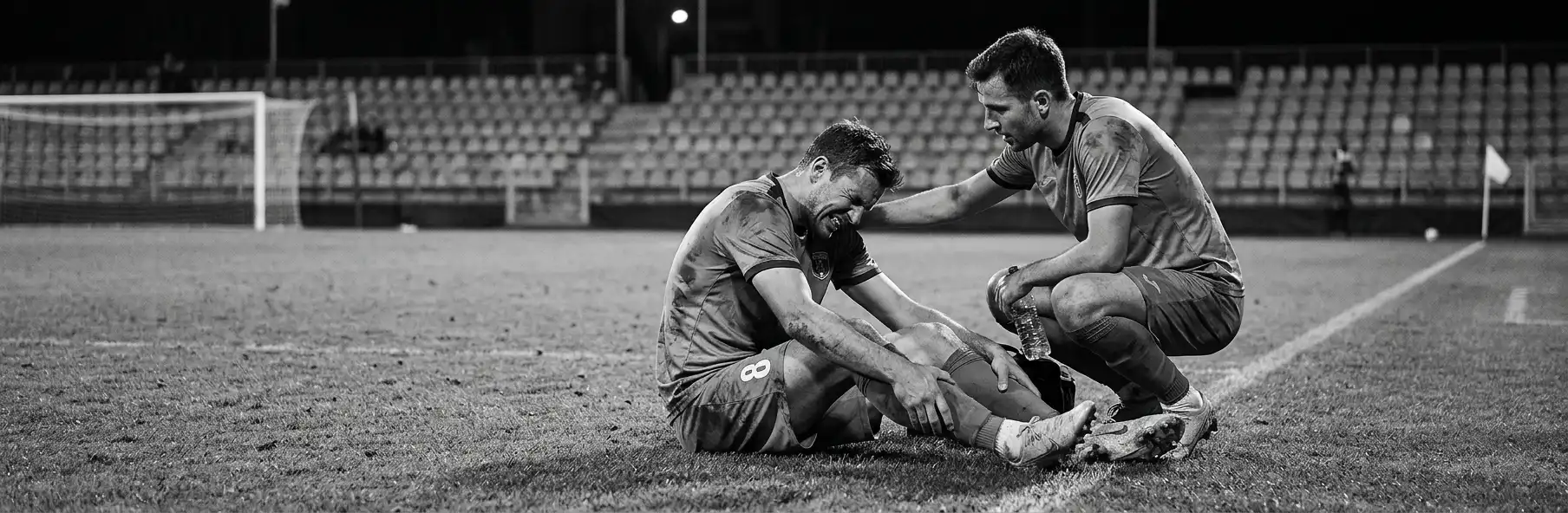
78th minute. You’re protecting a one-goal lead, the opposition are piling forward, and suddenly you feel your calf close up like a fist. You go down, the physio sprints on with the spray, pushes your foot up towards your shin, and you lie there for two minutes staring at the sky while your teammates play a man short. If this happens to you every other match in football, the usual explanation (“drink more water”) almost certainly isn’t enough.
Exercise-associated muscle cramp is one of the most poorly explained problems in grassroots sport. The idea that it’s purely dehydration and a lack of salts comes from an old theory, handy for selling drinks, but incomplete. More recent research points somewhere else: neuromuscular fatigue. When a muscle works beyond what it’s used to, the system that controls contraction and relaxation starts to misfire, and the result is the painful, involuntary contraction you know.
That doesn’t mean water and sodium don’t matter. They do, especially in heat. But the main trigger, in most cases, is too much load for that muscle on that day.
What Actually Sets Off a Cramp
Notice when cramps show up: almost always in the last third of the match, in extra time, or in games clearly more intense than the week’s training. They show up more in players back from injury, players who’ve moved up an age group, or players who’ve done 90 minutes after several weeks of 60. They show up more in players who’ve cramped before. None of that fits the “you were one bottle short of water” explanation.
It does fit the fatigue picture: a muscle not prepared for the demand of that match saturates, the receptors that regulate muscle tone lose their calibration, and the contraction fires by itself. Dehydration and sodium loss speed that process up because they raise nerve excitability, but they’re rarely the sole cause.
The Four Factors Present Every Time There’s Cramp
In practice, when a player comes to you with recurring cramp, there are four things to check before anything else:
- Load above the usual. A jump in minutes, a return from injury, a move up an age group, a game on a bigger pitch. The muscle took a dose it wasn’t adapted to.
- Heat and loss of fluid with sodium. Afternoon games in summer, dark kit, little top-up at half time.
- Low energy stores. A player who ate little at lunch, or ate late, or played with legs already emptied by a hard session the day before.
- Personal history. A player who’s cramped in one match is far more likely to cramp again over the following weeks, even after fixing hydration.
It’s rarely just one of these. It’s usually two or three adding up.
How to Work Out Which Case Is Yours
The only way to spot your pattern is to log it, because memory lies. After each match, note minutes played, perceived effort from 1 to 10, temperature, what you ate and when, and whether and when the cramp appeared. After four or five matches the pattern emerges: if cramps only turn up in games over 70 minutes, the problem is load. If they always turn up in hot games, it’s hydration and sodium. If they appear after weeks of heavy training, it’s energy and recovery.
To avoid loose bits of paper, it’s worth centralising that log. The SportsLabTools Athlete Journal tool lets the player note minutes, effort and symptoms in seconds at the end of each match, and after a month you’ve got the whole history side by side, instead of trying to reconstruct from memory why your leg locked up last Sunday.
The Week’s Plan to Reduce Cramp
Assuming it’s a mixed case, which is the most common, the plan has five fronts:
- Progression of minutes. A player sitting around 60 doesn’t go to 90 from one game to the next. Add 15 to 20 minutes at a time, over two or three weeks.
- Hydration with sodium on hot days. Not just water: too much water actually dilutes the sodium you have and makes things worse. An electrolyte drink before and at half time in hot games, and weigh in before and after to see how much you lose.
- Carbohydrate in the meal 3 hours before. Pasta, rice, bread, potato. Legs with full glycogen fatigue more slowly.
- Eccentric strength for calves and hamstrings, twice a week. Slow calf lowers, Nordic hamstring curls, Bulgarian split squats. A stronger muscle saturates later.
- Managing the last 20 minutes. If a player is cramp-prone, plan the substitution for 70 to 75 rather than waiting for him to go down at 80.
Points 1 and 5 force you to look at the week and the matchday sheet together. Mapping each player’s minutes progression and cross-referencing it with training load is easier in one place: the SportsLabTools Planning tool is there to spread those minutes across the weeks so the increase doesn’t land on the hardest session of the microcycle.
Common Mistakes That Keep the Problem Going
- Drinking only large amounts of plain water. Without sodium, it can make things worse rather than better.
- Static stretching cold before the game as “prevention”. It doesn’t prevent fatigue cramp and it can cut power for the following minutes. The useful stretch is the player’s own, to break the cramp once it starts.
- Ignoring the first mild cramp. That brief tightening on 65 that passed by itself is the warning. A player subbed then doesn’t go down at 80.
- Changing everything at once. If you alter hydration, food, load and strength in the same week, and it improves, you don’t know what fixed it, and you can’t repeat it.
When Cramp Is a Sign of Something Else
Most match cramp is benign and resolves with the plan above. But some signs justify seeing a doctor before pushing on with training: cramps that appear at rest or during sleep frequently, cramps very early in the game (at 20 or 30 minutes with normal load), cramps followed by very dark urine after effort, or muscle pain that doesn’t clear in two or three days. In those cases there may be medication, a metabolic issue, or a genuine muscle injury disguised as cramp. I’ve no way of knowing which from a distance, and that’s exactly why those cases come out of the training plan and go for clinical assessment.
See also: Post-Match Recovery in Football: A Practical 48-Hour Protocol, because poor recovery between games is one of the most overlooked causes of cramp.
If there’s one line to take from here it’s this: the 80th-minute cramp is usually decided well before the 80th minute. It’s decided in the minutes progression of the previous weeks, on the plate at the pre-match meal, and in the strength work that was or wasn’t done. Drinking water helps, but it’s the last piece, not the first.
Optional accelerator · the tool is always free
Start the season with the whole year already planned
Macrocycle, monthly mesocycles and weekly microcycles with the real season dates, sessions categorised by focus and technical-tactical blocks, and exercises with animated diagrams. From U11 to Seniors, 1 to 5 sessions per week.