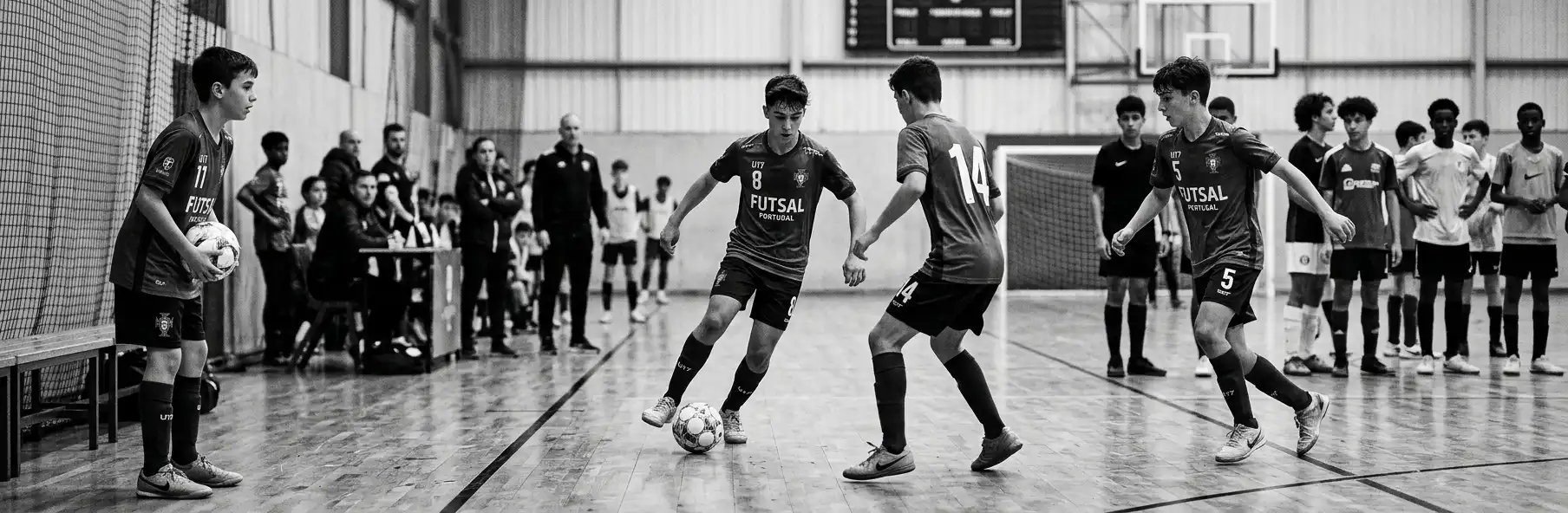
Early Specialisation vs. Multilateral Development in Youth Futsal
Specialise in futsal early or keep a child playing several sports? Advantages, risks, and decision criteria for each approach from under-13 to under-19 level.
Written by
João Araújo
Physical Education Teacher (FADEUP – University of Porto) · Futsal Coach – Level II · UEFA B License · Master’s in Physical Education
15 years teaching Physical Education in schools, 20 years coaching futsal at youth development level and 5 years coaching football. Federated and amateur football and futsal player.
The same dilemma comes up every year at the youth club: the parents of a talented under-13 ask whether their child should drop handball and swimming to “focus purely on futsal,” convinced that more hours of specific training is the fastest route to going pro. The scientific evidence on motor development says precisely the opposite in most cases.
There’s no universally correct answer. there’s the correct answer for that specific child’s age, physical profile, and goals. Understanding the advantages and limitations of each approach is what lets a coach guide parents and club directors with arguments, not just opinion.
Early Specialisation
Characteristics and Advantages
Total focus on futsal-specific training hours from an early age (under-11/under-13), with higher volume of technical and tactical repetition specific to the sport. Can accelerate acquisition of highly specific futsal patterns (control in tight spaces, quick shooting).
Limitations
Linked in the literature to higher overuse injury risk, higher likelihood of psychological burnout before age 16, and a deficit in general motor skills (coordination, balance, laterality) that multilateral development builds more completely.
When to use it: only in later stages of youth development (under-17/under-19), once the athlete already has a consolidated motor base and shows clear intrinsic motivation for a single focus himself.
Multilateral Development (Multi-Sport)
Characteristics and Advantages
Participating in several sports up to age 12-14 builds a broader motor base. coordination, decision-making in varied contexts, and transfer of patterns between sports (handball, for example, transfers spatial and passing awareness well into futsal).
Limitations
Requires more complex calendar management across clubs/sports, and can create tension with parents impatient for immediate results in the “main” sport.
When to use it: as a general rule up to age 12-13, especially in invasion sports like futsal, where game intelligence transferred from other sports has proven value.
How to Choose: Decision Criteria
- What’s the child’s age. still in the general motor development phase (up to 12-13) or already at the late-specialisation stage?
- Does the motivation for a single focus come from the child, or only from the parents/coach?
- Are there signs of accumulated fatigue, overuse, or demotivation suggesting the specific volume is already excessive for that age?
🔧 Useful Tool
Logging each young player’s specific training volume and motivational state across the season helps spot early signs of overload before they become a problem. The SportsLabTools Athlete Journal supports this individual tracking in youth development.
Comparison Table: Early Specialisation vs. Multilateral Development
| Criterion | Early Specialisation | Multilateral Development |
|---|---|---|
| Overuse injury risk | High | Low |
| Psychological burnout risk | High | Low |
| General motor development | Limited | Broad |
| Suitable before age 12-13 | Not recommended | Recommended |
See also: Futsal Youth Periodisation: What to Coach from Under-13s to Under-19s. how to structure futsal-specific training once specialisation is appropriate.
Conclusion
The problem isn’t futsal itself. it’s imposing early specialisation on a child who would still benefit from a broader motor base. Understanding each young player’s development stage, rather than just the pressure for results, is what lets a coach decide responsibly between focusing early and keeping the door open to other sports.
Track each young player’s development with information, not just intuition. Use the SportsLabTools Athlete Journal to monitor load and motivation in youth development.