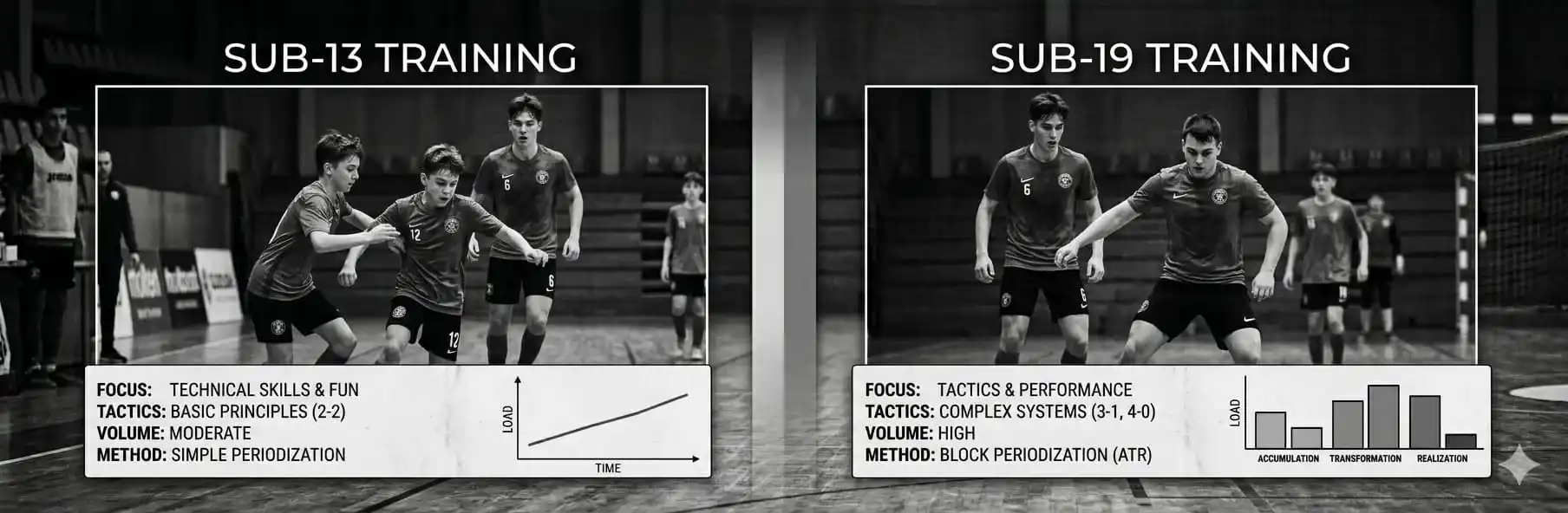
Futsal Youth Periodisation: What to Coach from Under-13s to Under-19s
A complete guide for technical directors structuring the annual youth futsal plan: what technical, tactical and physical content to prioritise at each age group, from Under-13 to Under-19.
Written by
João Araújo
Physical Education Teacher (FADEUP – University of Porto) · Futsal Coach – Level II · UEFA B License · Master’s in Physical Education
15 years teaching Physical Education in schools, 20 years coaching futsal at youth development level and 5 years coaching football. Federated and amateur football and futsal player.
When a technical director asks “what should I coach with the Under-15s?”, the wrong answer is “the same as Under-17s but slower”. The right answer is more nuanced and more powerful: each age group has a critical development window. A period in which certain content is learned far more effectively than at any other stage of a player’s career.
Periodisation in youth futsal is not simply dividing the season into training blocks. It is building a pedagogical progression that respects the biological, cognitive and motor development of each athlete.
Core Principles of Youth Periodisation
Three structural principles that apply across all age groups:
1. Simple to complex. Players can only understand collective systems once they master individual sub-skills. Don’t teach collective defensive organisation to players who haven’t yet mastered 1v1 defence.
2. General to specific. In younger age groups, general motor development has more impact than early technical specialisation. Coordination, agility and balance are the foundation for everything else.
3. Acquisition to consolidation. Content introduced in one season should be reinforced in the next. Intelligent repetition is more valuable than constant novelty.
Under-13 / Under-14: The 1v1 and Individual Technique Era
The Under-13/14 age group is the most critical period for individual technical acquisition. The developing brain at this stage has exceptional plasticity for learning and automating motor patterns. What is built here. Passing, receiving, shooting. Will form the foundation for the player’s entire career.
Technical Priorities
- 1v1 attacking: creating space, directional changes, basic feints (step-over, Cruyff turn)
- Ball carry: with both feet, at different speeds and directions
- Passing: accuracy of short pass, pass timing, low and chipped passes
- Shooting: with the dominant foot, from different angles and distances
Tactical Priorities
- Basic spatial concepts: knowing where to be when the team has the ball and when it doesn’t
- Supporting the ball carrier (simple triangulations)
- Concept of defensive line and individual defensive responsibility
What to Avoid
- Complex tactical systems (4-0, 3-1, 2-2). Players lack the technical foundation to execute them well
- Excessive analytical drills without game context. Learning at this age group should be predominantly in small-sided games (for example, in a 60-minute session, no more than 15 minutes of opposition-free analytical drills — the rest in small-sided games)
🔧 Useful Tool
Plan each age group’s annual programme with the SportsLabTools Futsal Planning Tool. Define monthly content blocks, organise sessions by pedagogical objective and maintain a record of technical and tactical progression throughout the season.
Under-15 / Under-16: Tactical Systems and Positional Intelligence
With the technical foundation from the previous age group, Under-15/16 is the time to introduce collective tactical logic. Players can now execute technical skills with reasonable consistency. They need to learn in which context and for what purpose to apply them.
Tactical Priorities
- 4-0 attacking system: ball circulation, space coverage, breaking runs
- Collective defensive principles: pressure, cover, balance, concentration
- Offensive transitions: quick exploitation after winning possession
- Introductory set pieces: corners and kick-ins involving two to three players
Development Indicator
A well-developed Under-15 player is not the most technically gifted. They are the one who makes correct decisions with consistency in game situations.
Under-17 / Under-18: Tactical Complexity and Positional Identity
Under-17/18 is where players begin to specialise in a position and understand the game in its entirety. Tactical load increases significantly and training intensity approaches senior futsal parameters.
Tactical Priorities
- Offensive system variants (3-1, 2-2, moments of libero): creating uncertainty for opponents
- Zone and mixed defensive organisation: when to use each system
- Numerical superiority and inferiority situations (5v4, 4v5)
- Advanced goalkeeper as 5th outfield player: concept and automatisms
- Introduction to opposition analysis: basic scouting principles
Under-19: The Bridge to Senior Futsal
The Under-19 group is the final step in the development pathway. The goal shifts from “developing the player” to preparing the player for senior level. With all the physical, tactical and mental demands that entails.
| Content | U-13 | U-15 | U-17 | U-19 |
|---|---|---|---|---|
| Individual 1v1 | ⭐⭐⭐⭐⭐ | ⭐⭐⭐⭐ | ⭐⭐⭐ | ⭐⭐⭐ |
| Attacking systems | ⭐ | ⭐⭐⭐ | ⭐⭐⭐⭐ | ⭐⭐⭐⭐⭐ |
| Defensive organisation | ⭐ | ⭐⭐⭐ | ⭐⭐⭐⭐ | ⭐⭐⭐⭐⭐ |
| Set pieces | ⭐ | ⭐⭐ | ⭐⭐⭐⭐ | ⭐⭐⭐⭐⭐ |
| Physical intensity | ⭐⭐ | ⭐⭐⭐ | ⭐⭐⭐⭐ | ⭐⭐⭐⭐⭐ |
| Game analysis | . | ⭐ | ⭐⭐⭐ | ⭐⭐⭐⭐⭐ |
See also: Futsal Drills for Under-13 / Under-15: How to Organise Playing Space. For practical ideas on spatial organisation in training with younger age groups.
Checklist: Annual Plan by Age Group
- Technical, tactical and physical content defined per age group before the season starts
- Pedagogical progression established (from the previous age group to the current)
- Each coach knows the expected exit profile for their age group
- Individual assessments aligned with the age group’s pedagogical objectives
- Vertical alignment between age groups (director reviews all coaches’ work)
- Content blocks distributed across the three season periods
Conclusion
Youth periodisation is the most strategic document a futsal club can produce. When well constructed, each player knows what they are learning, each coach knows what they are teaching, and the technical director can measure whether the development project is producing results.
Organise the annual plan for each age group with the SportsLabTools Futsal Planning Tool. Define content blocks, pedagogical objectives and training sessions for the entire season. From Under-13 to Under-19.
Optional accelerator · the tool is always free
Start the season with the whole year already planned
Macrocycle, monthly mesocycles and weekly microcycles with the real season dates, sessions categorised by focus and technical-tactical blocks, and exercises with animated diagrams. From U11 to Seniors, 1 to 5 sessions per week.