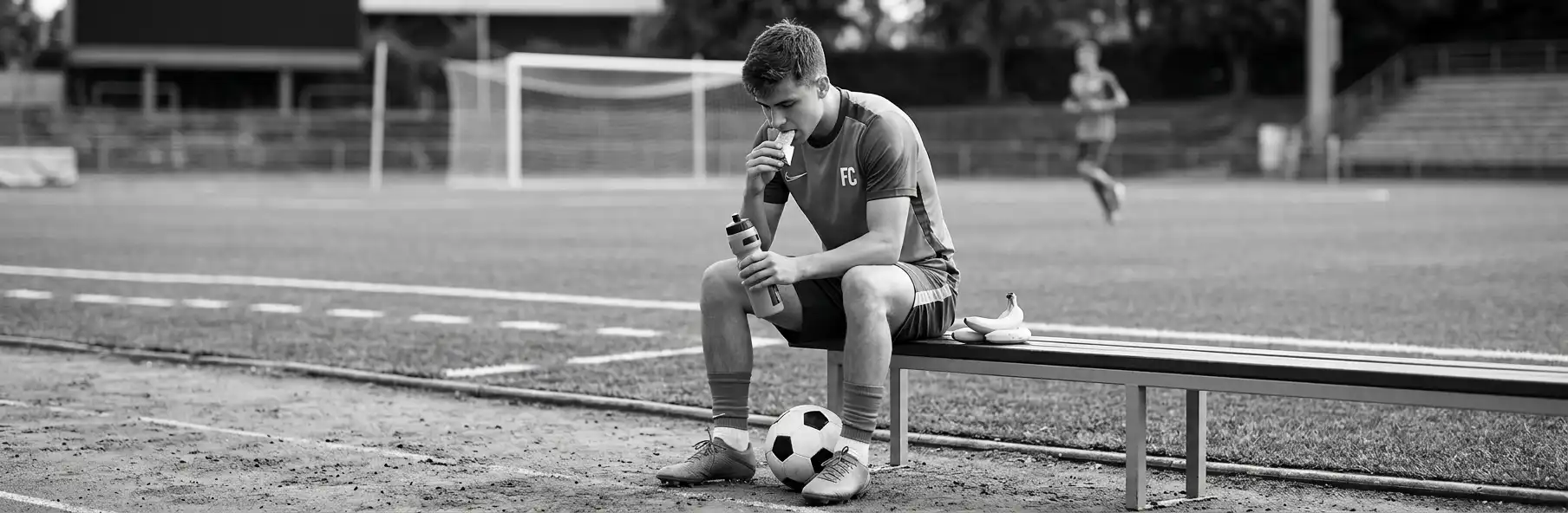
What to Eat Before and After Football Training: A Player's Guide
What you eat before a football training session doesn't serve the same purpose as what you eat after. A practical guide for young players on what to eat when, and why.
Written by
João Araújo
Physical Education Teacher (FADEUP – University of Porto) · Futsal Coach – Level II · UEFA B License · Master’s in Physical Education
15 years teaching Physical Education in schools, 20 years coaching futsal at youth development level and 5 years coaching football. Federated and amateur football and futsal player.
Eating before a football training session and eating after it aren’t the same job: they’re two completely different goals, with different time windows and foods that work better for each. The most common mix-up among young footballers is treating both meals as interchangeable, when in fact one prepares the body for the effort and the other repairs what that effort used up.
Eating Before Training
Characteristics and Purpose
The goal of the pre-training meal is to make sure energy is available without overloading digestion. Moderately slow-releasing carbohydrates, such as rice, pasta, bread and banana, supply the glycogen muscles will use in the first 60 to 90 minutes of intense effort.
Timing and Choices
- 2 to 3 hours before: a full meal with carbs, moderate protein and little fat (e.g. pasta with chicken and vegetables).
- 30 to 60 minutes before: just a light, fast-digesting snack (banana, toast with honey, a handful of dried fruit).
Limitations
Eating too close to kick-off, or a meal too heavy in fat and fibre, causes stomach discomfort exactly when the body needs blood in the muscles, not the gut.
When to use it: always, but adjust the amount and timing to when training is: an evening session leaves room for a full meal mid-afternoon, a lunchtime session needs more planning.
Eating After Training
Characteristics and Purpose
The post-training meal has a different job: replacing spent glycogen and supplying protein to repair muscle fibres. Here, the carbs-plus-protein combination matters more than at any other meal of the day.
Timing and Choices
- Within the first 30-45 minutes: the so-called “anabolic window” isn’t as strict as once thought, but eating early does help recovery, and a fruit-and-protein shake or a chicken sandwich does this job well.
- 1 to 2 hours later: a full meal with quality protein (meat, fish, eggs, pulses), carbs to restock glycogen, and vegetables for micronutrients.
Limitations
Skipping the post-training meal, or replacing it with just water and nothing else, delays muscle recovery and leaves the player more fatigued the next day, especially in weeks with two training sessions or a midweek fixture.
When to use it: always, after any session with real intensity, not just after matches.
Working with young players taught me that the biggest obstacle is never knowing what to eat: it’s remembering to eat it, and at the right time, especially in weeks with training at different hours. That’s why I recommend planning meals around the weekly training calendar, not the other way round. The SportsLabTools Planning tool helps you see the whole week at once and fit the right meals in before and after each session, instead of deciding it on the fly.
How to Choose: Three Questions Before Every Meal
- How long until training starts, or how long has it been since it finished? Determines whether it’s time for quick carbs or a full meal.
- Is today’s session intense or light? A low-intensity technical session doesn’t demand the same replenishment as a high-intensity session or a match.
- When’s the next training session or match? If it’s tomorrow, today’s post-training meal matters even more for arriving recovered.
Comparison Table: Before vs. After Training
| Criterion | Before Training | After Training |
|---|---|---|
| Main goal | Provide available energy | Restock glycogen and repair muscle |
| Key macronutrient | Carbohydrates | Protein + carbohydrates |
| Ideal timing | 2-3h before (meal) / 30-60min (snack) | 30-45min (snack) / 1-2h (full meal) |
| Common mistake | Eating too close to kick-off, too heavy a meal | Skipping the meal or having only water |
See also: Nutritional Periodisation in Football: Eating According to the Microcycle Day, how to apply this logic across the whole week, not just a single session.
Conclusion
There’s no “perfect” meal that works both before and after training; there’s the right meal for the right moment. Once a young player internalises that before is about available energy and after is about recovery, they stop needing to memorise food lists and start thinking in terms of what each meal is actually for.
Never forget to eat at the right time again. Use the SportsLabTools Planning tool to organise your meals around your training week.
Optional accelerator · the tool is always free
Start the season with the whole year already planned
Macrocycle, monthly mesocycles and weekly microcycles with the real season dates, sessions categorised by focus and technical-tactical blocks, and exercises with animated diagrams. From U11 to Seniors, 1 to 5 sessions per week.