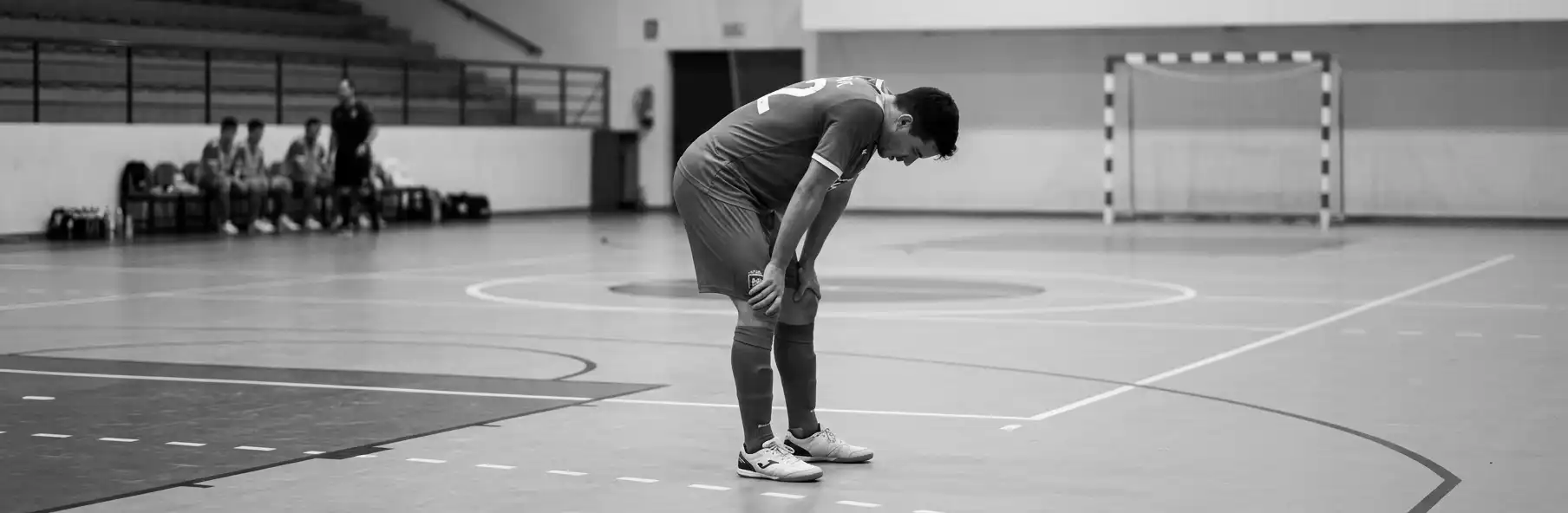
My First Session in a New Futsal Line-Up: An Adaptation Diary
I switched line mid-season in futsal and in the first session I was always off the beat. A first-person diary of the two weeks it took to adapt.
Written by
João Araújo
Physical Education Teacher (FADEUP – University of Porto) · Futsal Coach – Level II · UEFA B License · Master’s in Physical Education
15 years teaching Physical Education in schools, 20 years coaching futsal at youth development level and 5 years coaching football. Federated and amateur football and futsal player.
Tuesday, 8:15pm. The coach brings us into the middle of the court and reads out the lines for the next block. Me, having played with the same three since September, hear my name in another group: with the left winger from the B team, the taller pivot, and a defender I barely knew from the warm-ups. “We’ll try it like this until the end of the month.”
It’s not a disaster. I’m still playing, still in the same team. But from that moment, everything I used to do on autopilot stopped working. I knew where my old winger was going without looking. I knew when my old pivot was going to pin and when he was going to peel off. In this new line, I knew none of that, and the first session showed it to everyone.
Tuesday, 8:20pm: The First Drill and I Was Already Off the Beat
First ball-circulation drill, 4v0. Simple stuff. I’d pass and drive into the space like I always did, and the new winger wasn’t there. He’d make the move half a second later than I expected, or make a completely different one. Twice the ball ran out for a goal kick without anyone touching it, and both times it was me driving to the wrong place.
The coach didn’t say anything special, just “easy, you’re still getting to know each other”. But I felt it as if I was playing badly, when actually I was just playing the wrong cues. That’s an important difference, and it took me a while to see it.
Nobody Explained the Line’s Reference Points
What nobody does, and should, is explain in words how that line works. Every group of four has unspoken agreements: who goes up first on the press, which side the pivot prefers to receive on, whether the defender likes to carry or release quickly, who covers the far post at corners. In my old line I’d learned all of that over months, without noticing. In the new one, I was starting from zero, but playing at the speed of people who already know each other.
In that first session, the mistake that kept happening was me assuming the new pivot behaved like the old one. My old pivot would peel into the half-space to give me a passing line. The new one liked to pin the defender and hold the ball with his back to goal. I kept passing to where the other one would have been, and the ball bounced off an opponent’s back.
What I Logged That Night
I got home and, instead of being left with just the feeling of a bad session, I wrote. Three concrete things: the two plays where I lost the ball by driving early, the name of the move the new pivot makes that I still misread, and a question to ask the winger at the next session (“when do you peel off and when do you come to support?”).
I started doing this every session in the SportsLabTools Athlete Journal tool: one line for what went wrong, one for what I’ve now understood about the line, and one concrete question for the next day. It’s not to show the coach. It’s so I turn up to the next session with a plan instead of waiting for the chemistry to appear on its own.
The Next Two Weeks
The adaptation wasn’t linear. There was a session, on the fifth or sixth day, where it felt like we’d been playing together for a year, and in the weekend game we were all off the beat again. That’s normal and nobody had warned me: chemistry rises in fits and starts, not in a straight line.
What really helped was opening the SportsLabTools Athlete Journal tool and reading my own notes in a row after two weeks. It was written there, in black and white, that my driving-early mistakes had gone from four in the first session to one on the sixth. The feeling was that everything was still wrong. The numbers said I was improving fast. Without logging it, I’d have believed the feeling, and the feeling was lying to me.
What I’d Do Differently
If I went back to day one, I’d do three things straight away. I’d ask the pivot, before the session, how he likes to receive. I’d agree a simple signal with the winger for “I’m peeling off” and another for “I’m coming to support”, instead of guessing. And I’d give myself two or three weeks of margin before deciding whether the line “works”, because no line works by the third session.
See also: The Training Diary as a Self-Analysis Tool for Young Futsal Talents, on how to turn these loose notes into a habit that makes you improve faster.
I don’t know if every line takes the same time to click, maybe it depends a lot on the people. But if you got moved to a new group this week and the first session was a mess, that says nothing about your level. It just says you don’t know the cues yet. And that can be learned, if you ask the right questions instead of waiting in silence for it to pass.
*The account above starts from a real situation, with the player's identity protected and several contextual details deliberately changed to serve as an example.*