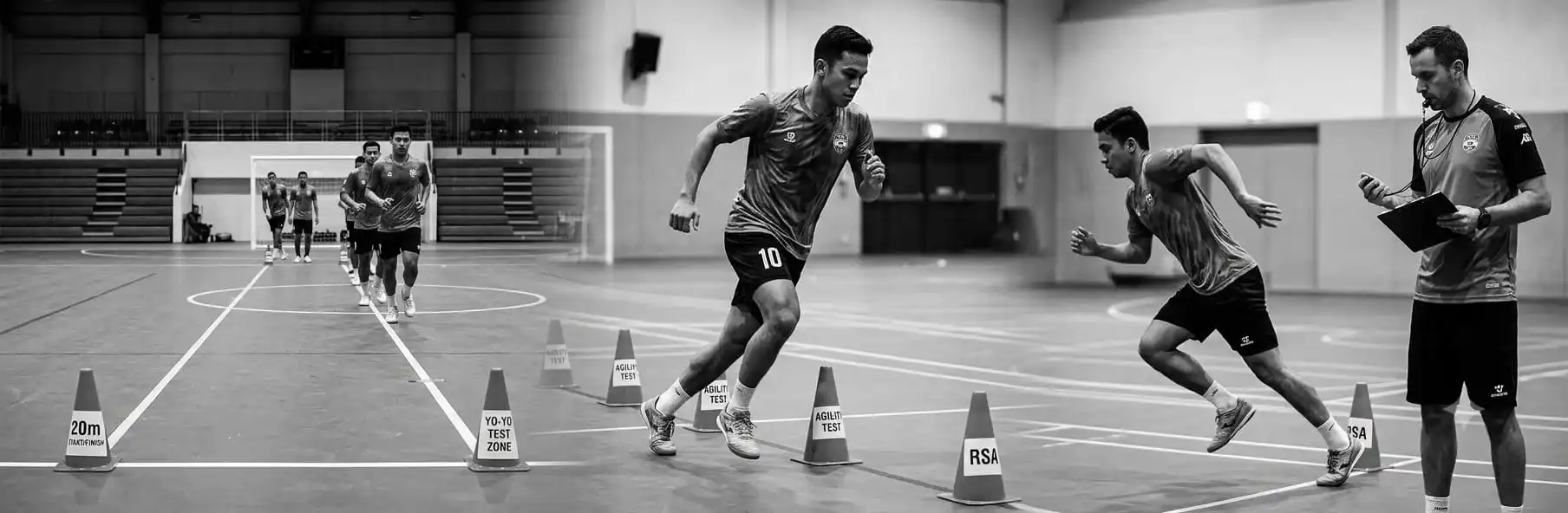
Fitness Testing in Futsal: How to Assess Your Team's Condition Before the Season
A practical guide to fitness testing in futsal: Yo-Yo Intermittent, RSA and court-specific agility tests, and how to use the results to individualise training.
Written by
João Araújo
Physical Education Teacher (FADEUP – University of Porto) · Futsal Coach – Level II · UEFA B License · Master’s in Physical Education
15 years teaching Physical Education in schools, 20 years coaching futsal at youth development level and 5 years coaching football. Federated and amateur football and futsal player.
Calling up a futsal squad for pre-season without knowing each player’s physical starting point is planning blind. Well-chosen fitness tests, run on the first day on court, give the coach an objective map of who needs more aerobic capacity work, who’s already ready for maximum intensity, and who’s returning from injury with deficits that visual observation won’t catch.
The problem is that most fitness tests used in 11-a-side football don’t translate well to futsal’s context. A small court, constant changes of direction, and training sessions often limited to a single hour of court time per week.
The Problem: Generic Tests Don’t Reflect Futsal’s Demands
Running a Cooper test or a timed mile on a futsal squad measures linear aerobic capacity but completely ignores the game’s real demands: 5-to-10-metre sprints, sharp braking, changes of direction every few seconds, and incomplete recovery between efforts. A player with good linear aerobic capacity might still have agility deficits or a poor repeated-sprint capacity that only a specific test reveals.
Core Principle: Three Essential Tests for Futsal
An effective futsal testing battery doesn’t need to be extensive. Three well-chosen tests cover the game’s main physical demands:
- Yo-Yo Intermittent Recovery Test (court-adapted). Assesses the ability to repeat high-intensity efforts with incomplete recovery, the physiological demand closest to the real game
- RSA (Repeated Sprint Ability). 6 to 8 short sprints (10-15 metres) with 20-25 second rests, measuring the ability to maintain speed across repeated efforts
- Court-specific agility test (T-test or adapted Illinois). Rapid changes of direction that replicate typical movements in a small playing space
Practical Application: Organising Testing Day
Testing Order
Run the tests in this order to avoid fatigue from one contaminating the next: agility first (needs a fresh nervous system), then RSA, and the Yo-Yo Intermittent last (the most metabolically demanding).
Individual Logging
Every player should have their results logged on an individual sheet, for direct comparison against future tests. Next pre-season, or a mid-season reassessment.
Practical Interpretation of Results
A player with weak RSA but a strong Yo-Yo score has a good aerobic base but needs specific repeated-speed work. The reverse. Strong RSA, weak Yo-Yo. Points to an explosive player with a recovery-between-efforts deficit, a risk profile in matches with extra time or heavy minutes.
Common Mistakes to Avoid
- Using only linear aerobic capacity tests. They don’t capture futsal’s intermittent, multidirectional nature
- Testing without controlling surface and footwear. Court results vary significantly from grass, invalidating comparisons
- Not repeating tests across the season. A single assessment point doesn’t allow you to track progress or catch form dips
- Ignoring recent injury context. Testing a player mid-recovery without adjusting demand can produce misleading data or added risk
🔧 Useful Tool
Logging and comparing fitness test results player by player needs an organised system. SportsLabTools Athlete Journal lets you store each player’s test results and track their progress across the season, quickly spotting who needs extra work.
Reassessment Frequency
Repeating the full testing battery every 8 to 10 weeks lets you track fitness progress without overloading the calendar with constant assessments. Between reassessments, daily RPE and the training journal are enough to monitor individual load.
See also: A 4-Week Futsal Pre-Season Plan with Limited Court Time. Where these test results help set the intensity of each training week.
Checklist: Fitness Testing in Futsal
- Three-test battery defined: Yo-Yo Intermittent, RSA and agility
- Testing order organised to avoid fatigue contamination
- Results logged individually per player
- Surface and footwear standardised across assessments
- Players returning from injury assessed with specific adjustments
- Reassessment scheduled every 8-10 weeks
- Results used to individualise each player’s training plan
Conclusion
Well-chosen fitness tests turn pre-season from “collective guesswork” into individualised, data-driven planning. Grassroots futsal teams that invest one session in testing properly gain weeks of more efficient training across the whole season.
Log and track each player’s physical progress with precision. Use SportsLabTools Athlete Journal to turn test results into training decisions.