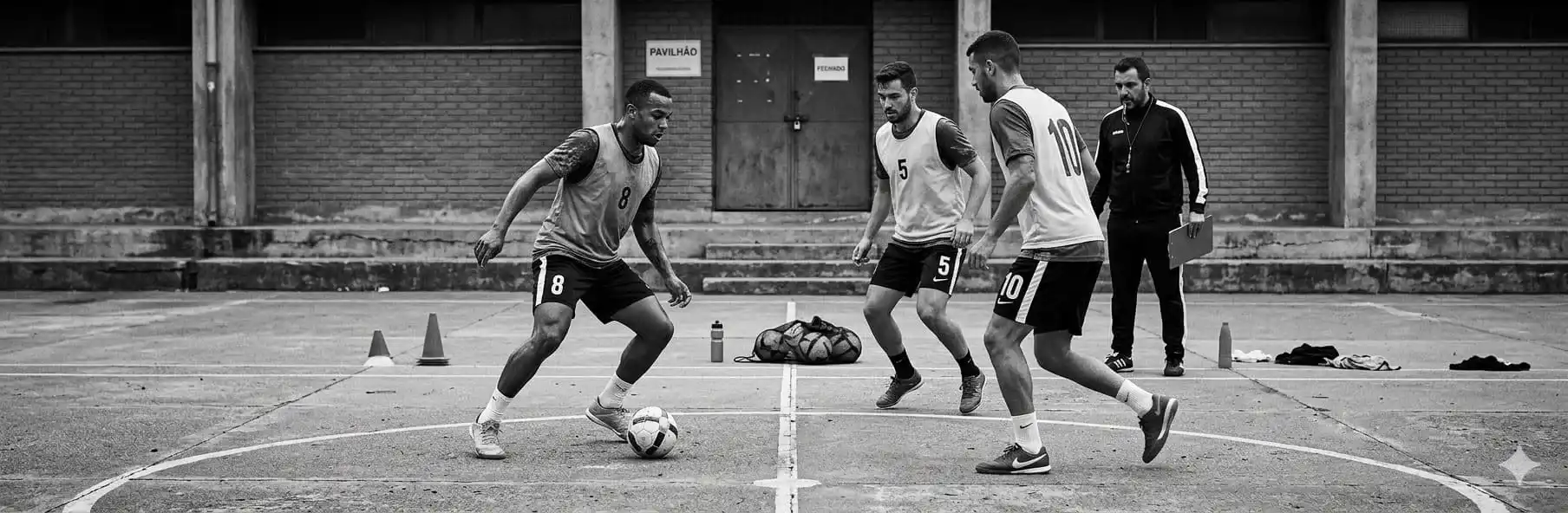
How to Plan a 4-Week Futsal Pre-Season with Limited Court Time
A complete pre-season futsal plan for amateur teams with limited gym/court access: 4 weeks of physical preparation, strength and conditioning outside the gym, integrated with tactical training.
Written by
João Araújo
Physical Education Teacher (FADEUP – University of Porto) · Futsal Coach – Level II · UEFA B License · Master’s in Physical Education
15 years teaching Physical Education in schools, 20 years coaching futsal at youth development level and 5 years coaching football. Federated and amateur football and futsal player.
August arrives and the sports hall is occupied with summer tournaments, holiday camps and maintenance works. The amateur futsal coach faces the annual most frustrating challenge: how to physically prepare the squad when the specific training space isn’t available?
The answer isn’t to wait for the hall. It’s to build the physical, muscular and energetic base outside it, so that when the space becomes available, players are ready to train at full intensity from day one.
Why a Pre-Season Outside the Hall Is an Opportunity, Not a Problem
Most amateur clubs start their pre-season in October when the hall is free, and spend the first three weeks “dusting off the cobwebs”. Trying to rebuild physical fitness while simultaneously introducing tactical content. The inevitable result: physical condition compromises the quality of tactical training.
A well-structured four-week pre-season that begins outside the hall solves this: when players arrive at the hall, they already have the physical base built. The coach can work tactically from day one with physically prepared athletes.
The 4-Week Plan
Week 1. Aerobic Base and General Strength (Outside the Hall)
Objective: rebuild cardiovascular base and general muscular endurance after the summer break.
Session template (3x per week, 60-70 min):
- Dynamic warm-up: joint mobility, glute activation, progressive jogging (10 min)
- Continuous moderate-intensity run: 20-25 min at 65-70% HRmax
- General strength circuit (2-3 sets): squats, planks, lunges, calf raises, adapted burpees
- Cool-down and stretching (10 min)
Suggested venues: outdoor football pitch, urban park, athletics track
Week 2. Power and Speed (Outside + First Hall Sessions)
Objective: develop the explosive component. Short acceleration and reaction speed are fundamental in futsal.
Session template (3x per week, 65-75 min):
- Warm-up with neuro-muscular activation (12 min)
- Repeated sprints: 8 × 20 metres with 90-second active recovery
- Agility drills with cones: T-test, 45° and 90° direction changes
- Explosive strength (2-3 sets): box jumps, agility ladder work, step-ups
- If hall available (1x per week): basic individual technique, no physical pressure
🔧 Useful Tool
Structure your pre-season week by week with the SportsLabTools Futsal Planning Tool. Define each session’s objectives, weekly volume and intensity, and the physical load progression over the four weeks. And share the plan with your players to maximise buy-in throughout August.
Week 3. Physical-Tactical Integration (Hall)
Objective: transfer the physical fitness built in weeks 1 and 2 into the specific futsal context.
Session template (3x per week, 70-80 min):
- Ball warm-up and futsal-specific movement (12 min)
- Ball intermittent exercises: rondos 4v2 under pressure, pressing and quick exit situations (15 min)
- Small-sided games with intensity focus: 3v3, 4v4 with time restrictions (20 min)
- Introductory tactical work: defensive organisation, ball circulation in the 4-0 (20 min)
- Final fitness exercise without ball: 4-6 min high-intensity work (30”/30” intervals)
Week 4. Competitive Tuning (Hall + Practice Match)
Objective: transition to season rhythm. Real match intensities, tactical systems introduced, first practice match to calibrate squad condition.
| Week | Location | Focus | Intensity |
|---|---|---|---|
| 1 | Outdoor/Gym | Aerobic base + general strength | Moderate (65-75%) |
| 2 | Outdoor + Hall (1x) | Power, speed, agility | Medium-high (75-85%) |
| 3 | Hall | Physical-tactical integration | High (85-90%) |
| 4 | Hall + Practice Match | Competitive rhythm | Competitive |
The Most Overlooked Component: Recovery During Pre-Season
Pre-season carries the highest injury risk of the year. Especially in the first two weeks. To minimise this:
- Sleep: minimum 7-8 hours per night
- Hydration: extra attention in August with higher temperatures
- Post-training nutrition: protein intake within 30-45 minutes of training
- Rest days: at least two rest days per week in the first two weeks
See also: 5 Essential Metrics Every Coach Should Record
Checklist: 4-Week Futsal Pre-Season
- 4-week plan structured before pre-season begins
- Alternative venues to the hall identified
- Load progression defined (week 1 moderate → week 4 competitive)
- Strength and power component included in weeks 1-2
- First hall session scheduled for week 2
- Practice match planned for end of week 4
- Recovery protocol communicated to players
Conclusion
The lack of hall time in August is not an obstacle. It is an opportunity to build the physical base that most amateur teams never have. The team that arrives at the first competitive match already in shape has a genuine competitive advantage.
Plan your futsal pre-season week by week with the SportsLabTools Futsal Planning Tool. Define session objectives, track load progression and ensure your squad arrives at match day one in their best possible condition.
Optional accelerator · the tool is always free
Start the season with the whole year already planned
Macrocycle, monthly mesocycles and weekly microcycles with the real season dates, sessions categorised by focus and technical-tactical blocks, and exercises with animated diagrams. From U11 to Seniors, 1 to 5 sessions per week.