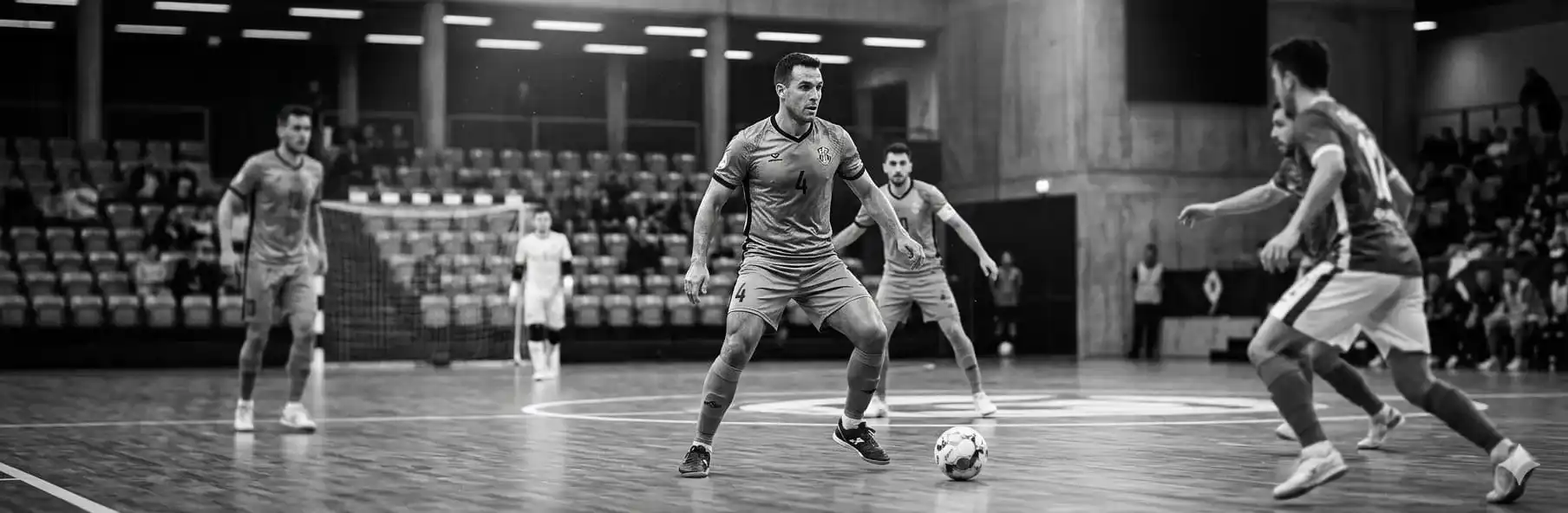
The Fixo in Modern Futsal: Roles, Positioning and Game Function
Complete guide to the fixo's role in modern futsal: 4 essential functions, positioning by phase of play, and common mistakes when developing this position.
Written by
João Araújo
Physical Education Teacher (FADEUP – University of Porto) · Futsal Coach – Level II · UEFA B License · Master’s in Physical Education
15 years teaching Physical Education in schools, 20 years coaching futsal at youth development level and 5 years coaching football. Federated and amateur football and futsal player.
The fixo remains the most misunderstood position in amateur futsal. Most coaches describe it simply as “the defender”. Someone who stays back and guards space while the others attack. This definition, valid in 1990s futsal, no longer captures what the modern game demands from this position.
In modern Iberian futsal. The world reference. The fixo is the game organiser. He dictates the press-breaking tempo, decides when to activate the zone press, and in possession serves as the anchor for winger and pivot rotations. Reducing the fixo to “defender” is the equivalent of describing a modern holding midfielder as “the one who stays back.”
What Changed in the Fixo’s Role
Modern futsal has accelerated transition tempo: teams like Barcelona or ElPozo Murcia in the UEFA Futsal Champions League execute offensive-defensive cycles in 4 to 6 seconds. In this context, the fixo can no longer be a passive player who receives the ball once the press is installed. He must be the first to initiate the press break and the last to provide cover.
Three structural changes define the modern fixo:
- Build-up play: the fixo receives under pressure and decides the exit. Short pass to the winger, long pass to the pivot, or dribble to open a passing lane
- Active pressing: in high zone press systems (common in compact 3-1), the fixo participates actively in the first press block, not just as a second-line player
- Foul count management: it is the fixo who has the global view of the foul counter and communicates to the team when to change defensive behaviour (before and after the 5th accumulated foul)
The Fixo’s 4 Functions in Modern Futsal
1. Tactical Organiser
The fixo reads the game from the widest perspective. It is the position with the broadest view. Seeing the entire defensive structure of the opposition in front of him. This positional advantage makes him the “coach on the court”: communicating coverage assignments, telling the winger when to double-team, and calling the press break.
In training: include exercises where the fixo must name out loud the next action before executing it. This automatically develops anticipatory thinking.
2. Builder in the Press Break
In the 3-1 or 4-0 system under opposition press, the fixo is frequently the player who receives from the goalkeeper and decides the exit direction. The two base options:
- Short exit: pass to the winger in the press corridor, drawing more opponents and creating superiority in another corridor
- Long exit: direct pass to the pivot or opposite winger, bypassing the press block in one pass
The quality of this decision. And the speed at which it is made. Determines whether the team exits cleanly or loses the ball under pressure.
3. Rotation Anchor
In offensive rotations (pivot-winger combination, winger cutting inside, second-line combinations), the fixo is the balance point. He does not enter advanced combinations. He holds position to: guarantee defensive cover in case of loss, serve as a back-pass option when the attack finds no passing lane, and restart organisation when the ball returns.
A fixo who gets too involved in offensive combinations leaves the team exposed to the counter-attack. The most frequent mistake in young fixos.
4. Collective Press Manager
The fixo decides when to activate the high press. Press triggers in futsal include:
- Opposition goalkeeper with the ball and little pressure on the carrier
- Back pass to the opposition fixo in a press zone
- Set piece with slow restart
- Favourable scoreline to risk pressing (e.g., leading by 2 or more goals)
🔧 Useful Tool
Preparing the fixo’s rotations and positioning assignments for the next match requires a visual tool. The SportsLabTools Futsal Tactical Board lets you draw and save rotation exercises and press-break patterns directly on tablet or PC, ready to show players in the changing room.
Positioning by Phase of Play
| Phase | Fixo’s base position |
|---|---|
| Defensive organisation (mid-block) | Centre of defensive half-moon, 8–10m line |
| High zone press | Advances into press zone, covers ball carrier or closes passing lane |
| Organised possession (3-1) | Lateral to the goalkeeper, available to receive and decide exit |
| Defensive transition (after loss) | Retreats immediately to centre. Does not chase the ball |
| Offensive power play (5v4) | Maintains cover in opposition press zone. Does not advance into the area |
The Most Common Mistakes in Developing the Fixo
-
Too passive in possession. Waiting for the ball instead of creating active passing lanes. Fix: possession exercises where the fixo must make at least one positional movement for every 3 team passes.
-
Advancing too far in offensive rotations. Leaves the team without cover. Fix: clear rule in exercises: the fixo never crosses the imaginary reference cone line.
-
Not communicating foul count management. Team concedes the 5th foul without warning. Fix: the fixo is exclusively responsible for announcing “we’re on the 4th foul” and “we’re on the 5th”. Must be drilled explicitly.
-
Losing cover position in transitions. Chasing the ball instead of returning to centre. Fix: video analysis with examples of goals conceded on the counter when the fixo was advanced.
See also: The Modern Futsal Winger: Roles, Positioning and the Evolution of the Position. The adjacent position that works directly in combination with the fixo in press breaks and offensive rotations.
Checklist: Developing the Modern Fixo
- Fixo receives under pressure and decides the exit direction in under 2 seconds
- Base positioning lateral to GK in organised possession (not in front)
- Does not cross the reference line in offensive rotations
- Communicates coverage assignments and foul count out loud
- Returns to centre immediately in defensive transition (does not chase ball)
- Knows the team’s 3 press triggers and decides when to activate them
- Distinguishes when to use short vs. Long exit under opposition press
Conclusion
The modern fixo is not a defender who plays behind. He is the central nervous system of the team’s game. A well-developed fixo reduces transition errors, accelerates press breaks and serves as a communicative reference point for the other three outfield players. Before asking your fixo to “defend better,” make sure he understands his 4 functions. And trains each one explicitly.
Plan the rotations and positioning for your fixo before the next training session. Use the SportsLabTools Futsal Tactical Board to draw the exercises and show players before they enter the gym.
Optional accelerator · the tool is always free
A library of exercises instead of drawing every one
Packs of 40 exercises per theme, with an animated tactical diagram, four levels of progression, teaching points and success criteria. Import them and they stay in your library, ready to edit and present to the team.