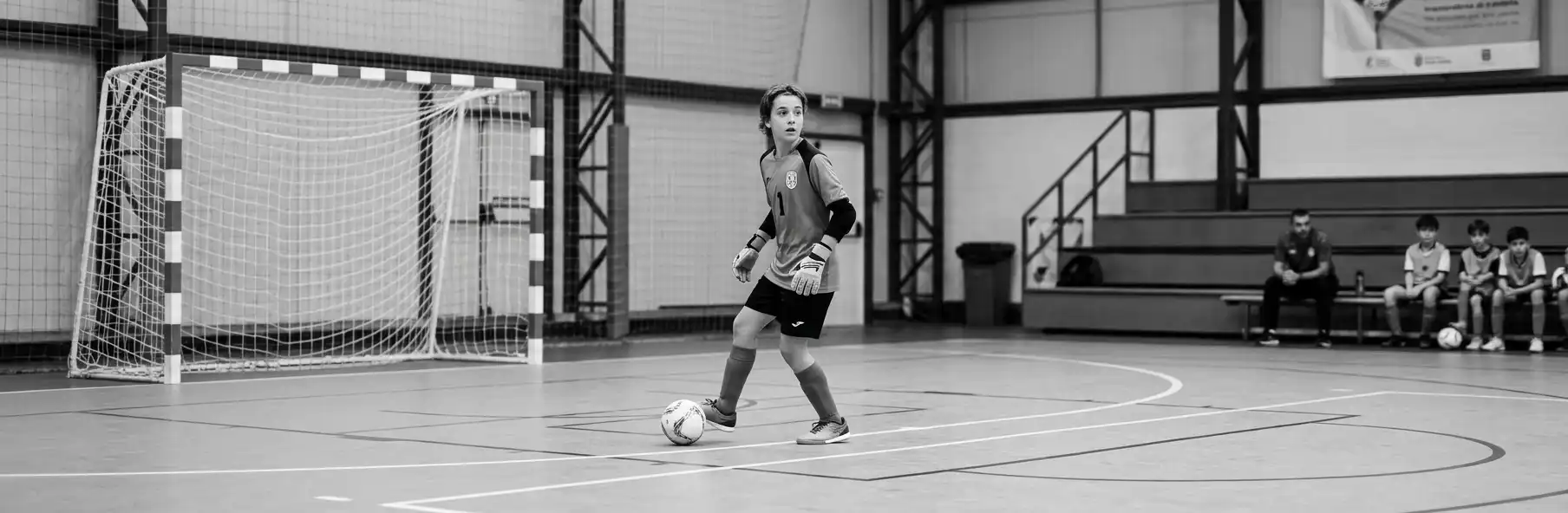
The Flying Goalkeeper in Youth Futsal: Are We Teaching It Too Soon?
Everyone installs the flying goalkeeper in youth futsal because the elite uses it. In most age groups it's taught too soon and hides more than it solves.
Written by
João Araújo
Physical Education Teacher (FADEUP – University of Porto) · Futsal Coach – Level II · UEFA B License · Master’s in Physical Education
15 years teaching Physical Education in schools, 20 years coaching futsal at youth development level and 5 years coaching football. Federated and amateur football and futsal player.
You watch a UEFA Futsal Champions League game or a national team, and the goalkeeper spends half the time outside the area, playing as a fifth outfield player. You go back to your under-15 session on Monday and decide your team is going to play like that too. It’s a strong and understandable temptation. In most youth age groups, it’s a scheduling error: the right thing, taught years too soon.
I’m not saying the flying goalkeeper has no place in youth football. I’m saying installing it at 13 or 14 as a regular tool usually costs more than it returns, and that cost stays invisible until it’s late.
What Everyone Says (And Why It’s Wrong)
The common argument is: “modern futsal plays this way, the sooner they learn it, the better”. It sounds logical. The problem is that the flying goalkeeper isn’t a move you learn, it’s the consequence of a team that already masters other things first: an oriented first touch under pressure, a safe short pass between tight lines, a quick read of when to release the ball and when to hold it. An average under-15 is still building that base.
When you put five players circulating the ball with a flying goalkeeper without that base, you’re not training modern futsal. You’re training slow sideways passes waiting for the error to happen, and the error happens on the side that scores an own goal. The picture looks like the elite one. The content has nothing to do with it.
What Experience Shows
I followed an under-15 whose coach installed the flying goalkeeper as the default response whenever the team was losing. In the first few weeks, a visible result: they kept the ball more. After two months, three problems had grown underneath. The outfield players had stopped training the four-man press break, because “there was always the extra man” to sort it out. The goalkeeper had got worse at saves, because he spent sessions playing with his feet and almost never working the goal. And the team conceded into an open net at a rate that wiped out any possession advantage.
What helped see this clearly was drawing the two situations side by side in the SportsLabTools Tactical Board tool: the real 4v3 press break they’d stopped training, and the 5v4 they were using as a crutch. Seeing the two schemes together, the coach realised he was skipping the stage that held up the next one.
When It Makes Sense to Start
The flying goalkeeper fits well into youth football when three conditions are met, and rarely before 16 or 17. First, the team builds out against the press four against three safely, without depending on the extra player. Second, the goalkeeper has enough technical foot base to receive oriented and pass under pressure without being a constant risk. Third, there’s training time left over after covering the fundamentals, not instead of them.
Even then, it’s introduced as an occasional tool, not as an identity: in the last few minutes with the team losing, in a numerical advantage already won by other means, or in short training blocks for the players to learn the mechanics. Before taking it into a game, it’s worth reviewing the first rehearsals on video. Seeing in the SportsLabTools Video Analysis tool where the ball is lost and who’s left out of position when that happens tells you, in ten minutes, whether the team is ready or whether you’re exposing the goalkeeper to goals that will undermine his confidence for months.
What to Train Instead
In the age groups up to 15, the time many spend setting up the 5v4 returns more if applied to: building out against the press with four players through every channel, 4v4 play in tight space, decision-making on the final pass, and specific goal work so the goalkeeper can be a goalkeeper. A team that does these four things well at 15 learns the flying goalkeeper in three weeks at 17. A team that spent two years hiding its gaps behind the extra player will take far longer, because it first has to unlearn the bad habits.
See also: Tactical Planning for the 5v4 Defence in Futsal: How to Prepare Your Team During the Week, because defending against the opposition’s flying goalkeeper is a youth priority long before knowing how to use it.
The rush to teach the flying goalkeeper early comes from wanting the team to look like the elite. But the elite arrived at the flying goalkeeper after a decade of mastering the fundamentals, not before. If your youth team still doesn’t build out with four players safely, what you’re going to install isn’t modern futsal. It’s a nice cover over a problem that’s still there, and that will show up at the worst possible moment.
*The case described here is inspired by a real situation; the person involved is not identifiable and some contextual details have been recreated purely to serve as an example.*
Optional accelerator · the tool is always free
A library of exercises instead of drawing every one
Packs of 40 exercises per theme, with an animated tactical diagram, four levels of progression, teaching points and success criteria. Import them and they stay in your library, ready to edit and present to the team.