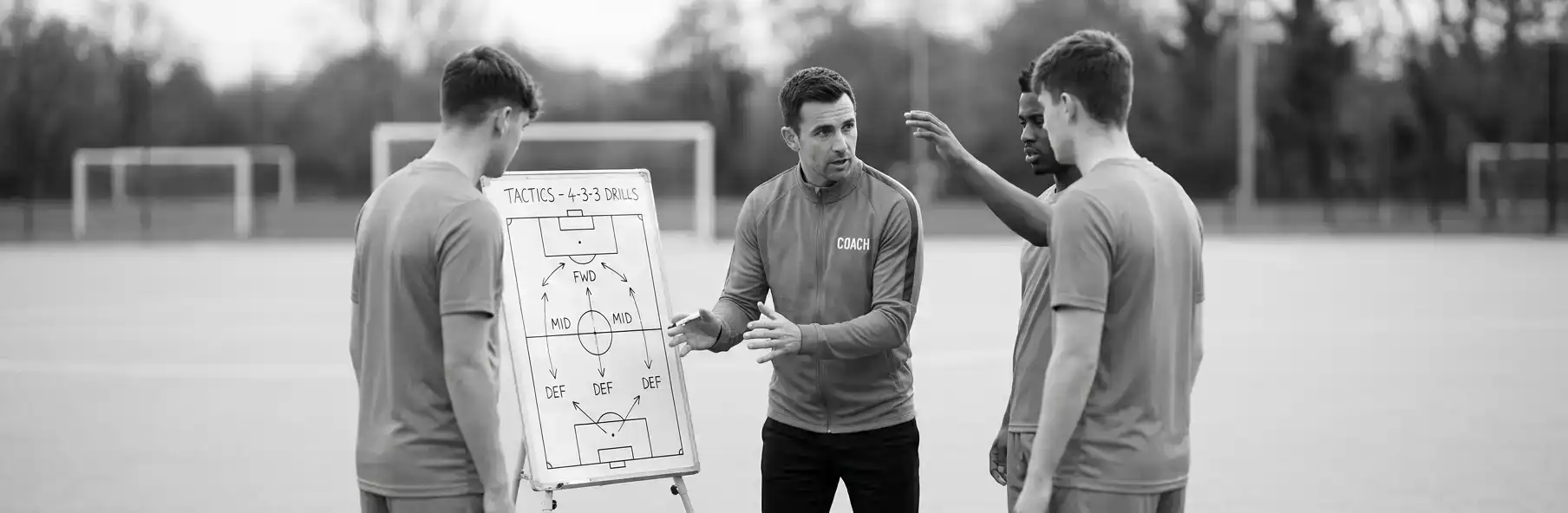
Football Pre-Season Without Friendlies: Test Your Tactical System in Training
Not enough pre-season friendlies to test your football team's system? Learn how to install and confirm your tactics through structured training drills.
Written by
João Araújo
Physical Education Teacher (FADEUP – University of Porto) · Futsal Coach – Level II · UEFA B License · Master’s in Physical Education
15 years teaching Physical Education in schools, 20 years coaching futsal at youth development level and 5 years coaching football. Federated and amateur football and futsal player.
Not every non-league or amateur football club can line up five or six friendlies before the season kicks off. Limited opposition, travel costs, or a packed fixture list leave plenty of managers with two, maybe three friendlies to trial everything they’ve planned in pre-season.
The problem isn’t the shortage of matches itself. it’s confusing “testing the system” with “playing friendlies”. A system is installed on the training pitch, through drills with opposition and clear coaching points. Friendlies confirm it; they don’t teach it.
Why Friendlies Alone Aren’t Enough
In a 60- or 70-minute friendly, each tactical principle only comes up a handful of times, and in a context you don’t control. The opposition might sit in a low block for the whole match and never test your build-up play against a high press. Without isolated repetition, players memorise a response to that specific opponent rather than internalising the principle.
On the training pitch, you control the trigger: how many times the squad builds out against high pressure, how many times they defend in a mid-block, how many times they finish from the wide channel. That controlled, varied repetition is what fixes the system. not the friendly’s scoreline.
Principles for Testing the System in Training
- Isolate before combining: work on defensive organisation and attacking organisation in separate drills before merging them into a conditioned game.
- Involve the goalkeeper from day one: if the system depends on building out from the back, the goalkeeper takes part in every build-up drill, not just the friendlies.
- Set clear success criteria: “build out in four passes to the halfway line” beats a vague “play well”.
- Test the transition, not just the settled phase: whoever loses the ball in the drill must react according to the system (counter-press or reorganise), not just stop the exercise.
Practical Application: A 3-Week Sequence
| Week | Focus | Sample drill |
|---|---|---|
| 1 | Positional organisation, no opposition | Positional rondo + 8v2 possession game |
| 2 | Reduced opposition | 6v6+GK conditioned game with finishing zones |
| 3 | Match-realistic context | 8v8 small-sided game on a full-size pitch + 1-2 friendlies to confirm |
In the final two sessions before matchday one, the goal shifts: it’s no longer about installing the system, it’s about confirming it under fatigue and time pressure. The two variables a single training drill can never fully replicate.
🔧 Useful Tool
With no friendlies to trial every variant of your system, the drill design itself carries more weight. The SportsLabTools Tactical Board lets you draw and save each principle. build-up, pressing triggers, transitions. so you repeat the training sequence with precision week after week.
Common Mistakes to Avoid
- Testing the system only in small-sided games and never taking it to a full-size pitch.
- Ignoring set pieces within the system’s logic (who stays back, who starts the counter-attack).
- Trying to install everything in one session: attacking organisation, defensive organisation and transitions at once creates cognitive overload and no principle lands clearly.
- Judging the system by the friendly’s result instead of the training criteria set beforehand.
See also: Installing a New Tactical System in Football Pre-Season Without Wasting Time. A deeper dive into the step-by-step installation sequence.
Checklist: Testing a Tactical System Without Enough Friendlies
- Attacking and defensive organisation drilled separately before combining
- Goalkeeper included in every build-up drill
- Success criteria defined per drill, not just “play well”
- Attacking and defensive transitions built into conditioned games
- 3-week sequence planned through to matchday one
- Set pieces integrated into the system’s logic
- Remaining friendlies used to confirm, not to install
Conclusion
A shortage of friendlies is no excuse to arrive at matchday one with an unpolished system. If anything, it’s an argument for more structured, more deliberate training. Managers who rely on matches to teach get little out of them; managers who teach on the training pitch use matches only to confirm.
Structure every tactical installation session without depending on friendlies. Use the SportsLabTools Tactical Board to draw and repeat your system’s principles with precision.
Optional accelerator · the tool is always free
A library of exercises instead of drawing every one
Packs of 40 exercises per theme, with an animated tactical diagram, four levels of progression, teaching points and success criteria. Import them and they stay in your library, ready to edit and present to the team.