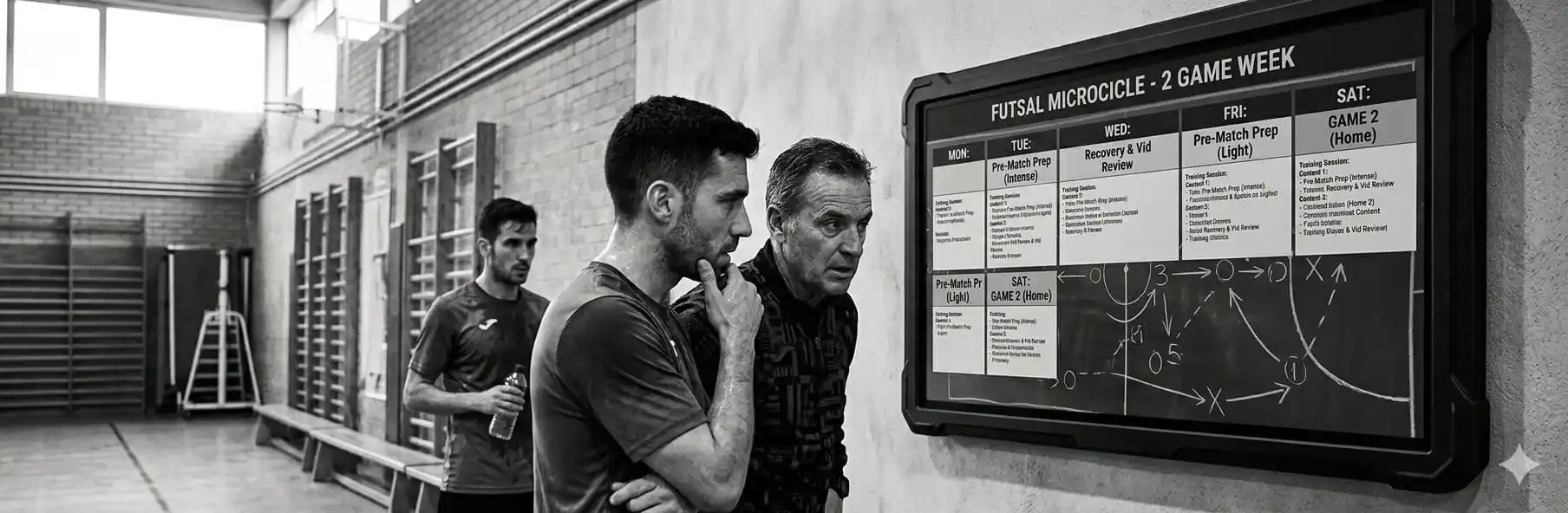
How to Build the Perfect Futsal Microcycle for Double Matchweeks
Learn how to structure your futsal training microcycle during double matchweeks: how to split sessions between recovery, tactics and pre-match activation without burning out your squad.
Written by
João Araújo
Physical Education Teacher (FADEUP – University of Porto) · Futsal Coach – Level II · UEFA B License · Master’s in Physical Education
15 years teaching Physical Education in schools, 20 years coaching futsal at youth development level and 5 years coaching football. Federated and amateur football and futsal player.
A double matchweek is the ultimate test of a futsal coach’s planning ability. When the fixture list crams two games into seven days, the easy. But destructive. Path is to keep your normal training rhythm and hope the players hold up. The predictable outcome: accumulated fatigue, muscular injuries, and a second half of the second game played at half intensity.
There is a smarter way to manage this week. And it starts with understanding that total training load must decrease when the number of matches increases.
Why Double Matchweeks Are a Different Challenge
In amateur futsal, most players train twice a week and play at the weekend. Their recovery capacity is calibrated to that pattern. When a double matchweek arrives, that pattern breaks: instead of one competitive effort, they now face two. And the recovery window between them may be just three to four days.
Sports science is clear on this: a minimum of 48 to 72 hours is required between high-intensity efforts for muscular and central nervous system fatigue markers to return to baseline. An intense training session mid-week, when the second match falls on Thursday, directly compromises performance quality.
The key takeaway: cutting volume is not tactical weakness. It is intelligent planning.
The Double Matchweek Microcycle Structure
There is no single solution. It depends on each week’s specific fixture schedule. But the structural principles remain constant: recovery after each match, a low-intensity tactical session midweek, and a pre-match activation session the day before.
Practical Example: Match on Wednesday and Saturday
This is one of the most common scenarios in amateur national futsal. A midweek fixture and a weekend fixture.
| Day | Session Type | Intensity | Duration |
|---|---|---|---|
| Monday | Active recovery / rest | Very low | 30 min (optional) |
| Tuesday | Tactics + individual technique | Low-medium | 60-70 min |
| Wednesday | MATCH | Competitive | . |
| Thursday | Active recovery | Very low | 30-40 min |
| Friday | Activation + set pieces | Low-medium | 50-60 min |
| Saturday | MATCH | Competitive | . |
| Sunday | Rest / passive recovery | . | . |
The Polarisation Principle
High-intensity days must be separated by clearly low-intensity days. There is no middle ground in a double matchweek. Tuesday and Friday sessions cannot be “medium”. They must be deliberately controlled to preserve the physical and mental reserves of your athletes for match days.
Low-intensity days are not wasted days. They are sessions of cognitive work: video review, tactical adjustments, technical drills without pressure, tactical group communication. Running volume can be minimal, but the mental investment is total.
The Most Common Mistakes in Double Matchweeks
After years working in youth development and amateur competition, the same error patterns emerge:
- Keeping the same volume as a normal week: two 90-minute high-intensity sessions plus two matches is a guaranteed recipe for cumulative fatigue
- No recovery session after the first match: fatigued muscle that doesn’t recover underperforms and is far more likely to sustain injury
- Introducing new tactical content before the second match: a double matchweek is not the time for new ideas. It’s the time to consolidate what already exists
- Underestimating mental fatigue: two matches in five days exhausts not just the body but the capacity for concentration and decision-making
🔧 Useful Tool
Structure your team’s microcycle with the SportsLabTools Futsal Planning Tool. Define each training session, daily objectives and load indicators. All in one place. In double matchweeks, visualising the complete microcycle is the first step to making smart choices about volume and intensity.
How to Reduce Volume Without Losing Tactical Identity
Cutting volume does not mean abandoning your game model. The key is selecting the essential content and working it with more focus and less repetition.
Practical rule: in double matchweeks, reduce total training volume by 20 to 30% compared to a normal week. If you normally deliver 100 minutes of effective training per week, drop to 70-80 minutes.
What to prioritise:
- Set-piece routines. Minimal physical demand, high competitive impact (for example, rehearsing just 2 prepared attacking corner variants instead of running the full system)
- Static defensive organisation. Positioning and communication without intensive running
- Reduced finishing drills. Quality over volume of shots
- Opposition video review. Tactical content with no physical cost
What to defer to normal load weeks:
- Pure fitness or high-intensity physical exercises
- New tactical systems or complex patterns
- Long training matches with high minutes per player
Communicating the Plan to Your Squad
One frequently overlooked aspect: players need to understand why training is shorter and less intense in a double matchweek. Without that explanation, a shorter session can be interpreted as disorganisation.
Communicate clearly: “We’ve got two games this week. Tuesday’s session is short and technical so you arrive at Wednesday’s match with fresh legs.” This has two benefits: it manages expectations and reinforces a group culture built around intelligent planning.
See also: The Difference Between Volume and Intensity: What Your Data Says. To understand how to measure and interpret training loads throughout the season.
Checklist: Double Matchweek
- Active recovery session the day after the first match (max 30-40 min)
- Total volume reduced 20-30% compared to standard week
- No high-intensity training between the two matches
- Low-intensity tactical session midweek
- Short activation session the day before the second match
- Zero new or complex content introduced this week
- Squad briefed on the rationale for the reduced microcycle
Conclusion
Managing a double matchweek is not a matter of luck. It is a deliberate technical decision that begins the moment the fixture list is published. The team that arrives at the second match physically capable and mentally focused is not the one that trained most. It is the one that trained most intelligently.
Plan your next double matchweek microcycle with the SportsLabTools Futsal Planning Tool. Define each session, adjust volume and ensure your squad arrives at the second match in the best possible state of preparation.
Optional accelerator · the tool is always free
Start the season with the whole year already planned
Macrocycle, monthly mesocycles and weekly microcycles with the real season dates, sessions categorised by focus and technical-tactical blocks, and exercises with animated diagrams. From U11 to Seniors, 1 to 5 sessions per week.