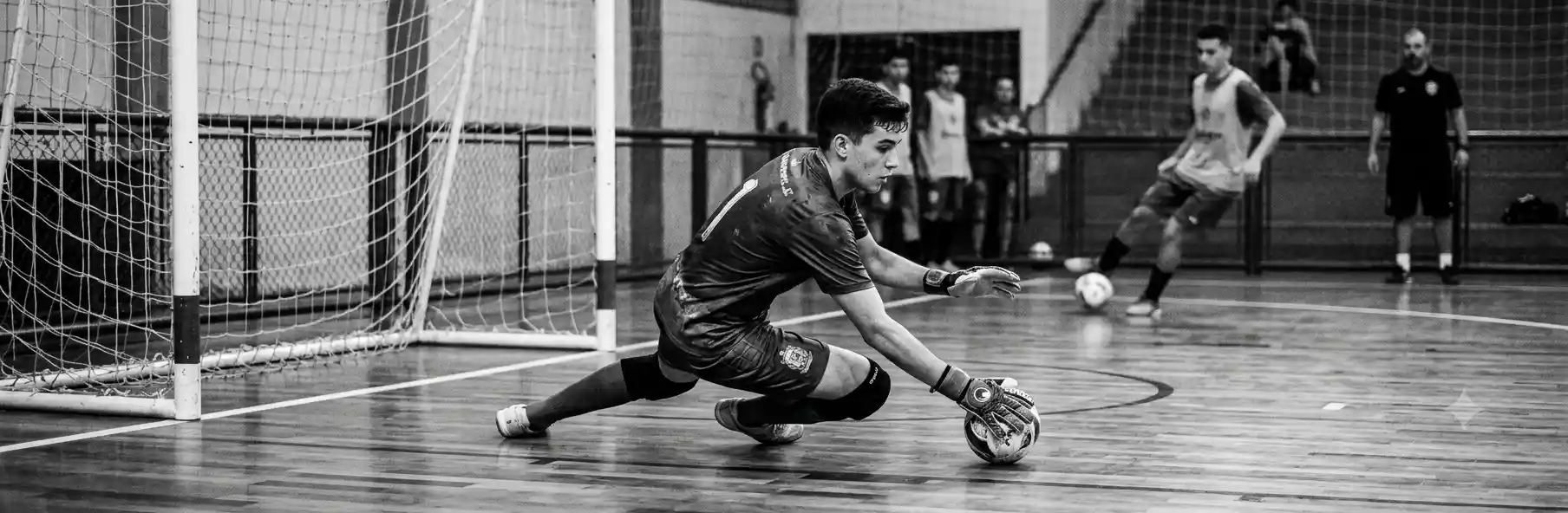
Futsal Goalkeeper Training: How to Structure Your Number 1's Week
Weekly training plan for the futsal goalkeeper: blocking technique, distribution, power-play involvement and how to integrate the GK into team training.
Written by
João Araújo
Physical Education Teacher (FADEUP – University of Porto) · Futsal Coach – Level II · UEFA B License · Master’s in Physical Education
15 years teaching Physical Education in schools, 20 years coaching futsal at youth development level and 5 years coaching football. Federated and amateur football and futsal player.
The goalkeeper is involved in more than 50% of the decisive defensive actions in a futsal match. And at most amateur clubs he trains exactly like the outfield players, plus half a dozen shots at the end. It’s the most decisive position in the sport and the most neglected in weekly planning. In a game where the goal sits 3 metres from the shot and the 1v1 with the pivot decides matches, an untrained goalkeeper is a low ceiling for the whole team.
The good news: you don’t need a full-time goalkeeping coach to structure a proper week. You need method and 20-30 specific minutes per session.
Why Futsal GK Training Is a Different Challenge
The futsal goalkeeper is not a football goalkeeper on a small pitch. The demands are specific: saves with feet and legs from point-blank range, the low block in the 1v1, the rapid throw that launches the counter-attack, distribution as a fifth outfield player in the press break. And, against the power play’s goalkeeping outfield player, constant reading of a permanent numerical inferiority.
Training science applies to him with one nuance: the GK’s actions are explosive, short and neuromuscularly demanding. Volume matters less than the quality and specificity of the repetitions. Ten quality blocks under controlled fatigue beat fifty random shots tacked onto the end of team training.
The Plan: The Goalkeeper’s Week in 3 Blocks
| Day | Block | Content | Duration |
|---|---|---|---|
| Session 1 (far from matchday) | Core technique | Blocks, footwork, 1v1 | 25-30 min before team training |
| Session 2 | Distribution + integration | Press break, throws, team training | 15 min + full session |
| Session 3 (pre-match) | Situational | Set pieces, power play, reactions | 15-20 min |
Step 1: Core Technique Block (Session 1)
The day furthest from the match is the technical loading day. Build in progression: lateral footwork with short steps (the foundation of everything in futsal), the low block with leg and hand (low drives from 6-8 metres), 1v1 defending against a dribbling attacker (delay, close down, block) and get-up-and-save-again work. The double save is routine in futsal, not the exception. Finish with realistic shooting series from winger and pivot positions (for example, 3 sets of 8 shots, with 30 seconds’ recovery between sets) with the GK already fatigued: that’s how he’ll be defending in minute 35.
Step 2: Distribution and Team Integration (Session 2)
Fifteen specific minutes before the group session: receiving under pressure, short passing with both feet, the long counter-attack pass (fast overarm throw and the clipped ball over the first pressing line). Then the most important part: the GK joins ALL of the team’s press-break drills as a genuine outfield player. The goalkeeper who only trains to save will never be the fifth element of build-up that modern futsal demands.
Step 3: Situational Block (Pre-Match Session)
The eve or final session before the game: low volume, high specificity. Defending the opponent’s scouted corners and kick-ins (with the squad reproducing the routines identified in scouting), behaviour in the defensive power play (communication with the quartet, when to step out to the goalkeeping outfield player) and short reaction games to activate without fatiguing. It’s also the moment for the tactical talk: what to expect from the takers and the opponent’s shooting patterns.
The Most Common Amateur GK Training Mistakes
- The GK as target practice. The outfield players’ finishing drills are not goalkeeper training; without technical intent, it’s just wear and injury risk
- Ignoring distribution. In modern futsal the GK touches the ball more with his feet than his hands; excluding him from possession drills trains half a position
- Uncontrolled diving volume. A futsal GK’s hips and knees take a beating; count dives per session the way you count sprints for outfield players
- Zero training for the second GK. The backup who never trains as a starter fails when called upon; alternate the leading role in the technical blocks
- No video feedback. The GK is the easiest position to film in a sports hall and the one that benefits most from reviewing positioning
🔧 Useful Tool
The GK’s specific block only survives if it’s written into the weekly plan. With the SportsLabTools Planning tool you build the goalkeeper’s three blocks into the team’s microcycle and guarantee those 25 specific minutes don’t vanish when the week gets tight.
Adapting to Context: Youth Football and Short Squads
At youth level (U13 to U17) the ratio flips: more core technique, less situational specialisation. And extra care with growth: diving and impact volume adjusted to developing bodies. In senior squads with only one quality GK, recruit an injured outfield player or the team manager to feed the drills: the quality of the service (realistic shots, not vanity blasts) defines the quality of the block.
Also read: How to Analyse Futsal Goalkeeper Statistics: Beyond the Save Count. The data that tells you whether your GK training plan is producing results.
Checklist: Your Goalkeeper’s Week
- 25-30 min technical block in the session furthest from the match
- Footwork and low block trained weekly
- GK integrated into every press-break drill
- Distribution with both feet every week
- Pre-match situational block with the opponent’s set pieces
- Diving volume counted and controlled per session
- Second goalkeeper given defined leading-role time
Conclusion
The goalkeeper who makes the impossible save in minute 39 wasn’t inspired. He was rehearsed. Structuring your number 1’s week costs 60-75 specific minutes and returns direct points: fewer 1v1 goals conceded, cleaner press breaks, set pieces defended with criteria. That’s not luck. It’s deliberate planning of futsal’s most decisive position.
Write your GK’s blocks into the weekly plan. Use the SportsLabTools Planning tool to structure the full microcycle, goalkeeper included.
Optional accelerator · the tool is always free
Start the season with the whole year already planned
Macrocycle, monthly mesocycles and weekly microcycles with the real season dates, sessions categorised by focus and technical-tactical blocks, and exercises with animated diagrams. From U11 to Seniors, 1 to 5 sessions per week.