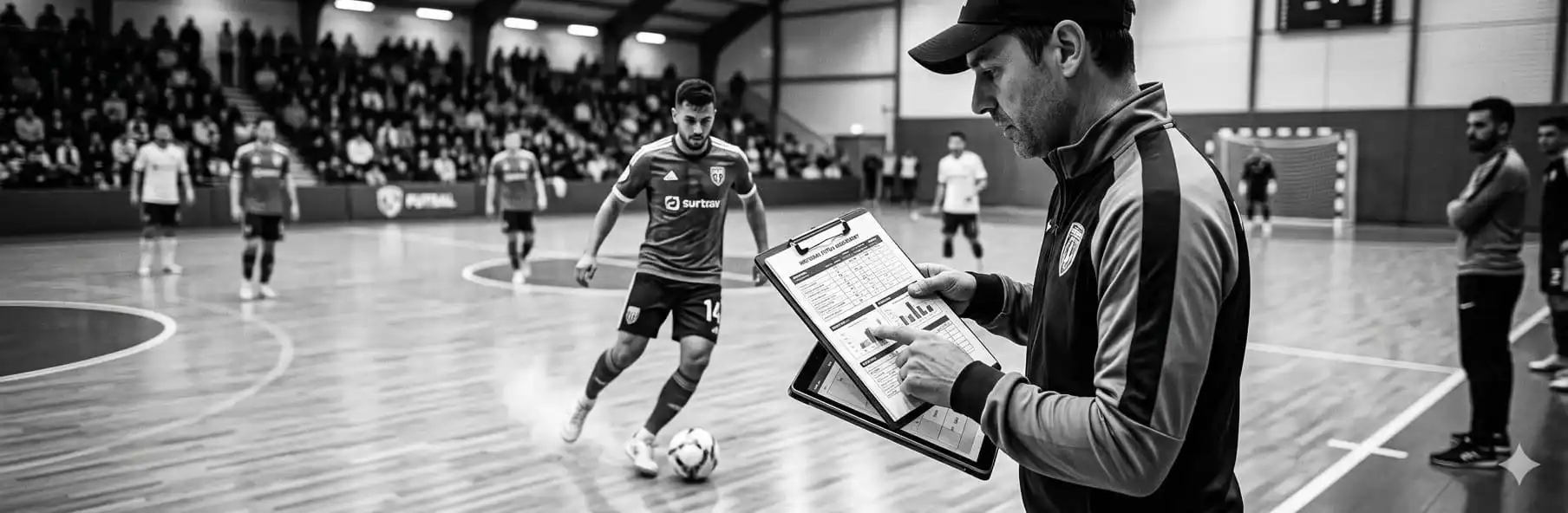
The Futsal Individual Player Assessment Card: How to Track Your Players' Development
A complete guide to creating and using a futsal individual assessment card: technical, tactical and psychological parameters to monitor athlete development throughout the season.
Written by
João Araújo
Physical Education Teacher (FADEUP – University of Porto) · Futsal Coach – Level II · UEFA B License · Master’s in Physical Education
15 years teaching Physical Education in schools, 20 years coaching futsal at youth development level and 5 years coaching football. Federated and amateur football and futsal player.
The season ends and a parent asks for an explanation: “My son trained all year. Why hasn’t he improved?” Without recorded data, your answer is subjective. With a structured individual assessment card, you can objectively demonstrate the starting point, the progress made and the areas still requiring work.
The individual assessment card is not a bureaucratic document. It is a technical leadership tool that transforms impressions into evidence and converts feedback into a process of continuous improvement.
Why Individual Assessment Is Non-Negotiable in Youth Development
In youth futsal, the primary product a club delivers is not competitive results. It is improved players. The central question for any technical director should be: by how much did each athlete improve between September and June?
Without a structured assessment card, this question has no objective answer. The coach relies on memory and subjective impression, which creates two serious problems:
- Imprecise feedback for the player and family, who cannot understand what to work on
- Loss of continuity when a player changes coach or moves up an age group. The new coach starts from scratch with no developmental history
A well-constructed card solves both problems and adds a further benefit: regular assessment improves the player’s self-awareness about their own game.
The Four Pillars of the Assessment Card
Pillar 1. Technical Parameters
These are the execution skills with and without the ball. In futsal, the essential technical parameters to assess include:
- Passing: accuracy, decision speed, variety (short, long, through ball)
- Reception and control: oriented control, receiving under pressure, first touch in tight spaces
- Ball carry: at speed, with direction changes, under opponent pressure
- Shooting: with dominant foot, with weak foot, first time, after receiving
- 1v1 attacking: ability to create space, creativity, effectiveness
Suggested scale: 1 to 5 (1 = below age-group expectations; 5 = above age-group expectations)
Pillar 2. Tactical Parameters
These are collective game behaviours. The ability to read the game and make correct decisions.
- Positioning without the ball: covering space, supporting the ball carrier, width
- Decision-making: speed and quality of decisions in different situations
- Transitions: defensive behaviour after losing possession and offensive behaviour after winning it
- Defensive organisation: marking, covering, collective pressing
- On-court communication: verbal leadership, positional calls, organising teammates
Pillar 3. Physical Parameters
In a youth context, the objective is not to rank players athletically. It is to record motor development and the capacity to maintain intensity:
- Reaction speed: response time to game stimuli
- Intensity endurance: capacity to maintain pace in the final ten minutes
- Strength and stability: resistance in duels, positional stability
Pillar 4. Psychological and Behavioural Parameters
This pillar is frequently overlooked, yet it is the one that most differentiates athletes in the long run:
- Training attitude: commitment, concentration, willingness to learn
- Response to adversity: reaction to errors, to conceded goals, to losing situations
- Team spirit: relationship with teammates, positive communication, ability to accept criticism
- Independent study: does the player watch matches and reflect on their own performance?
🔧 Useful Tool
Use the SportsLabTools Athlete Journal to record individual assessments throughout the season and track each player’s development. The record history becomes your strongest argument in conversations with players and families. And the most precise guide for planning individual work for each athlete.
When and How Often to Assess
A single assessment has no tracking value. The power of the card lies in comparison over time. The recommended approach for a youth development context:
| Moment | Assessment Type | Objective |
|---|---|---|
| Start of season (Sept/Oct) | Full assessment of all parameters | Individual baseline |
| Mid-season (Dec/Jan) | Full reassessment | Measure progress, refocus work |
| End of season (May/June) | Final assessment | Season review, transition planning |
| Specific moments (ad hoc) | Targeted parameters | After intensive work on a specific area |
The mid-season assessment is particularly valuable: it gives the athlete time to act on feedback before the season ends.
How to Communicate Results to the Player and Family
How you present results matters as much as the data itself. Effective practices:
- Always present progress, not just absolute level: “Jamie improved by 1 point in decision-making since October” is more motivating and more useful than “Jamie is at level 3 in decision-making”
- Identify two strengths and two areas for improvement per assessment. Avoid overwhelming with negative feedback
- Involve the player in the analysis: “What do you feel you’ve improved most this period?”. The player’s self-awareness is itself a valuable indicator
- Align expectations with the family: what the club can develop, and what depends on the player’s individual work outside of training
See also: What Scouts Look for in a Young Futsal Player. To understand which parameters professional scouts value most and how to align your assessments with the elite player profile.
Checklist: Futsal Individual Assessment Card
- Technical parameters defined and calibrated for the age group (scale 1-5)
- Tactical parameters specific to the club’s game model
- Physical parameters adjusted to expected capabilities by age band
- Psychological and behavioural parameters included in the card
- Initial assessment completed by end of October
- Mid-season reassessment completed in December/January
- Final assessment completed before season end
- Feedback communicated individually to each player
- Meeting with parents/guardians at least twice during the season
- Assessment history preserved for handover to the next coach
Conclusion
The individual assessment card is the most honest document a youth coach can create. It transforms futsal training into a process with measurable starting points, milestones and endpoints. And gives each athlete what they need most to grow: clarity about where they are and where they need to go.
Start tracking your athletes’ development today. Use the SportsLabTools Athlete Journal to build and maintain each player’s assessment history throughout the entire season.