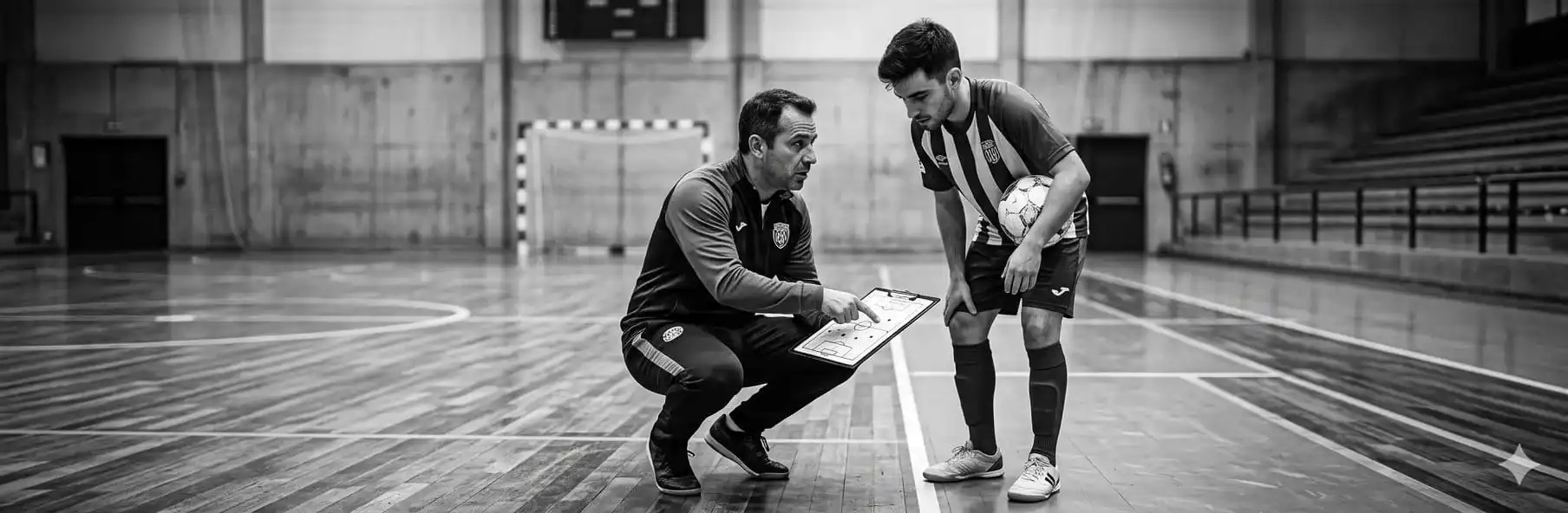
The Coach's Guide to Mapping and Correcting Your Libero's Decision-Making Errors in Futsal
How to analyse and correct the tactical errors of the futsal libero: the visual cues they must read, the most common decision-making errors and how to record individual data to accelerate correction.
Written by
João Araújo
Physical Education Teacher (FADEUP – University of Porto) · Futsal Coach – Level II · UEFA B License · Master’s in Physical Education
15 years teaching Physical Education in schools, 20 years coaching futsal at youth development level and 5 years coaching football. Federated and amateur football and futsal player.
The libero (defensive pivot / back player) is the most undervalued yet most critical position in modern futsal. They close the central corridor when the defensive organisation breaks down, decide when to press or drop to cover, and read tactical imbalances to start offensive transitions. A libero with systematic decision-making errors exposes the team on every sequence of play.
The problem: libero errors are rarely obvious to the naked eye in real time. They are subtle, contextual and often visible only in retrospect. Mapping and correcting them therefore requires a system. Not intuition.
The Visual Cues the Libero Must Read
Cue 1. Ball Position Relative to the Central Corridor
When the ball is in wide areas during an opposition attack, the libero must be in the central corridor blocking the most dangerous pass line. The pass to the opposition pivot behind the defence. The golden rule: the libero never chases the ball laterally. They close the central corridor and force the opposition into the pressure of the wide players.
Cue 2. The Timing of the Press Exit
When to step out and press the ball-carrier, and when to stay in cover? The libero should press when:
- The opponent receives with their back to goal
- The opponent’s decision time increases (under pressure from a wide player)
- Stepping out creates a defensive numerical advantage (2v1)
The libero should not press when stepping out leaves a space exploited by the opponent’s teammates, or when the ball reaches a player facing forward with positional advantage.
Cue 3. Cover After Defensive Imbalance
When a teammate leaves their defensive position (in a duel, in a press, at a set piece), the libero is the team’s defensive “firefighter”. They must read the imbalance before it happens and position themselves to cover the space before the opponent occupies it.
This is the hardest behaviour to coach because it requires anticipatory game-reading. Not reactive. It is the difference between the libero who thinks three moves ahead and the one who reacts to what has already happened.
🔧 Useful Tool
Record the tactical errors and individual behaviours of your libero in the SportsLabTools Athlete Journal. Log error patterns by session and match, track progress throughout the season and use the data to build a personalised correction plan. Data-supported feedback makes conversations with the athlete far more effective.
The Most Common Decision-Making Errors
Error 1. Premature Press in Numerical Equality
The libero sees an opponent with the ball and steps out. But leaves the central corridor open for the breakaway pass. This happens most often with offensive-profile liberos who haven’t internalised the “cover before pressing” principle.
Correction: 2v2 drills where the libero is penalised (goal counts double) every time they press and leave the central corridor exposed.
Error 2. Overly High Position in Attack
The libero participates in the attacking build-up and loses time returning to defensive position when the ball is lost. This systematically exposes the defensive transition and is one of the main causes of goals conceded on the counter.
Correction: clear “libero line” rule. Maximum attacking position defined in training, with the coach signalling every infringement.
Error 3. Passive Cover (Waiting Instead of Anticipating)
The libero is in position but doesn’t take the initiative to reduce space as the opponent approaches. Waits for the problem to arrive rather than anticipating the movement.
Correction: 3v3 drills with explicit focus on the libero’s compacting movements. The success criterion is anticipation, not reaction.
Error 4. Insufficient Defensive Communication
The libero has the best reading of the pitch when the ball is in wide areas. Not using that vision to organise teammates verbally weakens collective defensive cohesion.
Correction: integrate verbal communication as a training evaluation criterion. The libero who doesn’t communicate in specific situations receives immediate feedback, even if their physical positioning is correct.
Error Mapping Process
| Error Type | Frequency (1-5) | Correction Exercise | Sessions Required |
|---|---|---|---|
| Premature press | . | 2v2 with central corridor penalisation | 3-4 |
| High attacking position | . | Libero line rule with signalling | 4-6 |
| Passive cover | . | 3v3 anticipation focus | 3-5 |
| Communication deficit | . | Verbal criterion in training | Ongoing |
See also: Individual Marking Errors: How Video Can Help Your Wide Player
Conclusion
The libero who makes correct decisions in critical moments is not the product of innate talent. They are the product of deliberate training, specific feedback and systematic error pattern recording. The coach who maps individual errors with rigour can build a correction plan that transforms concrete weaknesses into correct automatisms.
Record your libero’s decision patterns in the SportsLabTools Athlete Journal. Track week-by-week progress and use the data to make tactical correction a systematic, measurable process.