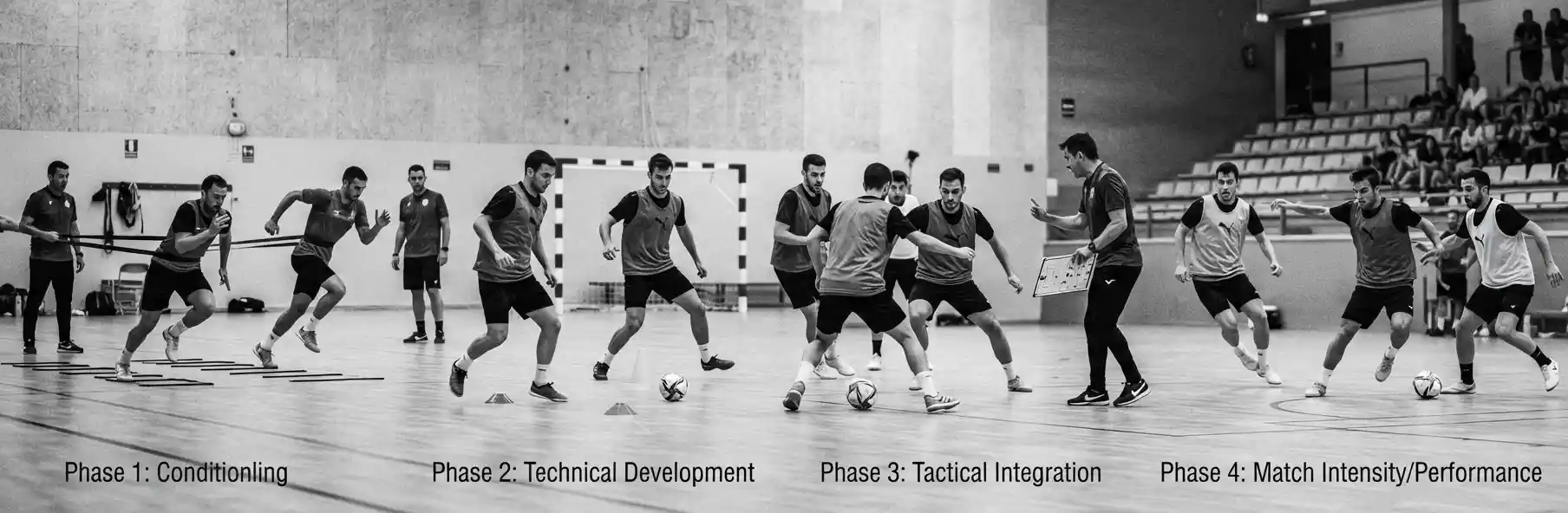
Futsal Pre-Season Periodization: The 4 Phases to Peak by Matchday One
How to structure futsal pre-season periodization into 4 phases, from general conditioning to match intensity, even with limited court access.
Written by
João Araújo
Physical Education Teacher (FADEUP – University of Porto) · Futsal Coach – Level II · UEFA B License · Master’s in Physical Education
15 years teaching Physical Education in schools, 20 years coaching futsal at youth development level and 5 years coaching football. Federated and amateur football and futsal player.
A futsal squad needs a minimum of 3 to 4 weeks of structured work to arrive at matchday one with the physical and tactical foundation required to compete. Rushed, or without clear phases, the usual outcome is players who show up “tired but not ready”, muscle injuries in the opening weeks of competition, and a tactical system that still hasn’t been internalised once points are on the line.
Futsal pre-season has a quirk that sets it apart from other sports: court access is usually limited, often shared with other teams or codes. That forces you to compress into a short window what, with more training hours, would be built more gradually. Periodization can’t be generic. It has to be designed phase by phase, with very specific goals in each one.
Why Futsal Pre-Season Is a Different Challenge
Futsal demands a rare combination: lactic anaerobic power (short, high-intensity efforts), constant agility and change of direction, and at the same time a highly demanding tactical positioning and game-reading component. Building all three at once, in 3-4 weeks with 3-4 court sessions a week, requires a logical sequence. There’s no point drilling reaction speed for high pressing if the squad doesn’t yet have the endurance base to sustain 40 minutes at that intensity.
The Plan: The 4 Phases of Futsal Pre-Season
| Phase | Duration | Main Focus | Intensity |
|---|---|---|---|
| 1. General Physical Base | Week 1 | Aerobic conditioning, general strength, mobility | Low-Medium |
| 2. Base Tactical Acquisition | Week 2 | Main tactical system, game principles | Medium |
| 3. Specific Intensity | Week 3 | Match-intensity game actions, set pieces | Medium-High |
| 4. Fine-Tuning and Friendlies | Week 4 | Match simulation, final adjustments, minute management | High |
Phase 1: General Physical Base
In this first week, the goal isn’t the tactical system. It’s preparing the body for the volume that follows. Aerobic endurance work (circuits, low-intensity small-sided games), general strength (core, lower limbs), and joint mobility. Few exercises with real match-context ball work; more individual and paired technical work.
Phase 2: Base Tactical Acquisition
With the physical base installed, introduce the tactical system the squad will use for the season (3-1, 2-2 or 4-0). The focus is understanding the principles. Rational occupation of space, support triangles, breaking the press. Rather than execution speed. Small-sided games and analytical drills with frequent stoppages to correct positioning.
Phase 3: Specific Intensity
Now raise the intensity of the repetitions: the same tactical principles from Phase 2, but now at match pace, under time and opponent pressure. This is also the time to work on set pieces (corners, kick-ins, free kicks) and numerical superiority/inferiority situations (5v4, 4v5).
Phase 4: Fine-Tuning and Friendlies
Final adjustments before matchday one. Practice matches or friendlies against other teams to test the system under real conditions, manage minutes for every player, and identify gaps that only surface in genuine competitive context.
The Most Common Pre-Season Periodization Mistakes
- Jumping straight to maximum intensity in week one. Sharply increases the risk of muscle injury (hamstrings, adductors).
- Spending too much time on ball-less analytical work. Demotivates the squad and doesn’t transfer to real match play.
- Not reserving time for set pieces. They account for a significant share of goals scored and conceded early in the competition.
- Ignoring individual load management. Players coming back from injury or inactivity need a differentiated progression.
🔧 Useful Tool
Structuring 4 distinct phases in a few short weeks requires visibility over what’s been trained and what’s still missing. The SportsLabTools Planning Tool lets you design each phase’s microcycle, assign goals per session, and track load progression without losing the thread.
Adjusting the Plan to Available Court Time
Not every club has daily court access. If the squad only trains 3 times a week, each phase should be compressed or extended. The principle (gradual progression) stays the same, but the number of sessions per phase adapts to the club’s reality. Always prioritise Phase 1 and Phase 2: without a physical base and a minimal tactical system, Phase 3 and 4 have nothing to build on. For example, a club with court access only on Tuesday, Thursday and Saturday can compress Phases 1 and 2 into a single week (two physical-base sessions plus one tactical-introduction session), reserving the next two weeks solely for Phases 3 and 4 — never the reverse.
See also: Planning a 4-Week Futsal Pre-Season with Limited Court Time. The companion guide for clubs with restricted court access.
Checklist: Futsal Pre-Season Periodization
- Set the total pre-season duration and split it into 4 phases
- Phase 1 focuses exclusively on general physical base
- Tactical system only introduced in Phase 2
- Set pieces trained in Phase 3
- At least 1 friendly scheduled in Phase 4
- Individualised load progression for players returning from injury
- Goals for each phase documented and communicated to the squad
Conclusion
A successful futsal pre-season isn’t the one with the most training hours. It’s the one that respects the logical sequence between physical base, tactical acquisition, and competitive intensity. Arriving at matchday one in shape is a planning decision, not a matter of luck.
Structure your pre-season phase by phase without losing control of the process. Use the SportsLabTools Planning Tool to design and track each of the 4 phases.
Optional accelerator · the tool is always free
Start the season with the whole year already planned
Macrocycle, monthly mesocycles and weekly microcycles with the real season dates, sessions categorised by focus and technical-tactical blocks, and exercises with animated diagrams. From U11 to Seniors, 1 to 5 sessions per week.