Groin Pain in Futsal: Preventing It With Adductor Strengthening
Groin pain is one of the most stubborn injuries in futsal. Why indoor courts punish the adductors, a 5-second test to spot it and the Copenhagen protocol.
Written by
João Araújo
Physical Education Teacher (FADEUP – University of Porto) · Futsal Coach – Level II · UEFA B License · Master’s in Physical Education
15 years teaching Physical Education in schools, 20 years coaching futsal at youth development level and 5 years coaching football. Federated and amateur football and futsal player.
In futsal, groin pain is the injury that costs players the most time without ever quite taking them out of the game. That’s what makes it dangerous. The winger keeps training, keeps playing, drags the pain along for weeks, until the day he can no longer shoot or accelerate. By then the lay-off isn’t two weeks. It’s two months.
Anyone coaching a futsal team knows the pattern: a player turns up at the sports hall, jogs through the warm-up with a slight limp, “warms into it” and then plays normally. The next morning he wakes up with a stiff groin. And repeats.
The good news is that there’s an exercise with solid evidence for reducing this problem, and a five-second test that lets you catch it long before it becomes serious.
Why Futsal Punishes the Groin So Much
Futsal brings together every ingredient that overloads the adductors. Constant changes of direction in a tight space. Sharp braking on a surface that doesn’t forgive, unlike grass. Ball control with the sole of the foot, which makes the leg work in abduction and adduction dozens of times per match. Toe-pokes and side-foot passes, often with no time to set the body.
Then there’s the rhythm. In a futsal match, a winger makes a high-intensity effort every few seconds during his shift, and that stop-start pattern is exactly what demands most from the adductors, which act as the hip’s lateral brakes.
A pivot defender who spends the game low, defending the 1v1 side-on, suffers one way. A pivot who plays with his back to goal and turns on the spot suffers another. But no position escapes.
Two more factors rarely come up. The first is the floor. A well-maintained sprung sports floor absorbs some of the impact; a council leisure centre with old wooden boards or painted concrete doesn’t. Teams that play away in halls very different from their own feel it over the following weeks. The second is footwear. Worn indoor trainers with smooth soles make the player brake with more muscular force because the foot slides. It looks like a detail. It isn’t.
Then there’s the September load spike. After six weeks off, futsal pre-season crams high volumes of changes of direction into a few days. Most groin complaints show up in the first four to six weeks, before the body has adapted. If you only have budget for one preventive habit, start it in the first week of pre-season, not after the first player complains.
“Groin Pain” Isn’t a Single Diagnosis
“Groin strain” or “pubalgia” is dressing-room shorthand for a set of different problems. The most widely used international classification today splits groin pain into four main groups: adductor-related, iliopsoas-related, inguinal-related and pubic-related.
In futsal, adductor-related pain is by far the most common. It sits on the inside of the thigh, near where the muscle attaches to the pubic bone, and gets worse when squeezing the legs together or shooting.
This matters because what follows is mainly about preventing adductor problems. If a player has pain higher up, around the lower abdomen, or pain that doesn’t get worse when squeezing the legs, that’s a conversation for the physio or doctor, not the strength coach.
The 5-Second Test That Spots It Early
The adductor squeeze test is the best friend of a coach without a medical department. The player lies on his back, knees bent at 45 degrees, and places a teammate’s closed fist (or a small ball) between his knees. He squeezes as hard as he can for five seconds.
Then he gives a number from 0 to 10 for the pain he felt.
We do this test every Monday or Tuesday at the start of training, with the whole squad. It takes three minutes. The rules are simple:
- 0 to 2: normal, trains without restriction.
- 3 to 5: warning sign. Cut shooting volume and changes of direction that week, step up the adductor work.
- 6 or above: no court training without a physio assessment.
What matters most isn’t the single value. It’s the trend. A player who goes from 1 to 3 and then to 4 over three weeks is heading for a lay-off, even if he’s still playing well.
I log these values weekly in the SportsLabTools Athlete Journal, where each player answers in seconds and I can see the whole squad’s trend in one view. Without a log, the trend gets lost in memory and we only notice the groin problem when it’s too late.
Copenhagen: the Exercise With the Most Evidence
The Copenhagen adduction exercise is, to date, the most studied intervention for preventing groin problems in change-of-direction sports. In a large trial with Norwegian teams, adding a short Copenhagen programme cut the prevalence of groin problems by around 40%.
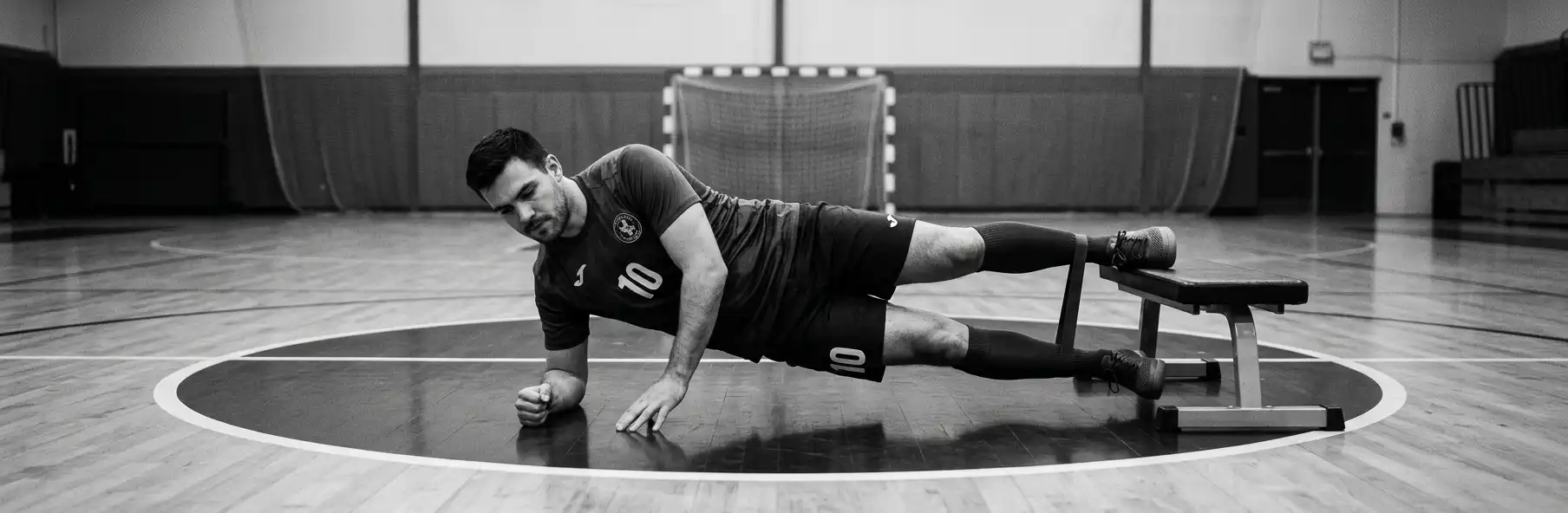
The player lies on his side, propped on his forearm. A teammate holds his top leg (or the leg rests on a bench). From there, he lifts his hips until his body is in a straight line and lowers under control. The top leg does the work: the adductor holds the body up.
Progression matters, because the full exercise is tough and causes muscle soreness in the first few weeks.
| Week | Version | Sets x reps per side | Sessions/week |
|---|---|---|---|
| 1-2 | Short lever (support at the knee) | 2 x 3-5 | 2 |
| 3-4 | Short lever | 3 x 6-8 | 2 |
| 5-6 | Long lever (support at the ankle) | 2 x 5 | 2 |
| 7-8 | Long lever | 3 x 8 | 2-3 |
| Season | Long lever | 2 x 6-8 | 1 |
In the short lever, the partner holds at the knee, which greatly reduces the load. In the long lever, he holds at the ankle. A player who feels joint pain (not muscle pain) around the pubic area during the exercise goes back to the previous version.
I add two things to the Copenhagen: abductor work (side raises with a band) to keep the hip balanced, and an anti-rotation trunk exercise such as a side plank with leg raise. The aim isn’t to build a gym programme. It’s to have three exercises the squad does well, every time.
Fitting It Into the Microcycle Without Losing Court Time
An amateur futsal team often has three 90-minute sessions a week, with the sports hall shared between age groups. Nobody wants to spend 20 minutes on strength work.
The answer is to build the Copenhagen into the warm-up, after mobility and before the ball work. With pairs already set, 2 sets per side take about 5 minutes.
In a week with a Saturday fixture, the adductor work goes in on Tuesday and Wednesday. On Thursday, the tactical activation day, and on matchday, it’s left out. After the match, at Monday’s active recovery session, we do the squeeze test before deciding the week’s load.
With the SportsLabTools Futsal Planning tool I lock the adductor block into the Tuesday and Wednesday sessions for the whole mesocycle. That avoids the classic week-five slip, when the fixture list gets busy and strength work is the first thing to vanish from training.
See also: Futsal Pre-Season Injury Prevention: Protocol for the First Weeks: how to build the preventive base before the competitive calendar starts.
When to Stop and Send Him to the Physio
Strengthening prevents. It doesn’t treat established groin pain. Some signs need an assessment, not another week of “let’s see”:
- Pain in the groin when coughing or sneezing.
- Pain that wakes the player at night.
- Squeeze test above 6 for two weeks in a row.
- Pain that doesn’t “warm up”, meaning it stays the same or gets worse during training.
- Pain on both sides of the groin at the same time.
There’s also a temptation I see a lot in grassroots futsal: the player with groin pain starts playing only as pivot, “to run less”. It doesn’t work. The pivot turns, brakes and shoots as much as anyone. The pain moves position on the court, but it doesn’t leave the groin.
And an honest admission: I’m not certain the Copenhagen protects a futsal goalkeeper in the same way, since his movement pattern is very different (lateral splits, dives). With goalkeepers, I use the squeeze test with the same rule and work on hip mobility more carefully, but the Copenhagen volume is lower.
A futsal team that does the squeeze test every week and keeps the Copenhagen going through the season doesn’t become immune to groin pain. But it stops being caught out by it. And in futsal, where a winger out for two months can mean a broken rotation, that’s worth a lot of points.
Optional accelerator · the tool is always free
Start the season with the whole year already planned
Macrocycle, monthly mesocycles and weekly microcycles with the real season dates, sessions categorised by focus and technical-tactical blocks, and exercises with animated diagrams. From U11 to Seniors, 1 to 5 sessions per week.