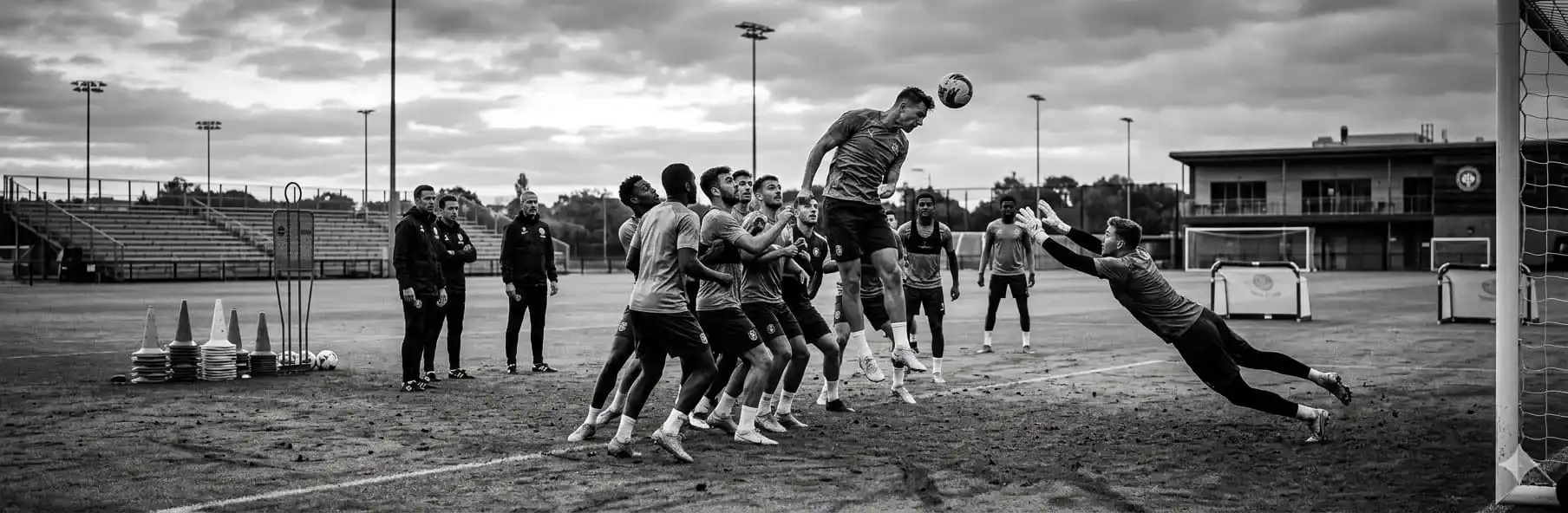
Set Pieces in Football Pre-Season: How to Train Corners and Free Kicks before Matchday 1
How to integrate set piece training into football pre-season: corners, free kicks, penalties and how to structure specific sessions before the start of competition.
Written by
João Araújo
Physical Education Teacher (FADEUP – University of Porto) · Futsal Coach – Level II · UEFA B License · Master’s in Physical Education
15 years teaching Physical Education in schools, 20 years coaching futsal at youth development level and 5 years coaching football. Federated and amateur football and futsal player.
Set pieces account for between 25% and 35% of goals scored in both professional and amateur football. Yet most amateur teams reach the first league match without having trained a single corner, free kick or penalty in a structured way. Pre-season is the ideal moment, and often the only one, to install routines that then work automatically throughout the season.
The problem is not lack of time. It is lack of priority. Many managers relegate set pieces to the last 10 minutes of training, when the group is already tired and concentration has dropped. The result: players who arrive at the season opener not knowing exactly what to do when the team wins a corner.
Practical Guide: Integrating Set Pieces into Football Pre-Season
Step 1. Inventory Your Set Pieces (Week 1)
Before training any routine, decide which ones you will install. Don’t try to do everything, it is better to have 3 routines the group knows by heart than 8 that nobody executes well.
Set pieces to consider:
- Offensive corners (1–2 variants: zonal + run)
- Defensive corners (man-to-man vs. mixed marking)
- Direct free kicks inside the penalty area
- Lateral/indirect free kicks (combination)
- Penalties (order and procedure)
- Throw-ins in pressure zones
Step 2. Block Specific Time (Week 2)
Don’t treat set pieces as “leftover time”. Block 15–20 minutes at the start of at least one weekly session, before fatigue accumulates. In that block, the group is focused and the manager can give quality feedback.
Step 3. Install Offensive Routines (Weeks 2–3)
Start with offensive routines, they are simpler to coordinate and have immediate impact on the group’s motivation.
Structure of an effective corner routine:
- Target zone: where the cross will go (near post, far post, central zone)
- Movements: who goes to which zone and when they make their run
- Recovery and counter-press: who covers against the counter-attack, typically the wide player on the corner side and the defensive midfielder who stays out of the box
- Short variant: signal for the short corner and what happens after
Training starts static (no defence), then with passive defence, then in game context.
🔧 Useful Tool
Visualising and communicating set piece routines is more effective with a digital tactical board. The SportsLabTools Football Tactical Board lets you draw and save set piece movements to share with players before and during training.
Step 4. Install Defensive Routines (Week 3)
Defensive set pieces are frequently neglected, which is a mistake. A team that does not defend corners well loses points that should be theirs.
Base decision: man-to-man or zonal marking?
| Criterion | Man-to-Man | Zonal |
|---|---|---|
| Communication required | High | Low |
| Vulnerable to movements | Less | More |
| Suited for | Good height, good communication | Teams with communication difficulties |
| Main risk | Losing your man | Empty zone at near post |
Mixed marking (zone at near post + man-to-man for the rest): a good compromise for amateur teams.
Step 5. Simulate in Real Context (Week 4)
In the final weeks’ friendlies, intentionally create set piece situations: ask the opposition to commit fouls in strategic zones, or for specific training, set up small-sided games where set piece goals count double.
Checklist: Set Pieces in Football Pre-Season
- Routine inventory defined (maximum 3–4 per category)
- 15–20 min blocked at session start weekly for set pieces
- Offensive corners: target zone, movements and short variant defined
- Defensive corners: man-to-man, zonal or mixed marking chosen
- Direct free kicks: 1–2 takers identified and routine defined
- Penalties: execution order and procedure communicated to the group
- Simulation in friendlies before matchday 1
Conclusion
Set pieces are one of the most cost-effective tactical resources in amateur football, and one of the most ignored. A team with clear, rehearsed and automated routines arrives at the first match with a genuine advantage over opponents who improvise at every corner. Pre-season is the time to install those routines. The competitive season is too short to do it afterwards.
See also: Video Analysis in Pre-Season Friendlies: What to Assess before Competition
Draw and communicate your set piece routines clearly. Use the SportsLabTools Football Tactical Board to create, save and share your schemes before every match.
Optional accelerator · the tool is always free
A library of exercises instead of drawing every one
Packs of 40 exercises per theme, with an animated tactical diagram, four levels of progression, teaching points and success criteria. Import them and they stay in your library, ready to edit and present to the team.