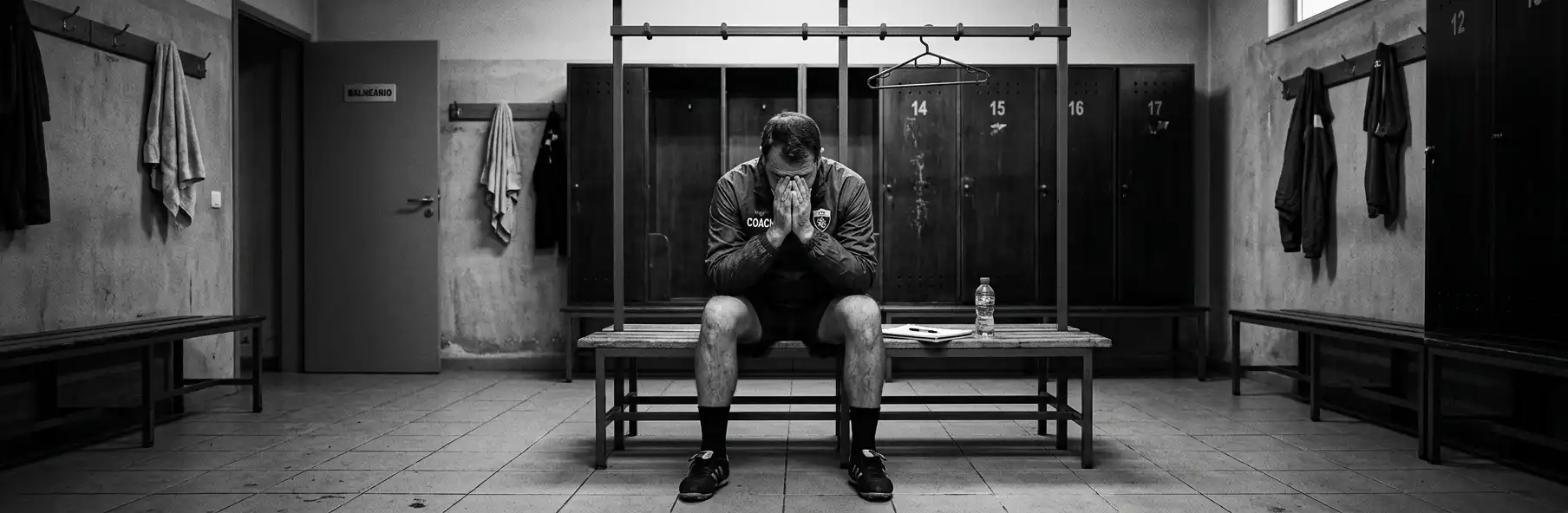
I Lost the Dressing Room at Half-Time: A Football Manager's Diary
A non-league football manager recalls the half-time talk where he shouted, blamed players and lost the group. What went wrong and the 10-minute routine he uses.
Written by
João Araújo
Physical Education Teacher (FADEUP – University of Porto) · Futsal Coach – Level II · UEFA B License · Master’s in Physical Education
15 years teaching Physical Education in schools, 20 years coaching futsal at youth development level and 5 years coaching football. Federated and amateur football and futsal player.
Saturday, 3.47pm. We were 2-0 down on a 3G pitch in West Yorkshire, matchday 6 in the Northern Counties East League. I got into the dressing room before the players. I remember the smell of Deep Heat and the clatter of studs on the concrete floor as they came in, one by one, not looking at me.
I didn’t wait for them to sit down. I threw my water bottle at the wall and said, word for word, that it was “an embarrassment” and that “half of you don’t deserve that shirt”. Then I pointed at Ryan, our centre-back, and asked him in front of everyone whether he knew what marking a striker meant. The second goal had been a free header right behind him.
I talked for seven minutes. I didn’t say a single tactical thing.
When the referee knocked on the door, the players left faster than they’d come in. We lost 4-0.
What actually happened in those seven minutes
At the time I thought I was “waking them up”. I’d read somewhere that some managers give their side a rollicking at half-time and it turns games. I wanted to be that manager.
What actually happened was something else. Ryan, who was already blaming himself for the goal, spent the second half playing scared. He dropped two yards behind the back line every time they attacked, which broke our offside trap. Their third goal came from exactly that, their striker played onside by his position.
Our skipper, Dan, who’s usually loud on the pitch, didn’t say a word for 45 minutes. He told me later he felt anything he said would sound like he was contradicting me.
And the other nine? They didn’t know what to change. I hadn’t told them. I’d told them they were poor, but not why or how to fix it. Our left winger kept tucking inside when he should have stayed wide, because nobody explained that their full-back was bombing forward down that side.
On Monday night, at the recovery session, you could feel the tension. The lads were chatting among themselves but nobody came over to me. Ryan didn’t show. Texted to say he was ill.
The mistake wasn’t shouting. It was shouting with nothing in it.
It took me a while to see this. For a week I convinced myself the problem was the tone and that next time I just had to speak more quietly.
That wasn’t all of it. Watching the game back on video, I realised that at half-time I didn’t even know what the tactical problem was. I’d spent the last 15 minutes of the first half reacting emotionally to every incident, and I walked into the dressing room without a diagnosis. The anger filled the space that should have been filled by analysis.
Ten minutes at half-time is short. Research on half-time communication and the experience of anyone who’s been in plenty of dressing rooms point the same way: players retain very little, two or three ideas at most, and far less when they feel under emotional threat. A player who feels attacked stops listening. He goes into defence mode, not learning mode.
Then there’s the problem of the target. Having a go at Ryan in public didn’t make him mark better. It taught the other ten that making a mistake on my watch meant humiliation. From that day, and for a few weeks after, the team played trying not to make mistakes. In football, that means playing backwards.
I’m not saying a manager can never raise his voice. I think he can, rarely, and aimed at the group, about attitude rather than individuals. But if raising your voice replaces information, you’ve lost the half-time.
What I changed afterwards
The following week I wrote a routine on an A5 sheet and stuck it inside the cover of my folder. I’ve used it ever since, with only small changes, for three seasons now.
Minutes 0 to 2: nobody talks. Players drink, sit down, take their shin pads off if they want. I stay by the door with my assistants. Those two minutes are as much for me as for them: they bring my heart rate down and force me to think before I open my mouth.
Minutes 2 to 3: quick word with my assistant. He’s brought three notes written during the first half. I pick two. Never more than two.
Minutes 3 to 7: the two corrections, drawn out. This is where I changed most. Instead of talking into thin air, I draw both situations. At first I used a battered magnetic board that lived in the dressing room. These days I’ve got the SportsLabTools Tactics Board on a tablet and I set up both drawings in the last minutes of the first half, still on the bench. When I walk in, I’m not improvising any more. I show where the space is, who needs to close it and what changes in the second half. The players look at the screen, not at my face, and that takes the emotional heat out of the conversation.
Minutes 7 to 8: one line for the group. Just one. About attitude or the moment in the game. “The first ten minutes of the second half are ours” works better than any sermon.
Minutes 8 to 10: one-to-ones, quietly. If someone needs an individual correction, it’s here, in his ear, in the corner. Never in front of the group.
The first few half-times with the routine felt odd. In the first game we were 1-0 up and those two minutes of silence felt like an eternity. One of the older lads, Tom, asked me afterwards if I was all right. I laughed. At Tuesday training I explained to the group what I was trying to do and why, including the 4-0. I think it was the first time I’d admitted in front of the squad that I’d got a match wrong. The reaction was better than I expected. Dan asked for a minute at the end, before my line for the group, to say something himself. I agreed, and it’s still that way now.
My assistant’s job during the first half changed too. Before, he watched the game like me, suffering. Now he has a sheet with three columns: out of possession, in possession and transitions. He writes the minute and a short phrase whenever he sees a pattern repeat twice. A one-off doesn’t count. On 35 minutes he hands me the sheet. I’ve already got my own impressions and I compare. When we agree, the decision is easy. When we don’t, I trust his sheet more than my memory, because my memory, when we’re losing, is a terrible adviser.
There’s one rule that isn’t written on the sheet but I always follow: if I’m too wound up to stick to the routine, I ask my assistant to do the tactical part. It’s happened twice in three seasons. Both times the team improved in the second half.
As for Ryan, I rang him on the Tuesday. I apologised for showing him up in front of the group. I didn’t apologise for demanding better marking, I stood by that. He was back on the Wednesday and played the full 90 the following Saturday. I don’t know if the relationship ever went back to exactly how it was. Probably not. But it got better.
What I still haven’t cracked
It would be dishonest to say I’ve got this sorted. In end-of-season games with relegation on the line, I feel the same surge of adrenaline around the 40th minute. The routine helps because it gives me something concrete to do, but it doesn’t remove the emotion.
I’m also not sure the format suits every squad. With an under-19 side I managed for a season, the two drawn corrections worked well, but the line for the group needed to be longer. The younger lads seemed to need to feel the manager more. With experienced senior players, less is almost always more.
And there are games where the half-time diagnosis is simply “we’re playing well and losing”. In those, the temptation to change everything is huge. I’ve learned to tell the group exactly that: keep going, the numbers are on our side. It doesn’t always work. But it’s more honest than inventing a problem.
See also: Dressing Room Leadership in Football: The Captain’s Role in Managing the Group: what the captain can do in the moments when the manager isn’t the best voice.
I still sometimes think about Ryan playing two yards behind the line, scared of me. When you walk into the dressing room at half-time, do you already know what you’re going to say, or do you find out when you open your mouth?
Get your two corrections ready before you walk in. Use the SportsLabTools Football Tactics Board to show them rather than shout them.
*This account is based on a real case, but the identities of the people involved have been protected and some details of the setting have been recreated for illustrative purposes.*
Optional accelerator · the tool is always free
A library of exercises instead of drawing every one
Packs of 40 exercises per theme, with an animated tactical diagram, four levels of progression, teaching points and success criteria. Import them and they stay in your library, ready to edit and present to the team.