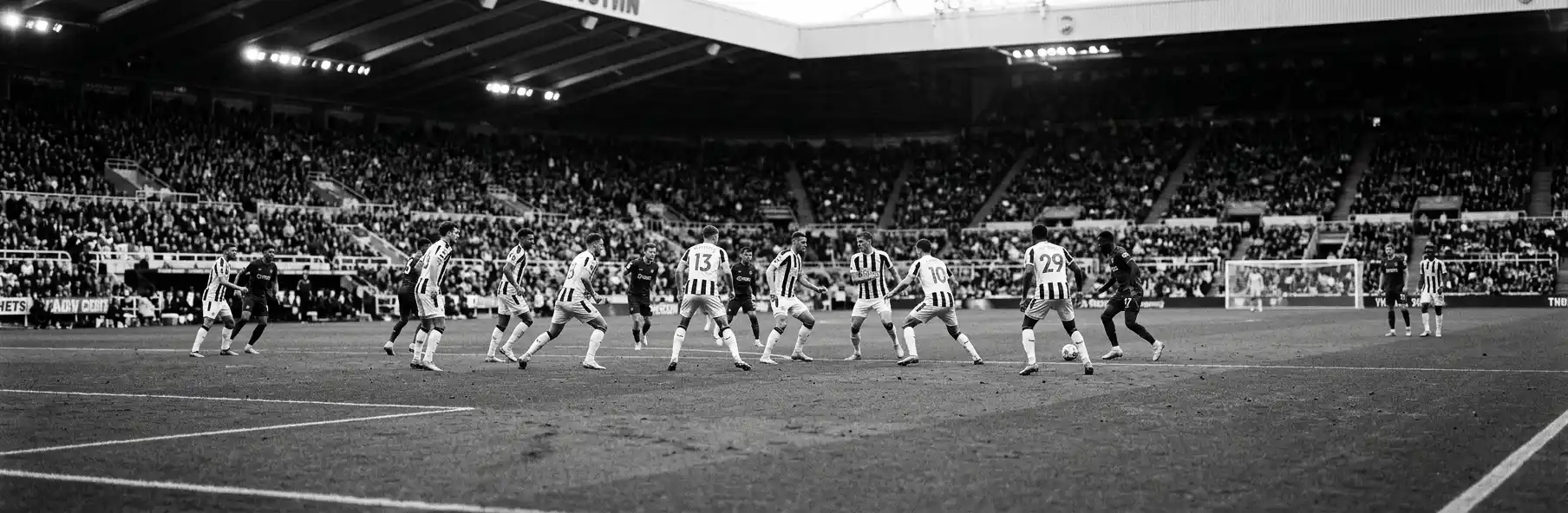
Mid-Block in Football: Defensive Organisation Between High Press and Low Block
Comparing mid-block, high press and low block in football: advantages, limitations, and criteria for choosing the right defensive structure.
Written by
João Araújo
Physical Education Teacher (FADEUP – University of Porto) · Futsal Coach – Level II · UEFA B License · Master’s in Physical Education
15 years teaching Physical Education in schools, 20 years coaching futsal at youth development level and 5 years coaching football. Federated and amateur football and futsal player.
There’s no universally superior defensive structure. there’s the one that best fits your squad’s quality, the day’s opponent, and the moment of the match. The mid-block is often dismissed as “the middle-ground option”, but that simplistic reading misses that, for most amateur and semi-professional sides, it’s the most sustainable structure across 90 minutes and across a whole season.
High Press
Characteristics and Advantages
The high press forces mistakes from the opposition near their own goal, creating scoring chances in high-value zones. When well executed, it cuts down the opposition’s time on the ball in comfort and can unsettle sides with a shakier build-up.
Limitations
It demands high fitness levels and near-perfect collective coordination. one player out of position at the pressing trigger leaves the whole line exposed. Against sides with a good passing build-up or fast players in behind, the risk of being played through is high.
When to use it: against opponents with a slow or unconfident build-up, and when your squad has the fitness to sustain the effort across a full 90 minutes.
Low Block
Characteristics and Advantages
It protects the space in behind and reduces the room available behind the defensive line, making the opposition’s direct play harder. It’s the safer option against technically superior sides, and allows you to hit them on the counter with space ahead.
Limitations
It cedes territorial control of the match and can build up psychological pressure. the longer a team defends near its own box, the higher the statistical likelihood of conceding.
When to use it: as a clear underdog against a superior opponent, or in the closing stages of a match to protect a result.
Mid-Block
Characteristics and Advantages
The mid-block sets the defensive line around the halfway line, letting the opposition build up in less dangerous zones while closing down space in the finishing areas. It combines two advantages: less physical strain than a high press, and less territorial exposure than a low block. It’s the structure most mid-level sides can maintain consistently across an entire season.
Limitations
It demands well-defined pressing triggers for the moment to step up. without those triggers, a mid-block easily slips into a passive block that concedes too much space between the lines.
When to use it: as the default structure for most matches in a season, adjusting to a high press or low block on a match-by-match basis depending on the opponent.
How to Choose: Decision Criteria
- What’s your squad’s real fitness level for sustaining a high press for 90 minutes?
- Does the day’s opponent build up with confidence, or do they have weaknesses on the ball?
- Does the scoreline and moment of the match call for territorial control or protecting a lead?
Practical example: an amateur team without specific pre-season conditioning for pressing rarely holds up a high block for 90 minutes — in that case, a mid block with clear triggers (for example, stepping up only when the opposing full-back receives with his back to goal) pays off more than trying to copy a press the squad’s fitness can’t sustain.
🔧 Useful Tool
Choosing between a mid, high or low block means visualising exactly where you want each player positioned at every trigger. The SportsLabTools Tactical Board lets you draw and animate all three structures to explain them clearly to the squad.
Comparison Table: Defensive Structures in Football
| Criterion | High Press | Mid-Block | Low Block |
|---|---|---|---|
| Fitness demand | Very high | Moderate | Low |
| Risk in behind the defence | High | Moderate | Low |
| Territorial control | High | Moderate | Low |
| Sustainability over 90 min | Difficult | High | High |
| Suitability as underdog | Low | Moderate | High |
See also: Defending in a Low Block and Hitting on the Counter: The Underdog Guide. for when the mid-block isn’t enough and you need to drop even deeper.
Conclusion
The problem isn’t choosing a fixed structure. high press, mid-block or low block. for the whole season. It’s fitting the structure to each match’s context, knowing that for most sides, the mid-block is the most sustainable base from which to adjust up or down on a given day.
Define each match’s defensive structure with clarity. Use the SportsLabTools Tactical Board to show the squad exactly when to step up the press and when to hold the block.
Optional accelerator · the tool is always free
A library of exercises instead of drawing every one
Packs of 40 exercises per theme, with an animated tactical diagram, four levels of progression, teaching points and success criteria. Import them and they stay in your library, ready to edit and present to the team.