Nordic Hamstring Curl in Football: How to Bring It Into Your Squad Without the Pain
The Nordic hamstring curl cuts football injuries, yet squads drop it because of the soreness. A 10-week protocol and where it fits in the weekly microcycle.
Written by
João Araújo
Physical Education Teacher (FADEUP – University of Porto) · Futsal Coach – Level II · UEFA B License · Master’s in Physical Education
15 years teaching Physical Education in schools, 20 years coaching futsal at youth development level and 5 years coaching football. Federated and amateur football and futsal player.
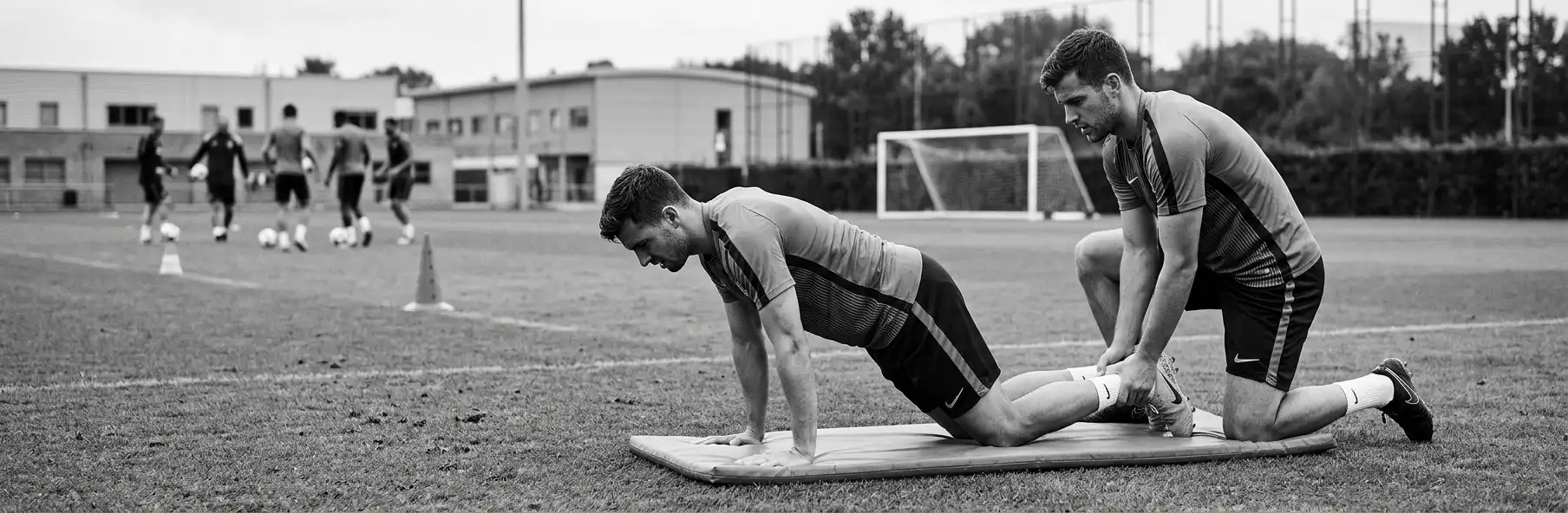
In football, hamstring strains are the most common muscle injury of all, and the exercise with the strongest evidence for preventing them fits in one square metre of grass. It’s called the Nordic hamstring curl. Two players, one kneeling, the other holding his ankles, and a controlled lean forward until the chest reaches the ground.
The research has been clear for over a decade. Even so, most squads I know start Nordics in July and drop them by September. Not because the manager lost interest. Because of the soreness in the first few days, which players link to the exercise and never forget.
This piece isn’t about why you should do Nordics. It’s about how to introduce them so your squad doesn’t reject them.
Why Nordics Work (and Why Almost Nobody Sticks With Them)
Sprinting is the moment of highest risk for the hamstrings. In the late swing phase, the muscle brakes knee extension while it’s lengthening. That’s a high-speed eccentric action, and it’s exactly the quality the Nordic trains.
The Danish and Dutch trials with amateur sides showed reductions in new hamstring injuries in the region of 50 to 70% for teams that completed the programme. The key word is “completed”. A survey of top European clubs found that only a small share were running the full protocol. The rest did it irregularly or had quietly given up.
The gap between the study and the dressing room is compliance. An exercise that protects players but nobody does protects nobody.
There’s also a status problem. In most dressing rooms, Nordics sit in the same mental box as “extra running”: something the fitness coach wants, not something the manager cares about. When the manager is standing next to the pairs, counting reps and making a comment about the ones done well, compliance changes within a fortnight. Players notice where the gaffer spends his attention.
The Real Obstacle: the First 10 Days of Soreness
Anyone doing Nordics for the first time at proper volume gets severe delayed-onset muscle soreness 24 to 72 hours later. Nothing dangerous. But if it lands on a speed session or a pre-season friendly, the player feels the exercise has “wrecked” him.
I watched this happen at a semi-pro side. The fitness coach programmed 3 sets of 10 in the first week of July. By the following Thursday, half the squad could barely sprint. The captain told the manager, in front of everyone, that it was “doing more harm than good”. Nordics never came back at that club.
The fix is boring: start with a ridiculously low volume. Two sets of five. Once a week. The goal of the first few weeks isn’t to build strength. It’s to get the muscle used to the eccentric load without triggering the reaction that kills compliance.
A 10-Week Introduction Protocol
This progression is based on the original Mjølsnes protocol, adapted to an amateur club training three nights a week.
| Week | Sessions/week | Sets x reps | Note |
|---|---|---|---|
| 1 | 1 | 2 x 5 | Partial range, stop halfway if needed |
| 2 | 2 | 2 x 6 | First full controlled lowering |
| 3 | 2 | 3 x 6-8 | Stretch the lowering phase to 3 seconds |
| 4 | 2 | 3 x 8-10 | Hands ready to catch the fall |
| 5-10 | 2 | 3 x 12, 10, 8 | Pre-season maintenance volume |
| Season | 1 | 2 x 6-8 | Weekly maintenance, never stop |
Minimum technique to count the rep
The body lowers like a plank, hips extended. If the player bends at the hip and “sits back”, he’s dodging the hamstring work. That rep doesn’t count.
The lowering has to be held for as long as possible. When the player can no longer resist, he drops onto his hands as if doing a press-up. The way back up can be assisted with a push from the hands. That’s not where the stimulus is.
Log it so you can adjust
I ask every player to log their muscle soreness the next day on a 0 to 10 scale. If more than a third of the squad reports 6 or above, next week’s progression is frozen. The SportsLabTools Athlete Journal collects these answers in seconds, and after three weeks you can see who adapts quickly and who needs longer at low volume.
Where Nordics Fit in the Microcycle
The worst days for Nordics are MD-2 and MD-1. The soreness peaks on matchday and the player feels heavy hamstrings on his first sprint.
In a standard week with a Saturday fixture, the best days are MD-4 (Tuesday), at the end of the strength session, and MD+2 (Monday) at reduced volume, if recovery allows. In season, one session at MD-4 is enough to hold the adaptation.
In weeks with two fixtures, drop Nordics for the week or do a single maintenance set on the active recovery day. It isn’t worth the risk.
Then there’s the timing within the session. Doing Nordics at the start and then training speed is a mistake: the muscle is fatigued and sprint quality drops. At the end of the session, after the technical and tactical work, it works better. The exception is when Nordics are built into a FIFA 11+ style warm-up at very low volume.
To keep track of the progression week by week, I plan Nordics like any other training content. The SportsLabTools Football Planning tool lets me put the exercise, sets and reps into every session of the microcycle, so the fitness coach and the assistants always know which week of the protocol the squad is on.
Mistakes That Make a Squad Drop the Exercise
Starting at maintenance volume. Three sets of ten in week one is the fastest way to kill Nordics. The squad has no memory of the science. It has a memory of the pain.
Using Nordics as punishment. Sounds obvious, but I’ve seen managers hand out extra sets after a defeat. From that day on, the exercise means punishment.
Not explaining why. Five minutes showing the club’s own injury record from last season does more for compliance than any instruction. If three players missed games with hamstring strains, that’s argument enough.
Stopping in October. The adaptation fades within a few weeks without a stimulus. Plenty of teams get through pre-season and forget the maintenance. The injuries turn up in November and nobody makes the connection.
Ignoring asymmetry. A player who always falls to the same side probably has one weaker leg. Worth a look with the physio.
Badly matched pairs. The teammate holding the ankles does half the job. If an 85 kg centre-back holds a 65 kg winger, fine. The other way round, the centre-back’s feet lift off halfway down and the rep is lost. Pairing by body weight rather than friendship fixes it in two minutes. Clubs with wall bars or a low fixed bar can anchor the feet to the structure, which frees the partner and adds stability.
Turning Nordics into a contest. Someone always wants to see who can lower slowest. For two weeks it’s fun. Then someone does an extra rep to win the bet and can’t sprint for three days.
See also: Muscle Injury Spike in Football: Reducing the Risk in the First Rounds: the load context in which Nordics make the biggest difference.
Players Who Need a Different Approach
Not every player should follow the same protocol. A striker who had a hamstring strain within the last six months should do Nordics under the physio’s guidance, with reduced range at first and a slower progression.
The older players in the squad, over 32 or 33, tend to get longer-lasting soreness. For them I prefer to stay at two sets rather than three for longer. I’m not certain the reduced volume gives them the same protection, but I’d take an exercise done consistently over a perfect exercise they abandon.
In youth football, up to under-15, the priority is technique and habit. One set of five well-executed reps built into the warm-up is enough to create the routine.
And some players simply can’t lower past 30 degrees in the first few weeks. That’s absolutely fine. A well-controlled partial lowering is worth more than an uncontrolled drop to the floor.
The Nordic isn’t a hard exercise to teach. It’s a hard exercise to keep. Managers who introduce it slowly, log it and fit it on the right day of the week finish the season with fewer players in the treatment room. Those who try to rush it end up without the exercise and with the same injuries as always.
Optional accelerator · the tool is always free
Start the season with the whole year already planned
Macrocycle, monthly mesocycles and weekly microcycles with the real season dates, sessions categorised by focus and technical-tactical blocks, and exercises with animated diagrams. From U11 to Seniors, 1 to 5 sessions per week.