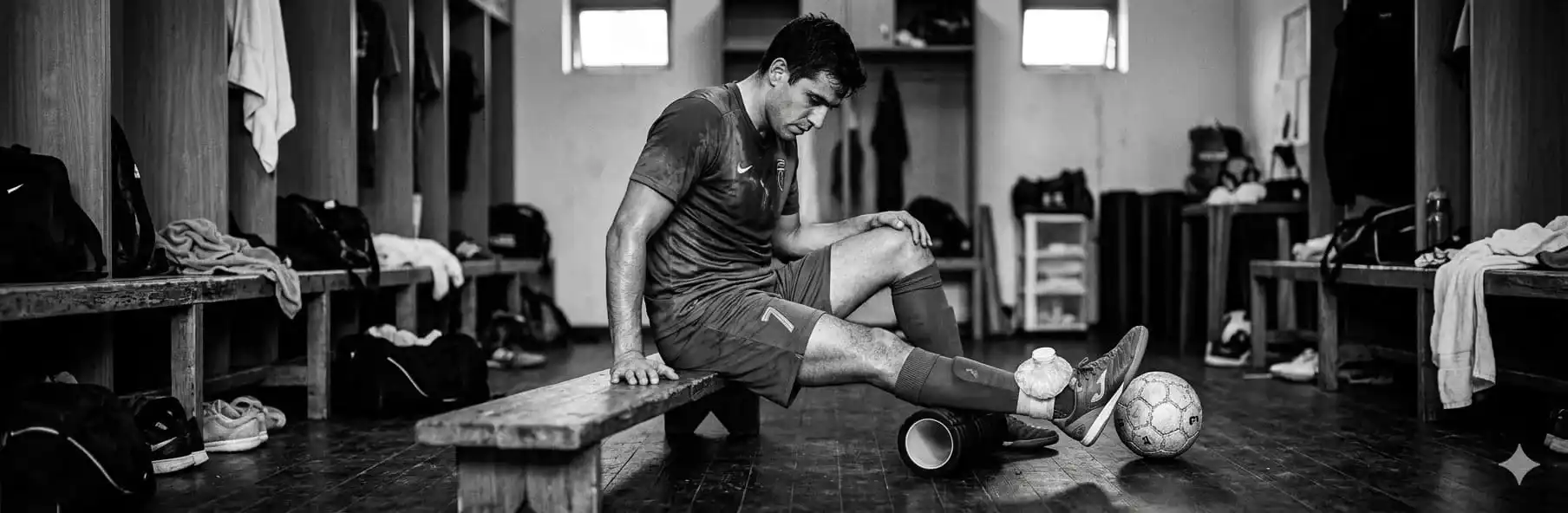
Post-Match Recovery in Futsal: A Practical Protocol for the Next 48 Hours
A structured futsal post-match recovery protocol across 4 time windows: immediate nutrition, muscle repair, sleep, and active recovery on the day after. Avoid the most common mistakes.
Written by
João Araújo
Physical Education Teacher (FADEUP – University of Porto) · Futsal Coach – Level II · UEFA B License · Master’s in Physical Education
15 years teaching Physical Education in schools, 20 years coaching futsal at youth development level and 5 years coaching football. Federated and amateur football and futsal player.
In the first 48 hours after a futsal match, your muscles are in active catabolic state. What you do, or fail to do, during that period directly determines your availability at the next training session and your long-term injury risk. Futsal places demands on the body that most amateur players underestimate: research suggests the sport generates roughly 30% more intensity per minute played than football, with direction changes every 2 to 3 seconds and repeated sprinting in a confined court.
The challenge is compounded for amateur players. Most have work the next morning, a midweek training session, and another match the following weekend. The recovery window is narrow, resources are limited, and team culture rarely values what happens away from the court. This article lays out a four-window protocol. with concrete actions in each. so you can recover consistently even with a life beyond futsal.
Why Post-Match Recovery in Futsal Is a Distinct Challenge
Futsal is not simply small-sided football. The density of actions, the frequency of contacts, the cognitive load of decision-making in tight space, and the need to sustain intensity without frequent rotation at amateur level create a distinct fatigue profile.
After an intense match, a player typically presents: 60 to 80% depletion of muscle glycogen, micro-damage to lower limb muscles (particularly quads and calves), fluid losses of 1 to 2% of body weight, and activation of the sympathetic nervous system that makes falling asleep harder. All of this happens while the player drives home, showers, and tries to wind down. Without a protocol, recovery is left to chance.
The Protocol: 48 Hours Across 4 Windows
| Window | Timing | Goal | Actions |
|---|---|---|---|
| Immediate | 0–30 min post-match | Rehydration + glycogen | Water, sports drink, banana or sandwich |
| Short | 30–120 min | Muscle repair | Protein (20–30 g), gentle stretching, ice if needed |
| Night | Sleep | Tissue repair | 7–9 h sleep, cool room, no screens 1 h before bed |
| D+1 | Day after | Active recovery | 20–30 min walk or light swim, mobility work |
Window 1: Immediate (0–30 min post-match)
This is the most neglected window in amateur futsal culture. and the most critical. Muscle sensitivity to glucose and amino acid uptake is at its peak. Delaying intake from 30 to 90 minutes can slow glycogen resynthesis by up to 50%.
Practical actions:
- Drink 500 ml of water immediately after the final whistle
- Add an isotonic drink (sodium + potassium) to help replace electrolytes
- Eat a fast-absorbing carbohydrate: banana, white bread sandwich, dried fruit
- Do not leave the sports hall without eating. “I’ll eat at home later” often becomes nothing until bedtime
If you weigh yourself before and after the match, multiply the kilograms lost by 1.5. that is the volume in litres to replenish over the following hours.
Window 2: Short (30–120 min)
Back home. This is the window for the proper recovery meal, combining fast-absorbing protein with carbohydrates to accelerate muscle repair and glycogen resynthesis simultaneously.
Practical actions:
- Protein: 20 to 30 g. eggs, chicken, cottage cheese, whey shake
- Carbohydrates: 1 to 1.5 g per kg of body weight. pasta, rice, potato
- Localised ice: if you have specific joint or muscle pain, 15 to 20 minutes of targeted icing is sufficient. Blanket icing without indication does not accelerate recovery
- Gentle static stretching: 10 minutes targeting the main muscle groups significantly reduces morning stiffness
Window 3: Sleep. The Most Overlooked Recovery Tool
Sleep is when most tissue repair takes place. It is during deep sleep that the body releases growth hormone (GH), which is essential for protein synthesis and muscle regeneration. Sleeping fewer than 7 hours after a match increases perceived fatigue markers the following day by 20 to 30%.
The problem: many players arrive home wired. adrenaline still running, post-match chat with teammates, phone glowing. and end up falling asleep late, sleeping briefly, then dragging themselves to work exhausted.
Practical actions:
- Avoid screens (phone, TV) for at least 45 minutes before bed
- Keep the bedroom between 18 and 20 °C to promote deeper sleep
- If the match kicks off late (10 pm or later), have a light protein snack before bed. not a full meal
- Aim for 7 to 9 hours. If work prevents that, a 20 to 30-minute nap the next day partially compensates
Window 4: D+1. Active Recovery
The temptation is to rest completely the day after. Evidence points the other way: light active recovery. low-intensity movement. increases blood flow to damaged muscles, accelerates metabolite clearance, and reduces soreness more effectively than total rest.
Practical actions:
- 20 to 30 minutes of comfortable-pace walking, light swimming, or easy stationary cycling
- Joint mobility work: hip rotations, thoracic mobility, ankle mobility
- Avoid intense running or heavy strength work. the muscle is still in the repair phase
- Hydrate throughout the day: urine should remain pale yellow all through D+1
The Most Common Recovery Mistakes
- Going to bed without eating: arriving home late, feeling too tired, and going straight to sleep eliminates the most important nutritional recovery window
- Alcohol after the match: culturally common in amateur futsal, alcohol directly inhibits muscle protein synthesis and disrupts sleep quality. even if you fall asleep faster, deep sleep is compromised
- No active recovery on D+1: total rest delays metabolite clearance and prolongs soreness
- Incorrect icing: systematic full-body icing without indication can inhibit positive muscular adaptations to training
- Ignoring hydration tracking: most amateur players arrive to a match mildly dehydrated and leave more so. without conscious rehydration, the deficit carries over to the next training session
🔧 Athlete Journal
Logging sleep quality, muscle soreness, and RPE after each match lets you identify recovery patterns across the season. The SportsLabTools Athlete Journal helps coaches and players detect fatigue trends before they become injury or performance decline.
Adjustments by Context
Midweek Match (recovery in 48–72 h)
When the next session is 48 to 72 hours away, priorities shift: Windows 1 and 2 are even more critical, sleep must be protected at all costs, and D+1 active recovery should happen even if it is only a 20-minute walk at lunch.
Matches on Consecutive Days (Sunday + Monday)
The most demanding scenario, common in play-off stages or tournaments. With only 16 to 24 hours of recovery, focus exclusively on Windows 1 and 2 (immediate nutrition and hydration), at least 8 hours of sleep, and eliminate all additional activity. Active recovery in this context is contraindicated. the muscle simply does not have enough time to benefit from it.
See also: How RPE and the Athlete Journal Prevent Overtraining in Amateur Futsal. for monitoring internal training load throughout the season and detecting accumulated fatigue with simple data.
Checklist: Recovery in the 48 Hours Post-Match
- Drink 500 ml of water in the first 30 minutes after the match
- Eat fast-absorbing carbohydrates in Window 1 (banana, sandwich)
- Have a protein + carbohydrate meal within 2 hours of the final whistle
- Sleep at least 7 hours. no screens for 45 min before bed
- Active recovery on D+1 (walk, light swim, or mobility work)
- Monitor urine colour throughout D+1 to confirm rehydration
- Log soreness, sleep quality, and RPE in the athlete journal
Conclusion
Post-match recovery in futsal does not need to be expensive or complicated. It needs to be consistent and intentional. The four windows described. immediate, short, sleep, and D+1. are simple actions any amateur player can implement regardless of available resources. The difference between a player who arrives at Wednesday training with energy and one who drags themselves in heavy-legged and sore lies largely in what happened in the 48 hours before.
Start by nailing Window 1 and the Sleep Window. they have the highest impact for the least additional effort.
Track your recovery match by match. Use the SportsLabTools Athlete Journal to log sleep, soreness, and RPE and identify your recovery patterns across the season.