How RPE and the Athlete Diary Prevent Overtraining in Amateur Futsal
Learn to use the RPE scale and athlete diary to monitor internal load in amateur futsal, detect chronic fatigue signs and optimise recovery, no GPS required.
Written by
João Araújo
Physical Education Teacher (FADEUP – University of Porto) · Futsal Coach – Level II · UEFA B License · Master’s in Physical Education
15 years teaching Physical Education in schools, 20 years coaching futsal at youth development level and 5 years coaching football. Federated and amateur football and futsal player.
No GPS. No lactate analyser. Your equipment monitoring budget is zero. Does that mean you’re unable to monitor your players’ training load? No, it means you need a different tool, equally validated by science and used in elite sport for decades: Rate of Perceived Exertion (RPE).
RPE, combined with a structured athlete diary, gives you access to what no GPS can measure directly: the internal response of your athlete’s body to training.
What RPE Is and Why It Works
RPE measures an athlete’s perceived effort during or after a training session or match. Two main versions exist:
Borg Scale (6-20): the original scale, where 6 = absolute rest and 20 = maximum possible effort.
CR-10 Scale (0-10): the simplified version, most intuitive for athletes and widely used in team sports. 0 = no effort; 10 = the hardest imaginable.
| CR-10 | Description | Futsal Example |
|---|---|---|
| 1-2 | Very light | Warm-up, individual technical work |
| 3-4 | Moderate | Tactical drills, low-intensity circuits |
| 5-6 | Hard | Small-sided games, moderate pressure |
| 7-8 | Very hard | Training match, repeated sprints |
| 9-10 | Maximum | Full-pressure match intensity, pre-season peak |
Scientific validity is well established: perceived effort correlates strongly with objective physiological markers such as heart rate, blood lactate and oxygen consumption.
The Session Load Method: RPE × Duration
Session Load = RPE × Duration (in minutes)
Example: a 70-minute session with average RPE of 6 generates a load of 420 arbitrary units (AU).
Tracking this weekly gives you:
- Total weekly load: comparable across weeks and players
- Load curve throughout the season: identifies overload peaks
- Acute:Chronic Workload Ratio (ACWR): the most powerful injury risk indicator
An ACWR above 1.5 is a clear warning sign: the athlete is loading more than the body can absorb.
🔧 Useful Tool
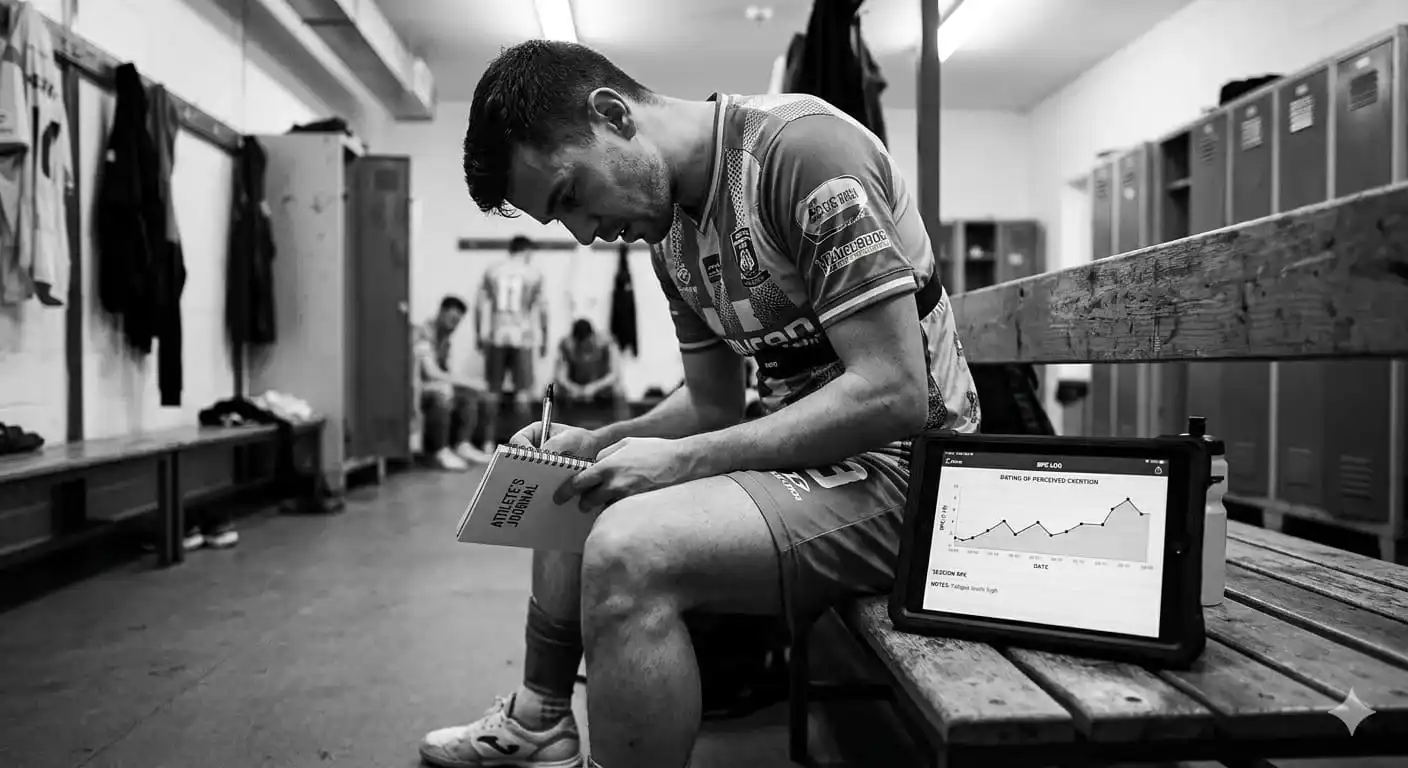
Record each player’s RPE after every session and match in the SportsLabTools Athlete Journal. With the weekly history of each player, you can visualise internal load trends, identify athletes at overtraining risk and adjust your training plan before fatigue becomes a real problem.
Overtraining Warning Signs the Diary Detects Early
The diary detects these signals weeks before they become visible on the pitch:
Sign 1. RPE consistently higher for the same training type An exercise normally generating RPE 6 being reported as 8 week after week signals incomplete recovery.
Sign 2. Sleep quality declining Fragmented or insufficient sleep is one of the earliest signs of overreaching. Include a sleep quality question (1-5 scale).
Sign 3. Motivation and overall mood dropping Central nervous system fatigue often manifests as lack of motivation, irritability and heavy legs. A daily “how are you feeling today (1-5)?” question captures this.
Sign 4. Persistent muscle soreness Soreness that doesn’t resolve within 48-72 hours after training signals compromised recovery.
Implementing the System in an Amateur Context
Three questions at the end of each session (maximum 2 minutes):
- “How hard was today’s session? (0-10)”
- “How was your sleep quality? (1-5)”
- “How are you feeling physically? (1-5)”
The coach reviews the data weekly, 10 minutes to identify any athletes showing warning signs and adjust accordingly.
See also: RPE vs % of 1RM: Which Intensity Method Should You Use?
Checklist: RPE + Athlete Diary System
- CR-10 scale explained and understood by all squad members
- Three questions defined for post-session recording
- Recording format chosen and tested
- Coach reviews data weekly (10-15 min)
- Acute:Chronic ratio monitored for higher-volume players
- Response protocol defined for athletes showing warning signs
- Players informed about the purpose of recording (transparency drives compliance)
Conclusion
You don’t need expensive technology to monitor your players’ load. You need consistency, a simple system and a tool that organises the data accessibly. RPE and the athlete diary provide exactly that.
Start recording your athletes’ RPE today. Use the SportsLabTools Athlete Journal to centralise internal load data and identify fatigue signals before they become serious problems.