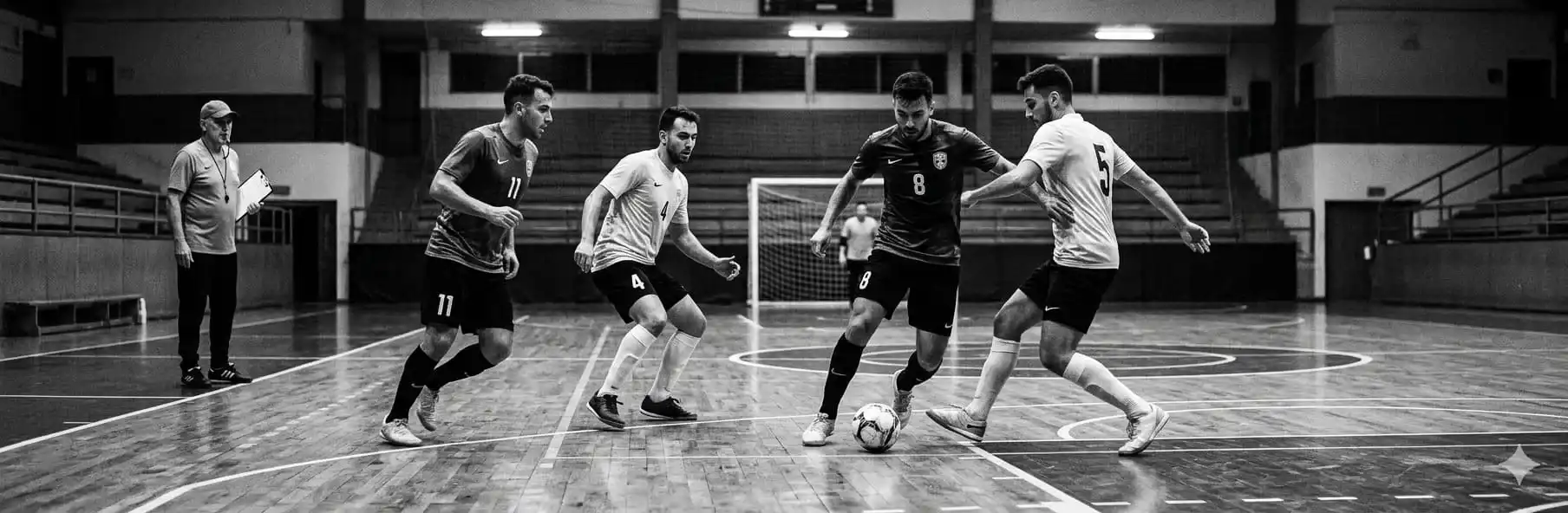
Small-Sided Games in Futsal Training: The Complete Coach's Guide
Learn how to design effective small-sided games for futsal to develop pressing, transitions and ball circulation. Practical guide with 3 examples and checklist.
Written by
João Araújo
Physical Education Teacher (FADEUP – University of Porto) · Futsal Coach – Level II · UEFA B License · Master’s in Physical Education
15 years teaching Physical Education in schools, 20 years coaching futsal at youth development level and 5 years coaching football. Federated and amateur football and futsal player.
Small-sided games are the most efficient training tool in futsal, and the most misused. Most coaches use them to fill time. The best coaches use them to develop decision-making, intensity and tactical principles simultaneously.
The difference is not in the drill itself. It is in the intention behind the design. A 3v3 with no defined objective is just a kickabout. That same 3v3 with a clear tactical purpose, adjusted space and a constraint that forces the desired behaviour is one of the most powerful pedagogical tools at your disposal.
This guide shows you how to think about small-sided games the right way, before you set foot on the court.
What Small-Sided Games Actually Are
A small-sided game (SSG) is any form of play with fewer players than the formal game, in a space adapted to the training objective. The sports science literature is consistent: SSGs increase ball contacts per minute, raise the frequency of tactical decisions and transfer more effectively to match performance than isolated analytical drills.
In futsal, this carries even more weight. The court is already small, the pace already high. A well-designed SSG replicates the pressure, transition and decision-making situations of real match play at even greater density, making every training minute more efficient.
The problem is not the tool. It is the absence of criteria when using it.
Principles for Designing Effective Small-Sided Games
Before you step onto the court with an SSG, answer three questions: What do I want to work on? Under what conditions does that behaviour appear in the real match? How do I force that behaviour in the drill?
Define the tactical objective before designing the exercise. Pressing, offensive transition, ball circulation, finishing under pressure, each objective demands a different structure. A “generic” SSG trains nothing specifically.
Adapt the space to the objective. Reduced space favours pressing, defensive blocks and quick decision-making. Larger space favours transitions, width and depth. Keeping the same space regardless of objective is one of the most common errors.
Use touch restrictions to change behaviour. One touch forces play without stopping. Two touches develops simple, direct play. Unlimited touches allow the player to delay and escape pressure, which may or may not be what you want.
Include conditions that force the desired principle. If you want to train pressing, add a rule that rewards winning the ball high (e.g. a goal scored immediately after a high recovery counts double). The rule shapes behaviour without the coach needing to verbalise it on every repetition.
Practical Application: 3 Examples by Objective
SSG for Pressing: 3v3+GK in reduced space
Court: half-pitch. Teams of 3 outfield players plus a goalkeeper. The team that recovers the ball in the opponent’s half automatically scores a point, regardless of whether they score a goal. This forces high defensive organisation and punishes slow circulation by the team in possession.
SSG for Transition: 4v4 with immediate countdown after recovery
Full court. After winning the ball, the team has 5 seconds to finish, otherwise the chance is cancelled. This time restriction replicates the urgency of real offensive transitions and forces players to identify passing lines immediately.
SSG for Circulation: 3v3 with forbidden zones
Court: two-thirds of the pitch. Two lateral zones are marked, the ball cannot be dribbled inside those zones, only passed through them. This forces the player on the ball to seek support and the team to maintain constant passing lines.
Common Mistakes
Using SSGs without a defined objective is the main one, and has already been covered. But others appear regularly:
- Same space regardless of objective. Adapting the space to the goal is half the drill.
- No tactical feedback during the exercise. An SSG is not a rest period for the coach, it is a moment to observe and intervene with precision.
- Using SSGs only at the end of sessions, when players are already fatigued. For high-intensity objectives (pressing, transitions), SSGs belong in the middle of the session.
- Confusing SSGs with conditioning work. An SSG is tactical training. If you are using it primarily to develop aerobic capacity, you are wasting its potential.
🔧 SportsLabTools Planning Tool
Fitting small-sided games into the weekly microcycle requires visibility over the total load and the objectives of each session. The SportsLabTools Planning Tool lets you schedule SSGs across the week based on match day proximity, ensuring each drill appears at the right moment.
Integrating Small-Sided Games into the Microcycle
The effectiveness of SSGs also depends on when you place them in the week. In a microcycle with a match at the weekend:
- MD-4 / MD-3: High-intensity SSGs (pressing, transitions). Players are fresh and can work at the effort level these objectives demand.
- MD-2: More positional and tactical SSGs. Lower intensity, greater focus on organisation and tactical principles.
- MD-1: Avoid SSGs. Activation, set pieces, automatisms only.
Correct integration prevents SSGs from becoming a random exercise and ensures their impact is reflected on matchday.
See also: The Perfect Futsal Microcycle for Double Game Weeks, to structure your SSGs during weeks with two fixtures.
Checklist: Designing an Effective Small-Sided Game
- Tactical objective defined before designing the exercise
- Space adjusted to the objective (reduced for pressing, larger for transitions)
- Touch restriction aligned with the desired behaviour
- Rule or condition that forces the tactical principle
- Session placement appropriate to the SSG’s intensity
- Tactical feedback planned (when and how to intervene)
- Evaluation criterion: how will you know if the objective was achieved?
Conclusion
Small-sided games are not a filler. They are one of the most powerful tools in futsal coaching, when used with intention. The difference between a well and poorly designed SSG is not the number of players or the size of the court. It is the clarity of the objective, the coherence of the structure and the quality of the coach’s feedback.
Start by defining the principle. The exercise builds itself from there.
Plan your small-sided games within a coherent weekly structure. Use the SportsLabTools Planning Tool to distribute your drills across the microcycle based on objective and match day proximity.
Optional accelerator · the tool is always free
Start the season with the whole year already planned
Macrocycle, monthly mesocycles and weekly microcycles with the real season dates, sessions categorised by focus and technical-tactical blocks, and exercises with animated diagrams. From U11 to Seniors, 1 to 5 sessions per week.