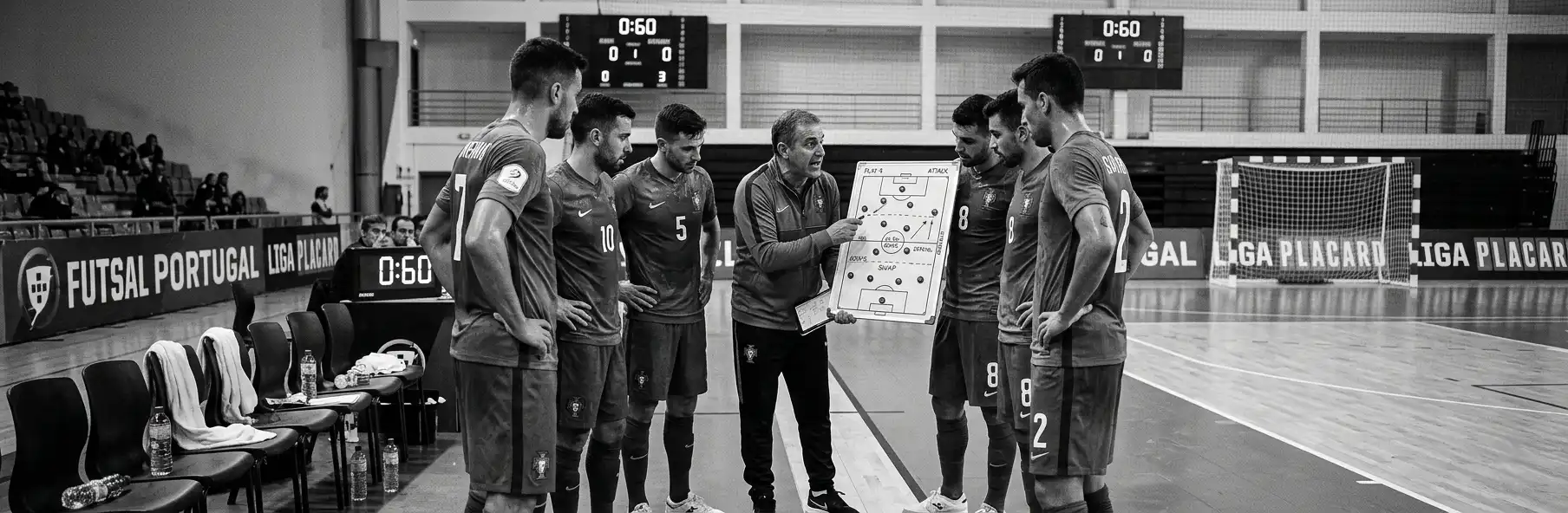
Timeouts in Futsal: How to Use the 60 Seconds to Change the Match
How to make the most of a futsal timeout: structure for the 60 seconds, a single message, and an exit routine to turn the stoppage into a real change in the match.
Written by
João Araújo
Physical Education Teacher (FADEUP – University of Porto) · Futsal Coach – Level II · UEFA B License · Master’s in Physical Education
15 years teaching Physical Education in schools, 20 years coaching futsal at youth development level and 5 years coaching football. Federated and amateur football and futsal player.
The team loses its rhythm, the opponent strings together three moves in a row, and the coach calls the period’s only timeout almost by reflex. Sixty seconds later, the players return to the court just as confused as when they left because the stoppage was used to vent frustration, not to solve the problem causing it.
In futsal, the timeout is a unique tactical tool. No other popular team sport gives the coach such a short, decisive window to intervene mid-action. Wasting it means wasting a structural advantage built into the game itself.
Why the Timeout Is Wasted So Often
Under the pressure of the moment, the natural temptation is to address everything that’s going wrong (marking, attitude, lack of focus) in a single intervention. Sixty seconds isn’t enough to fix everything, and trying to guarantees nothing actually gets resolved before play resumes.
The Cost of a Wasted Timeout
A team that leaves the timeout without a clear instruction repeats the same mistake within seconds and loses the tactical stoppage it could have used later in the match. The psychological impact matters too: a timeout where players only hear criticism leaves the group more tense, not more focused.
The Solution: Core Principles for Using the 60 Seconds
- One single tactical correction, not a list of problems.
- A short, specific phrase: something the player can execute on the very next play.
- End with an instruction on energy, not just tactics; the tone of the send-off matters as much as the content.
- Decide the reason for the timeout before calling it, not during the first seconds of the stoppage.
Application: Concrete Strategies
Before Calling the Timeout
Identify in seconds whether the problem is tactical (a system breaking down), physical (a tired quartet), or emotional (the team losing confidence); this determines the type of intervention, even before the team reaches the bench.
The Structure of the Talk
Ten seconds to settle the tone, thirty seconds for the specific correction, twenty seconds to reinforce the energy the team returns to the court with. A timeout isn’t a meeting; it’s an instruction.
After the Timeout
Confirm on court, with a gesture or a short word, that the instruction landed. If the same mistake repeats on the very next play, the problem may not be tactical but a matter of execution, and that changes the decision for the rest of the period.
🔧 Useful Tool
Explaining a tactical correction in sixty seconds, using only words, is hard under pressure. The SportsLabTools Futsal Tactical Board lets you have the variation already drawn before the match, ready to show in seconds during the timeout, without wasting time explaining positions in words.
Special Cases: Defensive vs. Attacking Timeout
A timeout to correct a defensive breakdown calls for a visual, immediate instruction: a position, a coverage. A timeout to unlock a stalled attack calls for more confidence than technical instruction; often, the team already knows what to do and just needs calm to execute it.
Also see: How the 10-Minute Halftime Can Change the Result of a Futsal Match. The same logic of decisive communication applies to the longer break in the match.
Checklist: How to Use the Timeout in Futsal
- Reason for the timeout identified before calling it (tactical, physical or emotional)
- One single tactical correction delivered, not a list of problems
- Short phrase, executable on the very next play
- Tone of the send-off reinforces energy, not just instruction
- Confirmation on court that the instruction landed
- Repeated mistake after the timeout identified as execution, not tactics
- Tactical variations prepared in advance to show quickly
Conclusion
The timeout in futsal isn’t a break to vent; it’s a tactical tool with a sixty-second window of usefulness. Deciding what to say before calling the stoppage and saying it clearly is what turns a rule of the game into a real advantage on court.
Don’t waste your timeouts on vague corrections. Use the SportsLabTools Futsal Tactical Board to have the visual instruction ready before you call the stoppage.
Optional accelerator · the tool is always free
A library of exercises instead of drawing every one
Packs of 40 exercises per theme, with an animated tactical diagram, four levels of progression, teaching points and success criteria. Import them and they stay in your library, ready to edit and present to the team.