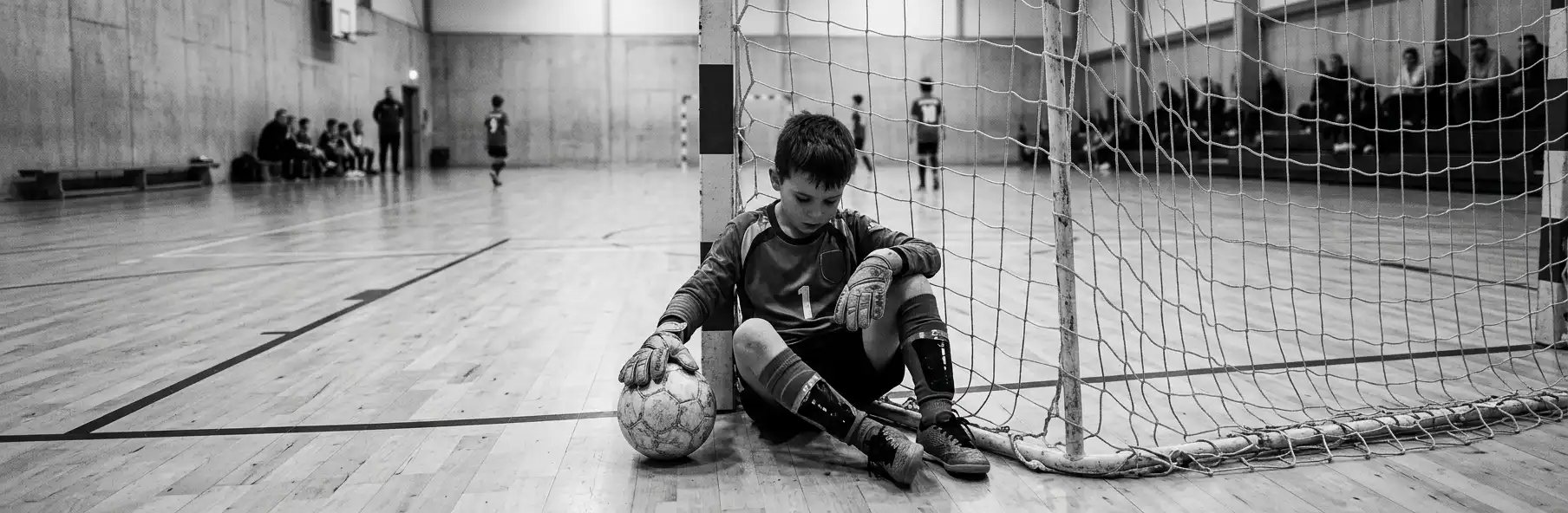
My Child Is a Futsal Goalkeeper and Concedes a Lot: Should I Worry?
A mum asked me whether to worry about her son, a futsal goalkeeper who concedes a lot of goals. The answer and how to talk about it at home.
Written by
João Araújo
Physical Education Teacher (FADEUP – University of Porto) · Futsal Coach – Level II · UEFA B License · Master’s in Physical Education
15 years teaching Physical Education in schools, 20 years coaching futsal at youth development level and 5 years coaching football. Federated and amateur football and futsal player.
I got this question from the mum of a 12-year-old, goalkeeper for an under-13 futsal team: “His team loses nearly every game by three or four goals. He comes home silent, goes straight to his room, and yesterday he said he doesn’t want to be a goalkeeper any more. Is this because the team is weak, or is there a problem with him?” It’s a question I hear a lot from parents of youth goalkeepers, and the honest answer is: almost always it’s the team, but the effect all lands on him.
The futsal goalkeeper is in an unfair position. On a small court, with shots from five or six metres, with the opposition creating overloads and shooting many times a game, conceding is inevitable even for very good goalkeepers. And unlike a winger who misplaces a pass, the goalkeeper’s mistake is marked on the scoreboard and everyone saw it.
Is It Normal for a Futsal Goalkeeper to Concede 5 or 6 a Game?
In youth age groups, and in a team that doesn’t control games, yes, it’s perfectly possible. Futsal is a high-scoring sport by nature. A team that defends badly in front of the goalkeeper, that loses a lot of balls building out under pressure, that doesn’t close down corners, is going to expose its number one to goalscoring chance after goalscoring chance. No 12-year-old goalkeeper solves that on his own.
The number of goals conceded, on its own, says little about the quality of your son. It says something about the quality of the collective defending in front of him. A goalkeeper can have a great game and still concede five, if the team handed him ten clear situations.
He Comes Home Devastated. How Do I Talk About the Goals?
This is the most delicate point, because how you talk at home can help or can pile the weight on him.
Three things that help. First, don’t do the technical analysis of the game in the car. He’s just lived it, he doesn’t need to be told where he could have got across better. Second, separate the result from his performance: “the team conceded four, but you made two really good saves” is a true and useful sentence, and he probably hasn’t heard it from anyone else. Third, let him talk first, and if he doesn’t want to talk that day, respect it.
One thing I often suggest to parents is to help the child log, after each game, how many saves he made, how many goals came from an individual error of his, and how many from situations the team handed him. The SportsLabTools Athlete Journal tool is there for this: instead of being left with “I let in four”, the kid sees that he made six saves and that only one of the goals was actually his fault. After a month, that distinction changes how he judges himself.
Should I Ask for Him to Play Another Position?
Only if it’s his own wish, and not as an escape from a bad patch. If your son likes being a goalkeeper and is just demoralised by the results, taking him out of goal teaches him that you abandon something when it goes wrong. If, after a few calm weeks, he still says he doesn’t want to, then it’s worth talking to the coach about trying him as an outfield player, without drama and without labelling him.
(I don’t have a perfect formula for knowing when it’s passing demotivation and when it’s a genuine wish to change. What usually works is giving it two or three weeks before deciding anything. The sentence said on a Sunday night after losing by five is rarely the same one by the following Wednesday.)
How Do I Know if It’s the Team or if It’s Him?
Here the numbers help more than the impression. Over five or six games, look at his save percentage (saves divided by shots on target) and at where the goals come from. If he saves a fair share of what’s thrown at him and most goals come from two-against-one situations, from balls lost building out, or from badly defended corners, the problem is in front of him. Cross-referencing the goalkeeper’s stats with the context of each goal in the SportsLabTools Stats tool shows this clearly, and it’s a conversation the coach should be having with you and with him.
If, on the other hand, he lets central shots through, comes out badly for crosses, hesitates in one-against-ones, and his save percentage is low game after game, then there’s technical work to do, and that’s good, because technique can be trained. What doesn’t get solved is what was never identified.
See also: The Parents’ Role in Youth Futsal: Supporting Without Adding Pressure, with more on what to say and what not to say in the car on the way home.
To the mum who asked me, I said this: your son isn’t conceding goals because he’s a bad goalkeeper, he’s conceding goals because the team hands him too many situations. That’s neither his fault nor yours. What you can do is help him separate what’s his from what’s the team’s, praise the saves nobody praises, and give him time before any decision about changing position. If he starts enjoying guarding the goal again, the wish to leave passes. If it doesn’t, then you talk about something else, calmly.
*This story is based on a true case; the name and identity of the person who lived it are not disclosed and part of the framing has been reconstructed for illustrative purposes only.*
Optional accelerator · the tool is always free
Reliable stats as soon as the next match
An action taxonomy ready for live logging from the bench, with pitch and goal location already active — heat maps and shot maps without configuring anything.