Football Pre-Season Microcycle: How to Structure Your Week with 2 Training Sessions
How to structure the weekly microcycle in football pre-season with only 2 sessions per week: load distribution, session objectives and a practical week template.
Written by
João Araújo
Physical Education Teacher (FADEUP – University of Porto) · Futsal Coach – Level II · UEFA B License · Master’s in Physical Education
15 years teaching Physical Education in schools, 20 years coaching futsal at youth development level and 5 years coaching football. Federated and amateur football and futsal player.
Most amateur football clubs have two training sessions per week during pre-season. This time constraint is often treated as a problem. but it can be an advantage if the microcycle is structured with clear purpose. Two well-designed sessions are worth more than four sessions without direction.
The question is not “how many sessions do we have?” but “what do we do with the time we have?”. The answer changes completely when the manager stops improvising session by session and starts thinking in weekly cycles with clear objectives.
Why Weekly Structure Matters in Pre-Season
In pre-season, unlike the competitive season, there is no match to set the reference point for the week. That means each week must be self-explanatory. each session must have a clear role within the cycle. Without that structure, managers tend to repeat the same type of training week after week: ball work, some physical conditioning, end-of-session small-sided game. Familiar, yes. Effective for tactical installation, no.
The Plan: Pre-Season Microcycle with 2 Sessions per Week
The base structure works for any phase of pre-season. what changes is the emphasis of each session according to the moment in the preparation.
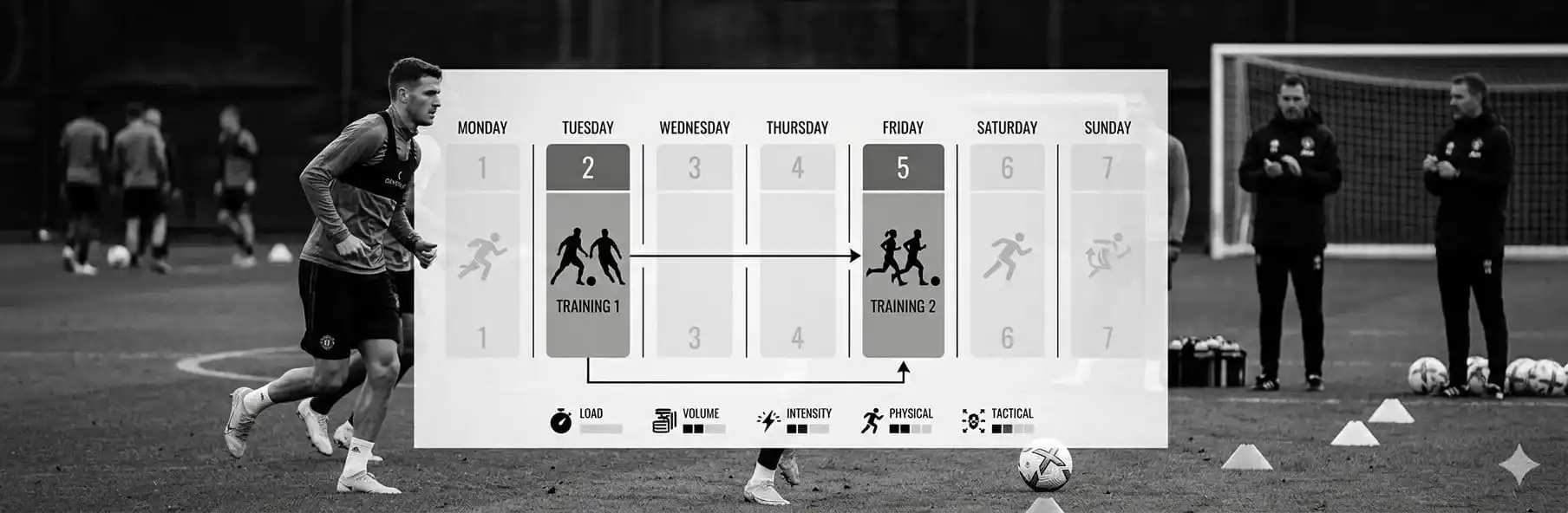
| Day | Session | Duration | Focus |
|---|---|---|---|
| Tuesday | Session A | 80–90 min | High physical load + basic tactical organisation |
| Thursday | Session B | 70–80 min | Specific work + situational small-sided game |
Recovery interval: 48h between sessions (minimum). essential for readaptation in the first weeks.
Weeks 1–2: Session A (Physically Demanding)
- Structured warm-up (15 min): physical and neuromuscular activation
- Physical work (20–25 min): positional games in large space (8v8) or interval work
- Tactical block 1 (25–30 min): defensive organisation. positioning, pressing triggers
- Conditioned small-sided game (15 min): rules that force worked defensive behaviours
- Cool-down (5 min)
Weeks 1–2: Session B (Technically Demanding)
- Ball warm-up (15 min): rondos, individual technique
- Technical-tactical block (30 min): unit work. build-up and offensive progression
- Free small-sided game (25 min): application in real context with post-session feedback
- Preventive work (10 min): hamstring strengthening, proprioception
Weeks 3–4: Session Adjustment
As physical condition improves, reduce standalone physical work and integrate more intensity within tactical exercises. Small-sided games in smaller spaces (4v4, 5v5) to increase intensity without increasing volume.
Weeks 5–6: Preparation for the Season Start
- Session A: tactical rehearsal close to the game model. all four game moments (offensive organisation, defensive organisation, offensive transition, defensive transition) worked in a real-game context
- Session B: set pieces + specific situations for the first opponent
🔧 Useful Tool
Organising and documenting the microcycle week by week is simpler with digital support. The SportsLabTools Training Planner lets you create sessions, set objectives and track squad progress throughout the entire pre-season.
How to Maximise 2 Sessions per Week
Integrate objectives: each session should work physical and tactical simultaneously. Positional games in large spaces are simultaneously aerobic and tactical. two objectives with one exercise. For example, a 7v7+3 support players possession game in a 40x30 metre area, with a mandatory switch of play every 4 passes, trains interval endurance and circulation principles at the same time.
Use the game as training: conditioned small-sided games are more effective than analytical drills for consolidating tactical behaviours; generate more intensity with less managerial coordination required.
Define the focus before training: before going to the pitch, write down: “the objective of this session is _____”. If you cannot complete that sentence, the session is not yet ready.
Checklist: Weekly Microcycle in Football Pre-Season
- Objective of each session defined before training
- Session A focused on physical load + defensive organisation
- Session B focused on specific tactical work + small-sided game
- Minimum 48h between sessions in the first 3 weeks
- Intensity increases progressively within each session across pre-season
- Set pieces worked before matchday 1
- Final week with volume reduction but maintained intensity
Conclusion
Two sessions per week are sufficient for an effective pre-season. provided each session has a clear objective, load progression is managed with criteria and exercises are chosen for their efficiency (doing more with less time). The time constraint forces the manager to be clearer about what really matters. which, paradoxically, tends to produce better results than squads with four unfocused sessions.
See also: How to Plan a Football Pre-Season: From the First Session to the First Match
Structure your weekly pre-season microcycle with clear session objectives. Use the SportsLabTools Training Planner to plan, document and track squad progress week by week.
Optional accelerator · the tool is always free
Start the season with the whole year already planned
Macrocycle, monthly mesocycles and weekly microcycles with the real season dates, sessions categorised by focus and technical-tactical blocks, and exercises with animated diagrams. From U11 to Seniors, 1 to 5 sessions per week.