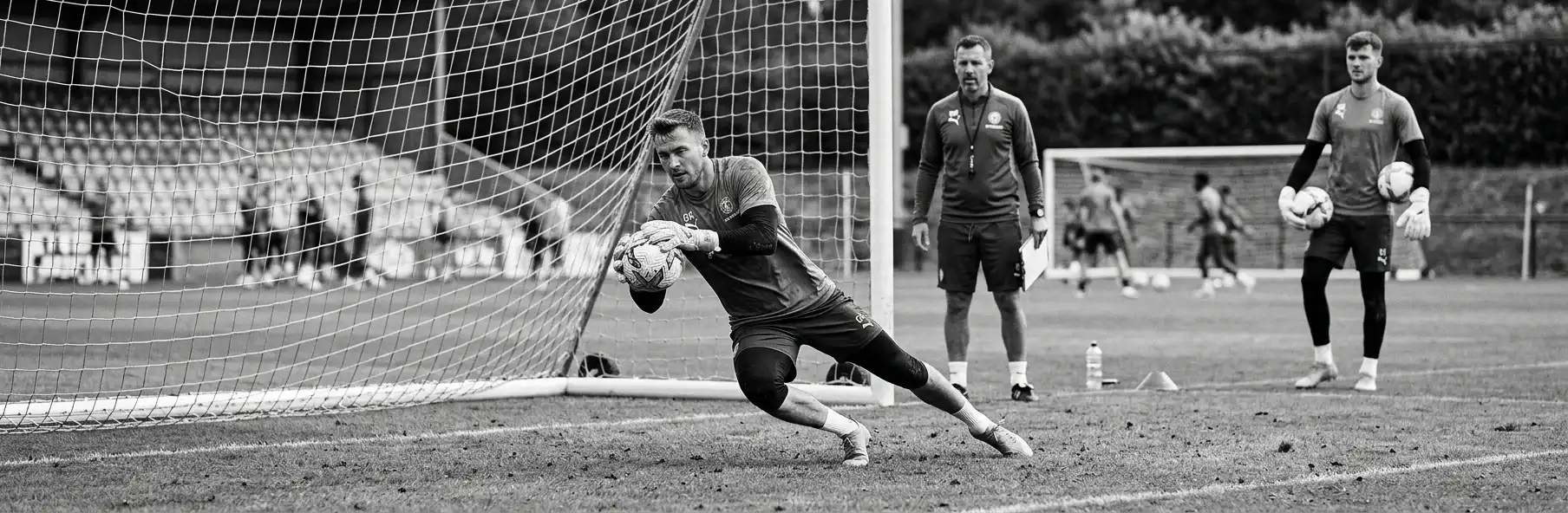
Goalkeeper Training in Pre-Season in Football: Priorities for the First Weeks
What to prioritise in specific goalkeeper training during the early weeks of pre-season: physical base, individual technique, and build-up play.
Written by
João Araújo
Physical Education Teacher (FADEUP – University of Porto) · Futsal Coach – Level II · UEFA B License · Master’s in Physical Education
15 years teaching Physical Education in schools, 20 years coaching futsal at youth development level and 5 years coaching football. Federated and amateur football and futsal player.
At most amateur and semi-professional clubs, goalkeeper training in pre-season is an afterthought bolted onto the rest of the squad’s session. 20 minutes of generic drills before or after the group training. The trouble is, a goalkeeper has physical and technical demands of his own that don’t get solved by squeezing him into the team’s general plan.
Without a specific plan for the early weeks, the goalkeeper arrives at matchday one with gaps that only surface once the game is real: slow reactions, discomfort under crosses, or unease playing out from the back with his feet. Setting clear weekly priorities heads that off.
The Problem: Treating GK Training as an “Extra” to the Group Plan
When goalkeeper training has no defined priorities, it tends to repeat the same drills. mid-range shot-stopping, the odd set piece. regardless of what stage of pre-season it is. That leaves decisive areas untrained: short-distance reactions, commanding the box in the air, and involvement in build-up play, which is now a core part of the role.
Core Principles for GK Training in Pre-Season
- Volume progression before intensity: in the early weeks, more reps at moderate intensity; maximum explosiveness comes later
- Individual technical work isolated from the group: 20-30 minutes daily with the goalkeeping coach, before integrating into team training
- Specific prevention work: hip and shoulder mobility, eccentric strengthening of hamstrings and adductors (the position demands repeated lateral dives and landings)
- Progressive integration into build-up play: the goalkeeper trains first in a static situation, then with simulated pressure from forwards
Practical Application: Weekly Priorities
| Weeks | Technical priority | Physical priority |
|---|---|---|
| 1-2 | Base technique (positioning, handling) | Moderate volume, mobility |
| 3-4 | Commanding crosses, 1v1s | Jump power, reaction |
| 5-6 | Build-up play under pressure | Maximum intensity, match simulation |
Example session in week 3: 15 minutes of commanding crosses from alternating sides (10 reps per side), followed by 10 minutes of 1v1s starting from a deep position to work on reading the attacker’s depth.
Common Mistakes in GK Training in Pre-Season
- Not setting aside dedicated time with the goalkeeping coach in the first sessions
- Introducing build-up pressure before the base technique is consolidated
- Ignoring the accumulated load from diving and landing when planning the goalkeeper’s physical week
- Treating the goalkeeper as a spectator in group possession drills instead of integrating him as an extra outfield player
🔧 Useful Tool
Having the goalkeeper’s technical and physical priorities written down week by week, not just in the coach’s head, makes tracking and adjusting far easier. SportsLabTools Planning lets you structure the goalkeeper’s week alongside the squad’s plan.
Communicating the Plan to the Goalkeeper
A goalkeeper who understands why he’s training short reactions instead of long-range handling in week one buys into the process instead of questioning it. Sharing the weekly plan with the player himself strengthens buy-in to the progression.
See also: Football Pre-Season Microcycle: How to Structure Your Week with 2 Training Sessions. The weekly framework this GK plan fits into.
Checklist: Goalkeeper Training in Pre-Season
- Technical priorities set week by week (weeks 1-2, 3-4, 5-6)
- Dedicated daily time with the goalkeeping coach
- Physical intensity progression aligned with diving and landing load
- Build-up play work introduced gradually
- Specific prevention work (hip, shoulder, hamstrings) included from week one
- Plan communicated to the player before pre-season starts
Conclusion
The goalkeeper isn’t a piece that fits into the team’s plan. it’s a position with its own demands that deserves its own plan. Setting technical and physical priorities week by week is what turns the goalkeeper’s pre-season from an “extra” into deliberate preparation.
Structure your goalkeeper’s pre-season with the same rigour as the squad’s. Use SportsLabTools Planning to organise the priorities week by week.
Optional accelerator · the tool is always free
Start the season with the whole year already planned
Macrocycle, monthly mesocycles and weekly microcycles with the real season dates, sessions categorised by focus and technical-tactical blocks, and exercises with animated diagrams. From U11 to Seniors, 1 to 5 sessions per week.