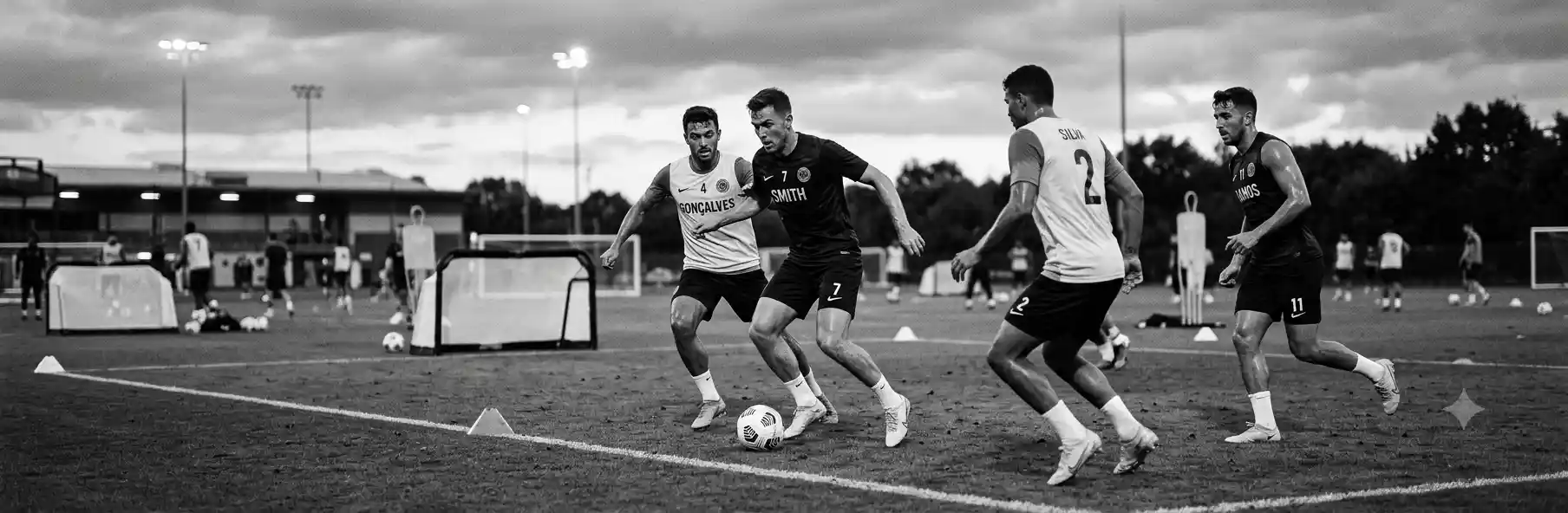
Small-Sided Games in Football: Training Tactics and Fitness at the Same Time
Guide to small-sided games in football: how to manipulate space, numbers and rules to train tactical principles and physical load simultaneously.
Written by
João Araújo
Physical Education Teacher (FADEUP – University of Porto) · Futsal Coach – Level II · UEFA B License · Master’s in Physical Education
15 years teaching Physical Education in schools, 20 years coaching futsal at youth development level and 5 years coaching football. Federated and amateur football and futsal player.
Training time is the scarcest resource for the grassroots manager. Two or three sessions a week aren’t enough to train fitness, technique and tactics in separate blocks, and the good news is you don’t need to. Well-designed small-sided games train everything at once: the tactical principle from your game model, the week’s physical load, and decision-making under genuine pressure.
But “playing football on a small pitch” isn’t automatically a well-designed small-sided game. The difference lies in deliberately manipulating the constraints: space, numbers, rules and time.
The Problem: Isolated Drills That Don’t Transfer
Running without the ball, unopposed technical circuits, 20-minute tactical lectures, all have their occasional place, but the game is a problem of decision-making under spatial and temporal pressure. Tactical periodisation, in the tradition of Vítor Frade, has argued for decades that training should be a fraction of the game, not a sum of isolated parts.
The small-sided game solves the transfer problem: the player decides, executes and receives feedback from the game itself, dozens of times per minute. A midfielder in a 4v4+3 touches the ball more in 4 minutes than in an entire 11v11.
Core Principles: The Four Manipulation Levers
- Space: more area per player = higher aerobic demand and more decision time; less area = more actions per minute, more duels, higher neuromuscular intensity
- Numbers: equal numbers (4v4) train duels and transition; overloads (5v3, floaters) train retention and decision-making with advantage; including the goalkeeper trains real build-up
- Rules: touch limits speed up circulation; goals only after a line-breaking pass reward verticality; points for regains within 6 seconds train counter-pressing
- Time: 3-4 minute sets with short rests keep intensity high; 8-10 minute sets approach the aerobic regime of match play
Rule of thumb for load: small formats (3v3, 4v4) in tight spaces produce more accelerations, decelerations and duels, high neuromuscular load, ideal far from the match (MD-4). Medium/large formats (7v7 to 10v10) in big spaces produce more high-speed running, specific endurance load.
Practical Application: Three Small-Sided Games with Tactical Intent
4v4+3 floaters for possession and pressing (MD-4): 25x20m area, floaters on the touchlines plus one inside. The team in possession scores with 8 consecutive passes; the team out of possession scores by regaining within 6 seconds. Trains possession under pressure and reaction to the loss with high neuromuscular load.
7v7 with goals and conditioned build-up (MD-3): half pitch, a goal counts double if the move starts with short distribution from the goalkeeper and beats the first pressing line with a pass. Trains your model’s build-up at medium-high aerobic intensity.
8v8 transition game on an elongated pitch (alternating MD-3/MD-4): 60x35m divided into three zones; after a regain, the team has 8 seconds to reach the finishing zone. Trains attacking/defensive transition and high-intensity running.
Common Small-Sided Game Mistakes
- Designing the game and forgetting the principle: if the drill has no target behaviour from your game model, it’s just intense entertainment
- Wrong spaces for the physical goal: demanding maximum intensity on a huge pitch with 4 players produces running, not duels; and vice versa
- Over-coaching during play: stopping the game every 30 seconds kills the physical load and decision flow; correct between sets
- Ignoring rest between sets: without defined work-rest ratios (e.g. 4 min play, 90s rest), intensity drops and the drill trains something else
- Unbalanced teams: big quality gaps turn the game into a frustration exercise for both sides
🔧 Useful Tool
The effectiveness of small-sided games depends on placing them correctly in the week. With the SportsLabTools Planning tool you can organise the full microcycle and make sure each format lands on the day with the right physical and tactical objective.
Progression Across the Season
In pre-season, use bigger formats and longer sets to build the aerobic base with the ball. In the competitive period, small intense formats concentrate on MD-4, medium ones on MD-3, and MD-2 is reserved for low-load small-sided games focused on the game plan. In double-game weeks, cut volume (fewer sets), never intensity.
Also read: The Standard Football Microcycle (MD-4 to MD+1): Structuring the Competitive Week, where each small-sided format fits in the training week.
Checklist: Your Small-Sided Games
- Every SSG has a target tactical principle from the game model
- Area per player calculated for the day’s physical objective
- Scoring rules steer the intended behaviour
- Work-rest ratios defined before the session
- Small/intense formats on MD-4, medium on MD-3
- Corrections made between sets, not during play
- Teams balanced and kept stable through the session
Conclusion
Small-sided games are the highest-yield tool for the time-poor coach, but only when designed with intent. Define the tactical principle, size the space for the load you need, write rules that steer behaviour, and let the game do the teaching. The small pitch is your laboratory: use it with method.
Plan your week of small-sided games in advance. Use the SportsLabTools Planning tool to design the microcycle and guarantee each drill lands on the right day.
Optional accelerator · the tool is always free
Start the season with the whole year already planned
Macrocycle, monthly mesocycles and weekly microcycles with the real season dates, sessions categorised by focus and technical-tactical blocks, and exercises with animated diagrams. From U11 to Seniors, 1 to 5 sessions per week.