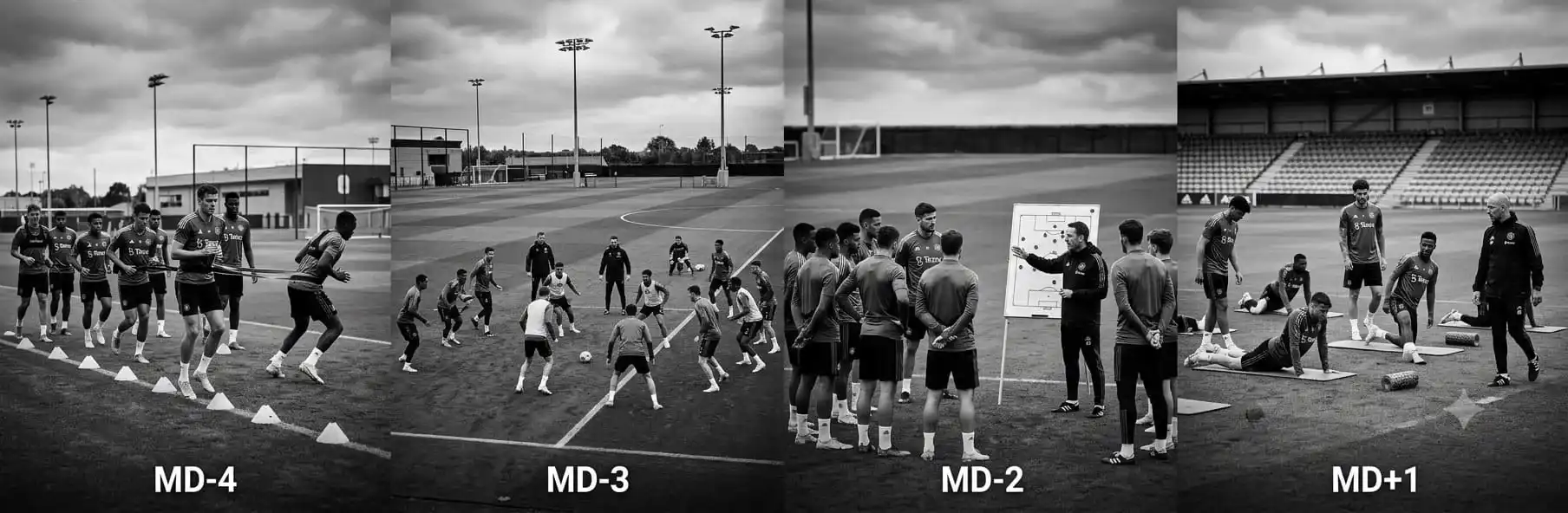
Standard Football Microcycle (MD-4 to MD+1): How to Structure Matchweek Training
A step-by-step guide to the standard football microcycle, from MD-4 to MD+1: load distribution, daily tactical focus, and how to avoid periodisation mistakes.
Written by
João Araújo
Physical Education Teacher (FADEUP – University of Porto) · Futsal Coach – Level II · UEFA B License · Master’s in Physical Education
15 years teaching Physical Education in schools, 20 years coaching futsal at youth development level and 5 years coaching football. Federated and amateur football and futsal player.
A player needs a minimum of 48 to 72 hours to fully recover from the neuromuscular load of a competitive match. That’s the scientific basis behind the standard football microcycle, the weekly structure that distributes physical load and tactical content according to distance from the next match, not a fixed drills calendar.
The MD-4 to MD+1 model (matchday minus 4, through to matchday plus 1) is the standard used at professional clubs and adapted successfully at academy and grassroots level, and its logic, inherited from Vítor Frade’s Tactical Periodisation, is replicable with the resources most clubs already have.
Why the Standard Microcycle Is a Different Kind of Challenge
Unlike pre-season, where the goal is to accumulate volume, the in-season microcycle has a hard constraint: the next match already has a fixed date, and the team has to arrive physically fresh and tactically sharp. That flips the usual training logic, the highest intensity isn’t the day after the match, it’s mid-week, far enough from the previous match’s fatigue and from the residual tiredness that precedes the next one.
The Plan: MD-4 to MD+1 Structure
| Day | Focus | Intensity | Volume |
|---|---|---|---|
| MD+1 | Active recovery | Very low | Low |
| MD-4 | Strength and aerobic capacity | High (physical) | Medium-high |
| MD-3 | Attacking organisation | High (tactical) | High |
| MD-2 | Defensive organisation + transitions | Medium-high | Medium |
| MD-1 | Activation and set pieces | Low | Very low |
| MD | Match | Maximum | , |
Phase 1: MD+1 and MD-4. Recover and Rebuild
The day after the match (MD+1) is dedicated to active recovery: regenerative work, mobility, pool sessions where available, and collective video review with no physical demand. MD-4 (usually the day off or the first session of the week, depending on the fixture list) is the week’s most physically demanding day, strength, aerobic capacity and speed work, because residual fatigue from the previous match has cleared and there’s still enough time to recover before the next one.
Phase 2: MD-3 and MD-2. Core Tactical Content
These are the highest tactical-density days. MD-3 typically focuses on attacking organisation, ball circulation, build-up patterns, forward runs. MD-2 focuses on defensive organisation and transitions, at slightly lower intensity to start managing accumulated load before matchday.
Phase 3: MD-1. Final Activation
The session the day before the match has to be short, physically light, and confidence-focused: set pieces, finishing, and repeating the tactical system’s key automatisms. The costliest mistake at this stage is training at high intensity “to make sure the team is ready”, that just piles on unnecessary fatigue.
The Most Common Mistakes in the Standard Microcycle
- Training at the same intensity every day: ignores the recovery curve and builds up fatigue across the season
- Cramming all tactical content into MD-1: cognitively overloads players the day before the match, when they should be consolidating, not learning
- Not adjusting the microcycle in two-match weeks: the six-day structure has to be compressed without simply cutting recovery
- Ignoring individual load: players who played the full 90 minutes need different management from those who came off the bench
🔧 Useful Tool
Structuring and sharing the microcycle with the coaching staff requires a visual, shareable system. SportsLabTools Planning lets you build the MD-4 to MD+1 week with focus, intensity and volume defined for each session, and adjust quickly for weeks with two matches.
Adjusting the Microcycle in Two-Match Weeks
When the fixture list tightens and there are two matches in the same week, the standard microcycle has to be compressed: the most physically demanding day (MD-4) practically disappears, and the focus shifts almost entirely to recovery and light tactical activation. In these weeks, squad rotation stops being optional, it’s the only way to maintain competitive intensity without injuries.
See also: Football Pre-Season Microcycle: Structuring the Week with Two Sessions a Day, the pre-season version of this same weekly structuring principle.
Checklist: Standard Microcycle MD-4 to MD+1
- MD+1 dedicated exclusively to active recovery
- MD-4 identified as the week’s most physically demanding day
- Core tactical content concentrated on MD-3 and MD-2
- MD-1 with reduced volume and intensity, focused on confidence
- Individual load adjusted based on minutes played in the previous match
- A backup plan prepared for two-match weeks
- RPE logged daily to validate whether the load curve is being followed
Conclusion
The standard microcycle isn’t luck, it’s a deliberate technical decision about when the team should be tired and when it should be fresh. Respecting this logic across the season is what separates teams that arrive at decisive matches with fresh legs from those dragging through the accumulated fatigue of months of inconsistent planning.
Build your weekly microcycle with clarity and share it with the whole coaching staff. Use SportsLabTools Planning to structure every week from MD-4 to MD+1.
Optional accelerator · the tool is always free
Start the season with the whole year already planned
Macrocycle, monthly mesocycles and weekly microcycles with the real season dates, sessions categorised by focus and technical-tactical blocks, and exercises with animated diagrams. From U11 to Seniors, 1 to 5 sessions per week.